United States Senate Chamber: History, Design, and Evolution
The United States Senate chamber is more than just a room for legislation; it is a physical record of the growth and adaptation of the American legislative process. From its humble beginnings in Philadelphia to the sophisticated architectural hub in the U.S. Capitol, the chamber has evolved to meet the needs of a growing nation and the health requirements of its representatives.
The Early Years and Relocations
The Senate first convened in 1790, operating out of a second-floor chamber in Congress Hall located in Philadelphia, Pennsylvania. This arrangement lasted until 1800, when the Senate moved into the Old Supreme Court Chamber within the Capitol building. For nearly five decades, from 1810 to 1859, the Senate utilized the Old Senate Chamber for its primary legislative functions.
As new states joined the Union, the Senate nearly doubled in size. This growth necessitated a significant expansion of the United States Capitol. Starting in 1851, the Capitol underwent a series of expansions, which included the addition of new wings, dedicated chambers for both houses of Congress, and the construction of the iconic new dome.

Architectural Design and Construction
Construction of the current Senate chamber began in 1851 and was completed by 1859. The designers aimed for a space that mirrored the acoustical and line-of-sight qualities of a theater to ensure that proceedings were audible and visible to all participants.
The chamber is a rectangular, two-story room situated in the center of the Capitol's north wing. Its layout features a semi-circular tiered platform containing 100 individual desks, all facing a raised rostrum (the platform at the front of the room where the presiding officer sits). To accommodate the public, a visitor's gallery overlooks the Senate floor from all four sides of the second level. Public observation has been permitted since 1795, and during the nineteenth century, these galleries—including a specific women's gallery—became popular tourist destinations. Additionally, a press gallery is located above the presiding officer's desk to allow reporters to cover legislative business.
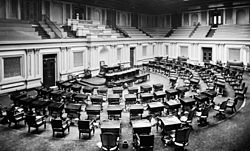
Despite the ambitious design, early users were not entirely satisfied. Senators complained about poor acoustics, uncomfortable drafts, and the noise created by rain hitting the glass-paneled ceiling.
From Public Theater to Legislative Sanctuary
Due to its size and theater-like atmosphere, the chamber was frequently used for non-legislative events. A notable example occurred in 1863, when the room hosted a presentation of the narrative poem "The Sleeping Sentinel." The poem told the story of William Scott, a Union Army soldier sentenced to death for falling asleep at his post—a man whom President Abraham Lincoln, who attended the performance, had previously pardoned.
Eventually, the Senate grew weary of these competing uses. After hosting a final lecture on post-Civil War reconstruction, the Senate enacted a formal rule prohibiting the chamber from being used for any purpose other than the official business of the United States Senate.
Health and the Introduction of Air Conditioning
In 1923, Senator Royal Copeland, a physician and former commissioner of the New York City Board of Health, raised alarms regarding the chamber's air quality. Copeland argued that the overly hot and poorly humidified air contributed to the spread of winter illnesses and general discomfort. He attributed the premature deaths of thirty-four serving senators over a twelve-year period to these poor environmental conditions.
In June 1924, the Senate voted to improve the "living conditions" of the chamber. While the architectural firm Carrere & Hastings initially proposed structural changes—such as lowering the ceiling and removing interior walls—Copeland later postponed this plan in favor of a more modern solution. In 1929, the Senate installed its first air conditioning system, a "manufactured weather" system designed by the Carrier Corporation.
Key Facts
- First Location: Congress Hall, Philadelphia (1790).
- Current Design: A rectangular, two-story room in the Capitol's north wing with a semi-circular tiered platform.
- Capacity: The platform includes 100 individual desks.
- Public Access: Visitors have been allowed to observe proceedings since 1795.
- Climate Control: The first air conditioning system, created by Carrier Corporation, was completed in 1929.
- Usage Rule: The chamber is now strictly reserved for United States Senate business.
| Period/Year | Location/Event | Key Development |
|---|---|---|
| 1790–1800 | Congress Hall, Philadelphia | Initial convening of the Senate. |
| 1810–1859 | Old Senate Chamber | Primary legislative functions during early growth. |
| 1851–1859 | North Wing Construction | Building of the current theater-style chamber. |
| 1863 | Non-Legislative Use | Performance of "The Sleeping Sentinel" attended by Abraham Lincoln. |
| 1929 | Climate Upgrade | Installation of Carrier Corporation's air conditioning. |
Frequently Asked Questions
Where did the Senate first meet?
The Senate first convened in 1790 in a second-floor chamber located in Congress Hall in Philadelphia, Pennsylvania.
Why was the Senate chamber designed like a theater?
The designers wanted to ensure that the room had optimal acoustical properties and clear lines of sight, similar to a theater, so that senators and observers could clearly hear and see the proceedings.
Who was responsible for bringing air conditioning to the Senate?
Senator Royal Copeland advocated for better air quality due to health concerns, leading to the installation of a "manufactured weather" system designed by the Carrier Corporation in 1929.
Can the Senate chamber be used for public events today?
No. After a period of hosting various lectures and performances, the Senate enacted a rule stating that the chamber would not be used for any purpose other than the official business of the United States Senate.
What are the different galleries in the Senate chamber?
The chamber features a visitor's gallery on the second level for the general public (including a historically significant women's gallery) and a press gallery located above the presiding officer's desk for reporters.