United States Botanic Garden: A History of Botanical Exploration
The United States Botanic Garden stands as a testament to the American spirit of scientific discovery and the desire to catalog the natural world. From its early conceptualization in the early 19th century to its current status as a premier botanical destination in Washington, D.C., the garden has evolved through periods of dormancy, global exploration, and architectural transformation.
The Early Foundations and the Wilkes Expedition
The vision for the garden began in 1816, proposed by the Columbian Institute for the Promotion of Arts and Sciences. By 1820, an act of Congress provided land for the facility, situated west of the Capitol between First and Third Streets, and Pennsylvania and Maryland Avenues. Although the facility ceased operations in 1837 due to the society's inactivity, it was revitalized in 1842 thanks to the return of the United States Exploring Expedition.
Led by Charles Wilkes, this Congress-commissioned voyage aimed to circumnavigate the globe and explore the Pacific Ocean. Wilkes was a pioneer in botanical transport, utilizing Wardian cases—early portable greenhouses that protected live plants from salt spray and temperature extremes—to maintain specimens during the long journey. He returned in 1842 with a vast collection of plants previously unknown in the United States.
From Specimens to the National Herbarium
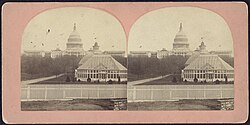
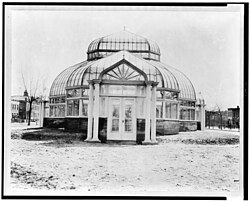
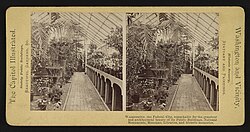
The legacy of the Wilkes Expedition split into two distinct paths. The dried specimens became the foundation of the National Herbarium, which is currently curated by the Smithsonian Institution's National Museum of Natural History. Meanwhile, the live plants and seeds were initially housed in the Old Patent Office greenhouse until 1850, when a dedicated botanic garden was constructed in the area now occupied by the Capitol reflecting pool.
Contributions of Photius Fisk
The garden's diversity was further enriched by the work of Photius Fisk, an abolitionist and U.S. Navy chaplain aboard the Frigate Raritan. While stationed in South America and the Pacific, Fisk conducted extensive scientific explorations of minerals and plants. He focused heavily on Brazilian flora, collecting species such as vanilla, dendrobium, cattleya, epidendrum, and stanhopea.
One of his most prized acquisitions was the rare butterfly flower, Oncidium Papilio, obtained from Saint Thomas. Fisk maintained meticulous observation notes on these species before delivering his collection to W. D. Breckenridge, the superintendent and botanist of the United States Botanic Garden, in February 1853.
Modern Evolution and Relocation
In 1933, the garden was moved to its current location southwest of the Capitol. The site is bounded by Maryland Avenue to the north, First Street to the east, Independence Avenue to the south, and Third Street to the west.
To maintain its world-class facilities, the building underwent a major renovation starting September 1, 1997. During this period, the collection was managed carefully: some plants were moved to the USBG Production Facility, others were retired to greenhouses in Florida, and some were composted. The garden officially reopened to the public on December 11, 2001.
Key Facts
- Founded: First suggested in 1816; land granted in 1820.
- The Wilkes Expedition: Brought back massive collections of unknown plants in 1842.
- National Herbarium: Formed from the dried specimens of the Wilkes Expedition.
- Photius Fisk: Contributed rare Brazilian orchids and the Oncidium Papilio in 1853.
- Current Location: Moved to its present site southwest of the Capitol in 1933.
- Recent Renovation: Closed from September 1, 1997, to December 11, 2001.
| Year | Event | Significance |
|---|---|---|
| 1816 | Initial Proposal | Suggested by the Columbian Institute. |
| 1820 | Land Grant | Congress provides land west of the Capitol. |
| 1842 | Wilkes Expedition Return | Introduction of unknown plants and Wardian cases. |
| 1850 | New Construction | Garden built at the current reflecting pool site. |
| 1853 | Fisk Collection | Rare South American species added to the garden. |
| 1933 | Relocation | Moved to current southwest Capitol location. |
| 2001 | Reopening | Public access restored after four years of renovation. |
Frequently Asked Questions
What were Wardian cases?
Wardian cases were early versions of portable greenhouses used by explorers like Charles Wilkes to keep live plants alive during long sea voyages by protecting them from harsh environments.
How is the National Herbarium related to the Botanic Garden?
The National Herbarium, curated by the Smithsonian Institution, was formed from the dried plant specimens brought back by the Wilkes Expedition, while the live specimens helped restart the Botanic Garden.
Who was Photius Fisk?
Photius Fisk was an abolitionist and U.S. Navy chaplain who collected rare seeds and plants, particularly from Brazil, which he donated to the garden in 1853.
Where was the garden located before 1933?
Prior to its 1933 move, the garden was located in front of the Capitol, in the area where the Capitol reflecting pool is now situated.
What happened to the plants during the 1997-2001 renovation?
Plants were either moved to the USBG Production Facility, sent to greenhouses in Florida, or composted.