United States Army Military Government in Korea: The Turbulent Transition (1945–1948)
Following the surrender of the Empire of Japan at the end of World War II, the Korean Peninsula entered a period of profound transformation and instability. From September 1945 to August 1948, the southern portion of the peninsula was governed by the United States Army Military Government in Korea (USAMGIK). This transitional period was marked by political friction, economic hardship, and the complex geopolitical maneuvering of the early Cold War era.
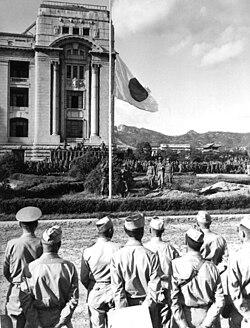
The division of Korea was defined by the 38th Parallel, an invisible line drawn by U.S. planning officers to split the former Japanese colony into Soviet and American occupation zones. While the North fell under Soviet influence, the South was placed under the administration of the U.S. military, a move that would eventually contribute to the permanent division of the nation.
Key Facts
- Duration: 9 September 1945 – 15 August 1948
- Primary Commander: General John R. Hodge
- Capital City: Seoul
- Official Languages: Korean and English
- Preceded by: Chōsen (Japanese colonial rule)
- Succeeded by: Republic of Korea
- Major Conflict: The Autumn Uprising (1946) and Jeju Uprising (1948)
The Arrival and Administration of USAMGIK
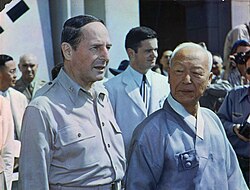
Under the direction of General Douglas MacArthur, the XXIV Corps of the U.S. Tenth Army landed at Jinsen on 8 September 1945. Lt. General John R. Hodge assumed leadership, tasked with accepting the Japanese surrender and establishing a military occupation. Initially, the administration faced criticism for its handling of the transition; Hodge originally announced that the Japanese colonial government would remain intact, though he later replaced the governor-general with an American official.

One of the primary challenges for the USAMGIK was a lack of preparation. Many administrators arrived with little knowledge of the Korean language or the intricate local political landscape. This lack of expertise often led to policies that had unintended, destabilizing effects on the local population.
Political Friction and the People's Republic of Korea
Before the U.S. arrival, the People's Republic of Korea (PRK) had been established, exerting control across much of the country. However, the USAMGIK viewed the PRK with suspicion, fearing communist alignment, and moved to outlaw the organization. This decision, along with the refusal to recognize the Provisional Government of the Republic of Korea led by Kim Ku, created significant tension between the military government and local political factions.
![Anti-trusteeship movement [ko] protest, December 1945](/images/2e/49/2e49744e9c16c701644279542c268bbb3fe427bb6b2b10a34081ddf172c37112.jpg)
Social and Economic Turmoil
The period was characterized by significant social unrest. The economy suffered as the U.S. military attempted to implement free-market reforms by removing controls on the production and distribution of essential goods like rice. While crop yields increased, the removal of controls led to widespread profiteering, hoarding, and rampant inflation. For instance, the price of a bushel of rice surged from 9.4 yen to 2,800 yen during this era.
Major Uprisings and Unrest
Discontent manifested in several violent episodes:
- The Autumn Uprising (1946): Following a massive general strike by railway and industrial workers, the U.S. administration declared martial law to suppress demonstrations, leading to significant loss of life.
- The Jeju Uprising (1948): A violent conflict involving left-wing radicals and South Korean police on Jeju Island, resulting in an estimated 14,000 to 30,000 deaths.
The Path to Independence
Despite the chaos, the USAMGIK laid certain foundations for the future state. In 1946, a council of Korean educators began mapping out a new educational path, and the military government oversaw the reopening of schools. The transition toward sovereignty culminated in the general elections of May 1948 and the subsequent establishment of the Republic of Korea on 15 August 1948.
Summary of USAMGIK Administration
| Category | Details |
|---|---|
| Status | Military occupational transitional government |
| Key Leaders | John R. Hodge (Commander), various US military Governors |
| Currencies Used | Won, "A yen" scrip, United States dollar |
| Major Economic Issues | Inflation, profiteering, and food shortages |
| Historical Era | Cold War / Post-WWII |
Frequently Asked Questions
What was the primary purpose of the USAMGIK?
The USAMGIK served as a military occupational transitional government intended to manage the southern half of the Korean Peninsula following the surrender of Japan until a sovereign government could be established.
Why was there so much economic instability during this period?
Economic instability was caused by a combination of factors, including the removal of price controls on rice, rampant inflation, counterfeiting, and the sudden influx of refugees and returnees from abroad.
How did the 38th Parallel affect Korea?
The 38th Parallel served as the dividing line between the Soviet-occupied North and the American-occupied South, a division that eventually led to the creation of two separate states.
When did the United States military officially withdraw?
Following the establishment of the Republic of Korea in August 1948, American troops continued to be present but eventually withdrew in 1949.
What was the role of the Korean Advisory Council?
Established by General Hodge in October 1945 to address popular discontent, the Council was primarily composed of members from the Korean Democratic Party, which included wealthy landowners and former colonial officials.