United States Air Force Aviator Badges: A History of Flight Insignia
The wings worn by members of the United States Air Force are more than just ornaments; they are symbols of qualification, experience, and professional achievement. From the early days of the Air Service in World War I to the modern era of unmanned combat aerial vehicles, these badges have evolved to reflect the changing nature of aerial warfare and aviation technology.
The Early Era: World War I
The first United States Aviator Badges were issued to members of the Air Service during World War I. These early insignias were categorized into three distinct degrees: Observer (featuring a "US" shield and one left-side wing), Junior Aviator or Reserve Aviation Officer (a "US" shield centered between two wings), and Senior Aviator (a star positioned over the "US" shield between two wings). Additionally, the Army Air Service provided the Aeronaut Badge, later renamed the Balloon Pilot Badge, specifically for balloon pilots.
The role of enlisted aviators during this period was limited. While 29 enlisted pilots existed before the U.S. entered the war, most received commissions in 1917. One notable exception was William A. Lamkey, the second enlisted aviator, who received a discharge and flew for Pancho Villa. During the war, 60 enlisted mechanics were trained as pilots in France; however, they were restricted to ferrying duties and did not engage in combat. The recruitment and training of enlisted aviators eventually ceased in 1933.
World War II and the Rise of the USAAF
With the emergence of the Army Air Forces (USAAF) during World War II, a new series of aviator badges was introduced. This design established the framework that persists today, with the Pilot Badge issued in three degrees: Pilot, Senior Pilot, and Command Pilot.
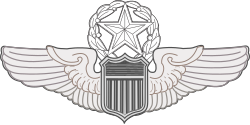
Between August 1941 and November 1942, the Enlisted Aviator program was revived. To qualify, candidates needed to be at least 18 years old, hold a high school diploma, and have graduated at the top of their class. These graduates, rated as Flight Staff Sergeants or Flight Technical Sergeants, wore the same wings as officers. They typically flew transport and auxiliary aircraft, allowing officer pilots to focus on fighters and bombers. Auxiliary pilots were issued specialized wings to denote their specific status.
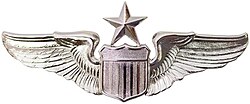
By November 1942, all enlisted pilots were promoted to the rank of Flight Officer, and cadets were graded as either Flight Officers or Second Lieutenants based on merit. To achieve the Senior Pilot Wings, a pilot required seven years as a rated pilot with a permanent rating, plus either 2,000 total flight hours or 1,300 hours of primary and instructor flight.
Transition to an Independent Air Force
In 1947, the USAAF became a separate service known as the U.S. Air Force (USAF). The new service maintained the USAAF badge designs. However, a material change occurred in the mid-1990s; the dull alloy wings used since 1947 were replaced by badges made of sterling silver or chrome metal.
Modern USAF Rating Systems
The modern USAF distinguishes between rated and non-rated (or un-rated) personnel. Rated aviators include traditional pilots and RPA (remotely piloted aircraft/unmanned combat aerial vehicle) pilots. Both receive badges in three degrees: pilot/RPA pilot, senior pilot/RPA pilot, and command pilot/RPA pilot.
Aeronautical and Medical Personnel
Rated personnel who are not aviators are classified as aeronautical personnel. This group includes navigators, combat systems officers (CSOs), air battle managers (ABMs), and observers. While navigators and CSOs share a badge design, each career field has a unique badge issued in three degrees: basic, senior, and master.
Medical rated personnel are divided into two fields. Flight surgeons receive a specific badge with three degrees: flight surgeon, senior flight surgeon, and chief flight surgeon. Pilot-physicians are unique individuals qualified as both a flight surgeon and a pilot (or RPA pilot), allowing them to wear both the Pilot/RPA Pilot Badge and the Flight Surgeon Badge.
Aircrew and Astronauts
Non-rated flyers are designated as aircrew and are awarded either the USAF Enlisted Aircrew Badge or the USAF Officer Aircrew Badge. Both are issued in three degrees, though the Officer Aircrew Badge is rarely awarded. Finally, the USAF Astronaut Badge is created by adding an Astronaut Device to the center of any rated aviator or aeronautical badge. Un-rated personnel who qualify as astronauts are rated as observers and wear the USAF Observer Badge with the Astronaut Device.
Key Facts
- Three-Tier System: Most USAF badges are issued in three degrees (e.g., Pilot, Senior Pilot, Command Pilot).
- Material Evolution: Badges shifted from dull alloy to chrome or sterling silver in the mid-1990s.
- Rated vs. Non-Rated: The USAF uniquely divides flying members into rated (pilots, CSOs, etc.) and non-rated (aircrew) personnel.
- Astronaut Designation: Astronaut status is indicated by adding a specific device to an existing aeronautical or observer badge.
- Senior Pilot Requirements: Requires 7 years as a rated pilot and either 2,000 total hours or 1,300 primary/instructor hours.
| Category | Personnel Types | Badge Degrees |
|---|---|---|
| Rated Aviators | Pilots, RPA Pilots | Pilot → Senior → Command |
| Aeronautical | Navigators, CSOs, ABMs, Observers | Basic → Senior → Master |
| Rated Medical | Flight Surgeons | Flight Surgeon → Senior → Chief |
| Non-Rated | Enlisted and Officer Aircrew | Three degrees (unnamed) |
Frequently Asked Questions
What is the difference between a rated and non-rated flyer?
Rated personnel are those who hold specific aeronautical ratings, such as pilots, RPA pilots, navigators, and combat systems officers. Non-rated flyers are considered aircrew and receive aircrew badges rather than aeronautical rating badges.
How does a pilot earn the Senior Pilot Badge?
A pilot must have a permanent pilot rating, seven years of service as a rated pilot, and either 2,000 total flight hours or 1,300 hours of primary and instructor flight.
Can a person wear more than one set of wings?
Yes, specifically in the case of pilot-physicians, who are qualified as both a USAF pilot (or RPA pilot) and a flight surgeon, allowing them to wear both respective badges.
How is the Astronaut Badge awarded?
The Astronaut Badge is not a standalone wing but is an Astronaut Device attached to the center of a rated aviator or aeronautical badge. Un-rated personnel who become astronauts use the Observer Badge as the base.
What happened to the enlisted pilot program?
The program existed in WWI and was briefly restarted from 1941 to 1942. In November 1942, all enlisted pilots were promoted to the rank of Flight Officer, and cadets were commissioned as Flight Officers or Second Lieutenants.