United Nations Convention on the Law of the Sea: Governing the World's Oceans
The oceans cover the vast majority of our planet, serving as vital corridors for trade, sources of food, and reservoirs of immense mineral wealth. To prevent chaos and conflict over these resources, the international community established the United Nations Convention on the Law of the Sea (UNCLOS). Often referred to as the "constitution for the oceans," UNCLOS provides the essential legal framework for all marine and maritime activities, balancing the rights of coastal nations with the freedoms of the high seas.
Key Facts
- Signed: 10 December 1982 in Montego Bay, Jamaica.
- Effective Date: 16 November 1994.
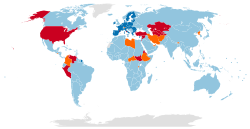
- Parties: 172 parties, including 169 sovereign states and the European Union.
- Purpose: Establishes legal zones for maritime jurisdiction, resource exploitation, and environmental protection.
- High Seas Treaty: A recent addition (BBNJ Agreement) aimed at protecting marine biodiversity in international waters.
The Evolution of Maritime Law
Before a unified global standard existed, nations operated under varying and often conflicting claims. In the early 20th century, countries began seeking ways to protect fish stocks, control pollution, and secure mineral resources. A significant turning point occurred in 1945 when U.S. President Harry S. Truman extended control over the natural resources of the United States continental shelf, prompting other nations to follow suit.
By the mid-20th century, maritime limits were inconsistent. While some nations adhered to a traditional 3-nautical-mile limit, others had extended their territorial seas to 12 nautical miles or claimed 200-nautical-mile fishing zones. To resolve these discrepancies, the United Nations organized several conferences, culminating in the Third United Nations Conference on the Law of the Sea (UNCLOS III) between 1973 and 1982. This conference utilized a consensus-based process to ensure broad international agreement.
Understanding Maritime Zones
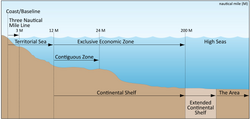
UNCLOS defines specific zones that dictate how much control a coastal state has over the waters adjacent to its shores. These zones are critical for managing everything from fishing rights to undersea mining.
The Contiguous Zone
Located beyond the 12-nautical-mile territorial sea, the contiguous zone extends an additional 12 nautical miles. In this area, a state can enforce laws related to customs, taxation, immigration, and pollution, provided the infringement began or was about to occur within the state's territory.
Exclusive Economic Zones (EEZ)
The Exclusive Economic Zone (EEZ) extends up to 200 nautical miles from a nation's baseline. Within this zone, the coastal nation holds sole rights to exploit all natural resources, including fisheries and undersea minerals. While coastal states manage these resources, foreign nations still maintain the freedom of navigation and overflight, as well as the right to lay submarine cables and pipes.
The Extended Continental Shelf
A state may claim rights to an extended continental shelf if the natural prolongation of its land territory extends beyond the 200-nautical-mile EEZ. This claim can extend up to 350 nautical miles from the baseline, or 100 nautical miles beyond the 2,500-meter isobath (the line connecting points of that depth). In this area, the state has exclusive rights to harvest minerals and non-living materials from the subsoil, as well as living resources attached to the shelf.
Summary of Maritime Jurisdictions
| Zone | Distance from Baseline | Primary Rights/Functions |
|---|---|---|
| Territorial Sea | Up to 12 nautical miles | Full sovereignty of the coastal state. |
| Contiguous Zone | Up to 24 nautical miles | Enforcement of customs, tax, immigration, and pollution laws. |
| Exclusive Economic Zone (EEZ) | Up to 200 nautical miles | Sole rights to natural resources (fishing, oil, gas). |
| Extended Continental Shelf | Up to 350 nautical miles | Rights to minerals and non-living resources in the subsoil. |
Modern Advancements: The High Seas Treaty
As environmental concerns have grown, so has the need for stronger protections in international waters. In 2023, an agreement was reached on the High Seas Treaty (formally the BBNJ Agreement). This treaty is designed to protect marine biological diversity in areas beyond national jurisdiction.
A major milestone for this treaty occurred on September 19, 2025, when Morocco became the 60th country to ratify it, paving the way for the treaty to enter into force in January 2026. The treaty enables the creation of marine protected areas in international waters, supporting the global goal to protect 30% of the world's oceans by 2030.
Frequently Asked Questions
What is the difference between the territorial sea and the EEZ?
The territorial sea is an area of full sovereignty for a coastal state, whereas the EEZ is a zone where the state has specific rights to resources (like fish and oil) but must still allow foreign vessels the freedom of navigation.
How many countries are part of UNCLOS?
As of October 2024, there are 172 parties to the convention, which includes 169 sovereign states and the European Union.
What happens in the contiguous zone?
The contiguous zone allows a state to exercise control to prevent or punish infringements of its customs, fiscal, immigration, or sanitary laws that occurred within its territory or territorial sea.
What is the purpose of the High Seas Treaty?
The High Seas Treaty provides a legal mechanism to conserve and sustainably use marine biological diversity in international waters, specifically through the establishment of marine protected areas.
Which major nations have not ratified UNCLOS?
The United States is one of the notable nations that has signed but not ratified the convention.