Unitary Authorities: Local Government Structures in the UK, New Zealand, and Beyond
In the world of public administration, a unitary authority is a type of local government that handles all local functions within its jurisdiction. Unlike two-tier systems, where responsibilities are split between different levels of government (such as a county and a district), a unitary authority acts as a single-tier body. These are typically established in towns or cities large enough to operate independently of a broader county or regional council.
Key Facts
- Definition: A single-tier local authority responsible for all local government functions in its area.
- New Zealand: Five unitary authorities exist as of 2026, combining territorial and regional council roles.
- United Kingdom: The Office for National Statistics uses the term "unitary administration" to cover all single-tier local government areas across the four nations.
- England: Maintains a mix of unitary authorities and a traditional two-tier system (county and district councils).
- Global Equivalents: Similar systems exist in Canada (single-tier municipalities), Germany (kreisfreie Stadt), and Poland (cities with powiat rights).
Unitary Authorities in New Zealand
In New Zealand, a unitary authority is a territorial authority—which could be a district, city, or metropolitan area—that also performs the duties of a regional council. As of 2026, there are five such authorities:
- Gisborne District Council (est. 1989)
- Tasman District Council (est. 1992)
- Nelson City Council (est. 1992)
- Marlborough District Council (est. 1992)
- Auckland Council (est. 2010)
Additionally, the Chatham Islands operate under special legislation established in 1995, granting their council powers similar to those of a regional authority.
The United Kingdom Framework
While the Office for National Statistics uses the collective term "unitary administration," the terminology and structure vary significantly across the four countries of the UK.
England
In England, unitary authorities were established under the Local Government Changes for England Regulations 1994. These bodies provide a single tier of government for specific areas. This differs from the two-tier system still used in many parts of England, where functions are split between county councils (upper tier) and district or borough councils (lower tier).
It is important to note that not all single-tier authorities are "unitary authorities"; for example, the Council of the Isles of Scilly was formed under older legislation and does not hold this specific status.
Northern Ireland
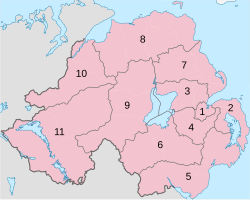
Northern Ireland has operated under a single-tier system since 1973 and is currently divided into eleven districts. These councils manage waste, recycling, leisure, community services, building control, and local economic development. Since 2015, they have also handled planning functions. However, they do not manage education, road building, or housing, and rates are collected by the Land and Property Services agency.
Scotland
Scotland's local authorities are unitary in function, though not officially in name. The Local Government etc. (Scotland) Act 1994 replaced the previous two-tier structure with 32 council areas on 1 April 1996. While the term "unitary authority" is not used in Scottish legislation, it is sometimes used descriptively in official publications.
Wales
Under the Local Government (Wales) Act 1994, unitary authorities are referred to as principal councils, and their jurisdictions are called principal areas. These may be designated as "County Councils" (Cyngor Sir) or "County Borough Councils" (Cyngor Bwrdeistref Sirol).
Global Comparisons and Similar Concepts
Many other countries employ similar single-tier administrative models to streamline local governance.
| Country | Term/Concept | Details |
|---|---|---|
| Canada (Ontario) | Single-tier municipalities | One level of local government. |
| Germany | Kreisfreie Stadt | "Circle-free city" combining municipality and district powers. |
| Poland | City with powiat rights | Urban counties (66 cities) responsible for district-level administration. |
| USA (Virginia) | Independent Cities | Cities that are independent from any county. |
| USA (Hawaii) | County Government | Counties are the only tier below the state government. |
In France, the city of Paris functions as both a department and municipal council. In Taiwan, most cities are independent of surrounding counties, and special municipalities are generally unitary.
Frequently Asked Questions
What is the main difference between a unitary authority and a two-tier system?
A unitary authority is a single-tier body that handles all local government functions. In a two-tier system, these responsibilities are divided between two separate levels, typically a county council and a district or borough council.
Are all single-tier authorities in England considered unitary authorities?
No. Only those set up under the Local Government Changes for England Regulations 1994 (via the Local Government Act 1992) are officially unitary authorities. Those formed under older legislation, such as the Council of the Isles of Scilly, are not.
Which functions do councils in Northern Ireland NOT manage?
Local councils in Northern Ireland have no responsibility for housing, road building, or education.
How many unitary authorities are there in New Zealand?
As of 2026, there are five unitary authorities: Auckland, Gisborne, Marlborough, Nelson, and Tasman.
What is a "kreisfreie Stadt" in Germany?
It is a "circle-free city" that possesses the administrative competences of both the municipality (Gemeinde) and the district (Kreis) levels.