UK Alternative Vote Referendum 2011: Process and Results
On May 5, 2011, the United Kingdom held a national referendum to decide whether to change the electoral system used to elect Members of Parliament (MPs) to the House of Commons. The vote centered on whether to replace the traditional first past the post system—where the candidate with the most votes wins—with the alternative vote (AV) system.
The referendum was legislated under an act comprising sections 1 to 9. While the primary focus was the voting method, the act also coordinated the poll date with various local and national elections across the UK, including those in Scotland, Wales, and Northern Ireland. Had the result been "Yes," the Representation of the People Act 1983 would have been amended to implement an instant run-off count, where voters rank candidates by preference (1, 2, etc.) rather than selecting a single name.
Key Facts
- Date: Thursday, 5 May 2011.
- Core Question: Whether to replace "first past the post" with the "alternative vote" system.
- Outcome: A decisive "No" victory with 67.90% of the vote.
- Turnout: 42.20% of registered voters.
- Administration: Conducted by the Electoral Commission and overseen by a Chief Counting Officer (CCO).
The Referendum Question and Design
The wording of the ballot question was a point of significant deliberation. The original proposal asked: "Do you want the United Kingdom to adopt the 'alternative vote' system instead of the current 'first past the post' system for electing Members of Parliament to the House of Commons?"
However, the Electoral Commission criticized this phrasing, noting that voters with lower levels of literacy or education found it difficult to understand. Following these recommendations, the government amended the Bill. The final question presented to voters was:
"At present, the UK uses the 'first past the post' system to elect MPs to the House of Commons. Should the 'alternative vote' system be used instead?"
In Wales, this question was provided in both English and Welsh, allowing for a simple "Yes" or "No" answer marked with an (X).
Voting Areas and Administration
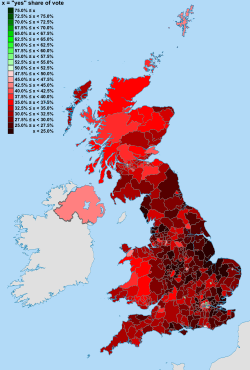
The referendum was organized into 440 distinct voting areas (or counting areas), managed by local Counting Officers (CO). These areas were distributed as follows:
- England: 326 areas (including district councils, unitary authorities, London boroughs, the City of London, and the Isles of Scilly).
- Scotland: 73 areas (Scottish Parliament constituencies).
- Wales: 40 areas (National Assembly for Wales constituencies).
- Northern Ireland: 1 single area.
To streamline the process, these local results fed into 12 regional counts overseen by Regional Counting Officers (RCO). These regions mirrored those used in the European Parliamentary Elections Act 2002, excluding Gibraltar, which did not participate. Results were declared on Friday, May 7, 2011, with no provision for national or regional recounts.
Voter Eligibility and Franchise
The right to vote was extended to UK residents who were British, Irish, or Commonwealth citizens, as per the Representation of the People Acts of 1983 and 2000. This included members of the House of Lords and UK nationals who had lived overseas for less than 15 years. Other EU citizens were generally excluded unless they held citizenship in Malta, Cyprus, or the Republic of Ireland.
Voting took place between 07:00 and 22:00 BST. To increase accessibility, postal ballots were sent to eligible voters approximately three weeks before the poll. The minimum voting age was 18. Notably, a House of Commons defeat blocked a proposed amendment that would have required a minimum 40% turnout for the result to be valid.
Final Results and Repeal
The final result was declared by Chief Counting Officer Jenny Watson on Saturday, May 7, 2011. The electorate overwhelmingly rejected the change, with a national turnout of 42.20%.
| Choice | Votes | Percentage |
|---|---|---|
| Yes | 6,152,607 | 32.10% |
| No | 13,013,123 | 67.90% |
| Total Valid Votes | 19,165,730 | 100% |
| Invalid/Blank Votes | 113,292 | 0.59% |
| Registered Voters | 45,684,501 | (42.20% Turnout) |
The "No" vote was consistent across all four constituent countries. England recorded 69.14% "No," Scotland 63.64%, Wales 65.45%, and Northern Ireland 56.32%. Following this decisive outcome, the provisions for the alternative vote system were repealed via a Statutory Instrument on July 8, 2011.
Frequently Asked Questions
What was the main purpose of the 2011 referendum?
The referendum was held to determine if the UK should switch from the "first past the post" electoral system to the "alternative vote" (AV) system for electing MPs to the House of Commons.
Why was the original referendum question changed?
The Electoral Commission found that the original wording was difficult to understand, particularly for voters with lower levels of literacy or education, and recommended a simpler version.
Who was eligible to vote in the referendum?
Eligible voters included British, Irish, and Commonwealth citizens resident in the UK, as well as UK nationals living overseas for less than 15 years and citizens of Malta and Cyprus.
How many voting areas were involved in the count?
There were 440 voting areas in total: 326 in England, 73 in Scotland, 40 in Wales, and one for Northern Ireland.
What happened after the "No" vote was declared?
Because the electorate rejected the proposal, the alternative vote system provisions within the act were repealed on July 8, 2011, through a Statutory Instrument.