Úbeda History: From Prehistoric Roots to Renaissance Splendor
Nestled in the heart of Spain, Úbeda is a city where legend and archaeology intertwine. While local lore attributes its founding to Tubal, a descendant of Noah, and links its name to the mythical tower of King Ibiut, scientific evidence reveals a timeline far more expansive. Recent research has positioned Úbeda as the oldest scientifically substantiated city in Western Europe, with a history stretching back six millennia.
Key Facts
- Oldest City: Scientifically substantiated as the oldest city in Western Europe based on 35 Carbon-14 datings at Las Eras del Alcázar.
- Ancient Roots: Settlements date back to the Copper Age (Chalcolithic period).
- Cultural Crossroads: Historically influenced by Greeks, Carthaginians, Romans, Visigoths, and Moors.
- Renaissance Hub: Became a center for Renaissance architecture in the 16th century, influencing Seville and the Americas.
- Jewish Heritage: Home to the 13th-century "Water Synagogue," featuring a rare ritual bath.
Prehistory and the Ancient World
The earliest human activity in Úbeda is centered around the Cerro del Alcázar. Archaeological investigations led by Professor Francisco Nocete have uncovered a sequence of settlements spanning the Copper Age, Argaric, Oretanian, Late Roman, and Visigothic periods. This deep history is anchored by findings at the Las Eras del Alcázar site.
In the protohistoric era, the nearby Iberian settlement of Iltiraka was eventually absorbed into the Roman colony of Salaria, becoming known as Old Úbeda (Ubeda Vethula). While Greeks and Carthaginians initially sought trade and imperial control in the region, the Romans ultimately prevailed. Following the Battle of Ilipa in 206 BCE, the city underwent Romanization and was renamed Betula, serving as a hub for diverse populations.
The transition into the post-Roman era was marked by instability. During the Gothic period, the Vandals devastated the region, prompting the population to consolidate into a new settlement known as Bétula Nova.
The Islamic Era and the Reconquista
The city saw a resurgence under Arab rule, particularly under Abderramán II, who established it as Ubbada (or Ubbadat Al-Arab). The city served as a strategic point to control the neighboring Mozarabs—Christians living under Muslim rule—of Baeza. By the 11th century, Úbeda was a contested prize among the taifa kingdoms of Seville, Toledo, Granada, and Almería before falling to the Almoravids.
As a center of Al-Andalus, Úbeda flourished through trade and craftsmanship, expanding its defensive walls to protect its prosperity. However, the 12th century brought increased pressure from Castilian kings. In 1091, the city was surrendered to Alfonso VI, and later, in 1212, it suffered a massacre by crusaders following the Battle of Las Navas de Tolosa.
The Reconquista—the campaign to reclaim the Iberian Peninsula for Christian rule—concluded for Úbeda in 1233 or 1234 under King Ferdinand III. Following its capitulation on May 8, 1234, the city's territories expanded significantly, eventually encompassing areas such as Santisteban del Puerto, Huesa, and Canena.
Political Turmoil and the Rise of the Middle Class
The 14th and 15th centuries were characterized by internal strife. Conflicts between the local nobility and the general population hindered growth, exacerbated by the Castilian Civil War in 1368 between Peter I and Henry II. Bitter rivalries between the de Trapera and de Aranda families, and later the de la Cueva and de Molina families, plagued the city until the Catholic Monarchs intervened by ordering the destruction of the Alcázar fortress.
Because Úbeda served as a geographic buffer between Castile-La Mancha and Granada, the crown granted the city official privileges known as the Fuero de Cuenca. This legal framework organized the population of Castilla and León and established a popular Council, which fostered the rise of a middle-class nobility.
The Golden Age of the Renaissance
The 16th century marked Úbeda's most prestigious era. Local aristocratic families ascended to the highest echelons of the Spanish Monarchy. Francisco de los Cobos and Juan Vázquez de Molina served as Secretaries of State for Emperor Charles V and Philip II, respectively. Other prominent figures included the Viceroy of Peru, Pedro de Toledo, and the governor of the Canary Islands, Juan de Rivera y Zambrana.
The competition for prestige among these families fueled a massive investment in the arts. Úbeda became a primary focus of the Spanish Renaissance, with architecture spreading from here to the Kingdom of Seville and the Americas. Master architects such as Diego de Siloé, Berruguete, and Andrés de Vandelvira designed landmarks including the Vazquez de Molina Palace (now the Council Town) and the Holy Chapel of the Saviour.
This prosperity waned during the crisis of the 17th century. It was not until the late 18th century that the economy began to recover, driven by handmade industries and agriculture.
Modern Era and Archaeological Discoveries
The early 19th century brought further economic hardship due to the Peninsular War (the War of Independence against Napoleon). The city only began to modernize toward the end of the century through technical agricultural and industrial improvements. This era also saw the rise of "casinos," which served as hubs for intellectual and ideological debate.
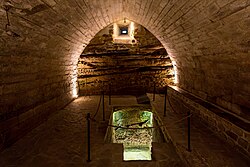
One of the most significant recent discoveries concerns the city's medieval Jewish community. In 2007, archaeologists uncovered the Sinagoga del Agua (Water Synagogue), dating to the 13th century. The site is named for its seven wells and a mikveh (a Jewish ritual bath). The complex includes a main synagogue room with a women's gallery, a patio featuring a "tree of life" design, and a cellar used for storing kosher wine and olive oil.
| Period | Key Designation/Era | Defining Characteristic |
|---|---|---|
| Prehistory | Copper Age / Chalcolithic | Earliest substantiated settlements in Western Europe. |
| Roman Era | Betula | Romanization following the Battle of Ilipa (206 BCE). |
| Islamic Era | Ubbadat Al-Arab | Prosperous center of Al-Andalus known for trade. |
| 13th Century | Reconquista | Capitulation to the Kingdom of Castile (1234). |
| 16th Century | Renaissance | Architectural boom led by high-ranking royal officials. |
| 19th Century | Industrialization | Recovery from the Peninsular War via technical improvements. |
Frequently Asked Questions
Why is Úbeda considered the oldest city in Western Europe?
This claim is based on scientific research led by Professor Francisco Nocete, who utilized 35 Carbon-14 datings at the Las Eras del Alcázar site to prove settlements dating back six millennia to the Copper Age.
What is the "Water Synagogue" and why is it called that?
The Sinagoga del Agua is a 13th-century Jewish synagogue discovered in 2007. It is named for the seven wells and the mikveh (ritual bath) found at the site.
How did the Renaissance influence Úbeda?
Wealthy families who held high positions in the Spanish Monarchy, such as Francisco de los Cobos, patronized great architects like Andrés de Vandelvira. This turned the city into a Renaissance hub whose style eventually influenced Seville and the Americas.
What was the Fuero de Cuenca?
The Fuero de Cuenca was a set of official privileges granted by the Castilian kings to the people of Úbeda. It helped organize the population on the border of Granada and led to the creation of a popular Council and a middle-class nobility.
Who were the primary architects of Úbeda's Renaissance landmarks?
The city's most significant Renaissance structures, including the Vazquez de Molina Palace, were designed by architects such as Diego de Siloé, Berruguete, and Andrés de Vandelvira.