U.S. Treasury Securities: A Comprehensive Overview of Marketable Debt
The United States Treasury issues various marketable securities to manage federal debt and ensure government liquidity. These instruments, governed by the Treasury's Uniform Offering Circular (31 CFR 356), serve as foundational assets in global financial markets, offering different risk profiles, maturities, and payment structures to attract a wide range of investors.
From short-term bills used for immediate cash management to long-term bonds that track macroeconomic trends, these securities provide a spectrum of options for those seeking government-backed stability.
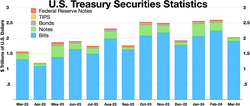
Key Facts
- T-bills are short-term, zero-coupon securities maturing in one year or less.
- T-notes offer intermediate maturities (2 to 10 years) with semi-annual interest payments.
- T-bonds are long-term investments with maturities of 20 or 30 years.
- TIPS protect investors from inflation by adjusting the principal based on the Consumer Price Index (CPI).
- STRIPS are securities where interest and principal are separated for individual sale.
- The minimum purchase for Treasury bills is $100.
Treasury Bills (T-bills)
Treasury bills, or T-bills, are zero-coupon bonds, meaning they do not pay regular interest. Instead, they are sold at a discount to their par value. The investor's yield is realized when the bill is redeemed at full par value upon maturity.
T-bills are typically issued with maturities of 4, 6, 8, 13, 17, 26, and 52 weeks. These are sold via single-price auctions; most are held weekly, while the 52-week bill is auctioned every four weeks. While available to the public, the largest purchasers are typically banks and primary dealers.

CUSIP Identification and Re-openings
Each T-bill issue is assigned a unique CUSIP number. In some cases, the Treasury performs a "re-opening," where a new bill is issued with a shorter term but the same maturity date as a previous issue. These re-opened bills share the same CUSIP number.
Cash Management Bills (CMBs)
When Treasury cash balances are exceptionally low, the government may issue Cash Management Bills (CMBs). Unlike regular T-bills, CMBs are irregular in timing, amount, and maturity. They are categorized as "on-cycle" if they mature on the same day as a regular bill, or "off-cycle" if they do not.
Treasury Notes (T-notes)
Treasury notes are intermediate-term securities with maturities of 2, 3, 5, 7, or 10 years. Unlike T-bills, T-notes pay a fixed interest rate (coupon) every six months. They are sold in $100 increments, and their secondary market prices are quoted as a percentage of par value in thirty-seconds of a dollar.
The 10-year T-note is particularly significant, as it is widely used by investors as a proxy for long-term macroeconomic expectations and a benchmark for the overall government bond market.
Treasury Bonds (T-bonds)
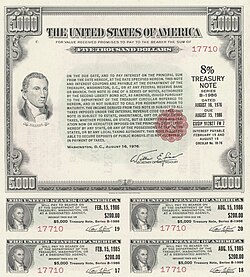
Treasury bonds, often called "long bonds," have the longest maturities, typically 20 or 30 years. Like T-notes, they provide semi-annual coupon payments.
The issuance of 30-year bonds was suspended between February 18, 2002, and February 9, 2006, during a period of budget surpluses. However, they were reintroduced in 2006 to meet demand from pension funds and institutional investors and to diversify Treasury liabilities. They are currently issued on a quarterly basis.
Specialized Securities: TIPS and FRNs
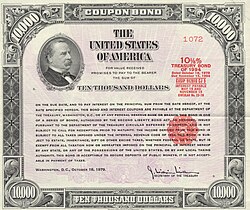
To mitigate risks associated with changing financial climates, the Treasury offers specialized instruments that adjust their terms over time.
Treasury Inflation-Protected Securities (TIPS)
Introduced in 1997, TIPS are inflation-indexed bonds available in 5, 10, and 30-year maturities. While the coupon rate remains fixed, the principal is adjusted based on the Consumer Price Index (CPI). If the CPI rises, the principal increases, thereby increasing the interest income and protecting the investor's purchasing power.
Floating Rate Notes (FRNs)
Floating rate notes are a different variation of Treasury notes. Instead of a fixed rate, FRNs pay interest quarterly based on rates determined by periodic auctions of 13-week Treasury bills. These notes typically have a two-year term, after which the par value is returned to the holder.
Coupon Stripping and STRIPS
In the secondary market, some investors prefer to separate the interest payments from the principal of T-notes, T-bonds, or TIPS. This process is known as "stripping." Historically, this involved physically cutting coupons from paper bearer bonds.
Modern versions are called Separate Trading of Registered Interest and Principal Securities (STRIPS). While the Treasury does not issue STRIPS directly—they are created by brokerage firms or investment banks—the Treasury does register them in its book-entry system. STRIPS must be purchased through a broker rather than TreasuryDirect.
Summary of U.S. Treasury Securities
| Security Type | Maturity Terms | Payment Structure | Key Feature |
|---|---|---|---|
| T-bills | ≤ 1 Year | Zero-coupon (Discount) | Short-term liquidity |
| T-notes | 2, 3, 5, 7, 10 Years | Semi-annual Fixed Coupon | Macroeconomic benchmark |
| T-bonds | 20 or 30 Years | Semi-annual Fixed Coupon | Long-term institutional hold |
| TIPS | 5, 10, 30 Years | Fixed Coupon / Adjusted Principal | Inflation protection |
| FRNs | 2 Years | Quarterly Floating Rate | Linked to 13-week T-bills |
Frequently Asked Questions
What is the difference between a T-bill and a T-note?
The primary differences are maturity and payment. T-bills mature in one year or less and are sold at a discount without coupon payments. T-notes have longer maturities (up to 10 years) and pay a fixed interest rate every six months.
How do TIPS protect against inflation?
TIPS adjust the principal value of the bond based on the Consumer Price Index (CPI). When inflation causes the CPI to rise, the principal increases, which in turn increases the interest payments since the coupon rate is applied to the adjusted principal.
What are STRIPS and how are they acquired?
STRIPS are securities where the principal and interest components have been separated to be sold individually. They are not issued directly by the Treasury but are created by investment banks or brokers; therefore, they must be purchased through a broker.
What is a CUSIP number in the context of T-bills?
A CUSIP number is a unique identifier for a specific security issue. In the case of T-bills, "re-opened" issues that mature on the same day as an original issue will share the same CUSIP number.
What are Cash Management Bills (CMBs)?
CMBs are short-term securities issued irregularly by the Treasury to meet extraordinary short-term cash needs. They are sold via discount auctions and can be "on-cycle" or "off-cycle" depending on their maturity date relative to regular bills.