U.S. News & World Report Rankings
For decades, U.S. News & World Report has been a prominent name in the world of data-driven evaluations. By applying specific methodologies to various sectors of society, the publication provides rankings that influence everything from where students apply for college to how consumers choose their next vehicle or where families decide to relocate.
Key Facts
- The "Who Runs America?" surveys were the publication's first rankings, running from 1974 to 1986.
- The Best Colleges rankings, launched in 1983, are considered the most influential institutional rankings in the U.S.
- Hospital rankings focus on 16 high-acuity (difficult) specialties.
- The Best States rankings evaluate all 50 states across categories like healthcare, education, and economy.
- Automotive rankings cover over 30 classes of vehicles, including new and used models.
The Early Years: Who Runs America?
From 1974 to 1986, U.S. News & World Report published an annual spring survey titled "Who Runs America?" This series identified the ten most powerful individuals in the United States. While the U.S. President consistently held the top spot, the second position varied, featuring figures such as Secretary of State Henry Kissinger (1974), Senator Edward Kennedy (1979), and Federal Reserve Chairmen Paul Volcker and Arthur Burns.
Although government officials dominated the top ten, the list occasionally included influential figures from other sectors, such as David Rockefeller (Chase Manhattan Bank), George Meany (AFL-CIO), Ralph Nader (consumer advocate), and journalists Walter Cronkite and Dan Rather. Notably, Rosalynn Carter was the only woman to appear in the top ten, achieving this in 1980. The publication also ranked top individuals in fields like finance, journalism, business, and education before the survey was discontinued in 1986.
Academic and Institutional Rankings
Best Colleges
Launched in 1983, the Best Colleges rankings evaluate universities and colleges across the United States. While highly influential, these rankings have faced criticism from education experts. Detractors argue that the system relies on self-reported data that may be fraudulent and encourages institutions to engage in gamesmanship to improve their standing. Critics also suggest that the rankings create an "admissions frenzy" by emphasizing prestige over individual fit and applying a single scale to institutions with vastly different missions.
Best Global Universities
In October 2014, the publication expanded its reach with the "Best Global Universities" rankings. This move positioned U.S. News as the first American publisher to enter a global ranking space previously dominated by the QS World University Rankings, the Academic Ranking of World Universities, and the Times Higher Education World University Rankings.
Healthcare and Automotive Evaluations
Best Hospitals
Since 1990, U.S. News has ranked hospitals based on their performance in high acuity cases—medical conditions that are severe or complex. These evaluations span 16 specialties, including:
- Cancer, Neurology, and Neurosurgery
- Heart and Heart Surgery, Pulmonology, and Rheumatology
- Diabetes and Endocrinology, Gastroenterology, and Kidney Disorders
- Gynecology, Ophthalmology, and Orthopedics
- Ear, Nose, and Throat, Geriatrics, Psychiatry, and Urology
Hospitals that demonstrate excellence across multiple areas are recognized on the Honor Roll.
Best Cars
Starting in 2007, U.S. News began ranking new and used automobiles across more than 30 classes, including SUVs, trucks, sports cars, minivans, and wagons. Each vehicle is graded on performance, interior quality, and a general recommendation score, derived from safety data, reliability metrics, and expert critics.
The publication also grants annual awards: "Best Cars for the Money" (announced in February) and "Best Cars for Families" (announced in March). The money award considers price and five-year ownership costs, while the family award focuses on interior space, family-friendly features, safety, and reliability.
Best States Rankings
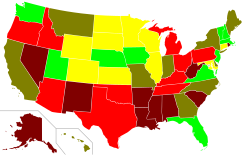
Introduced in 2017, the Best States rankings evaluate all 50 U.S. states. The overall rank is determined by weighting various categories based on resident surveys regarding what matters most.
| Year | Top Ranked State(s) | Worst Ranked State | Key Metrics/Categories |
|---|---|---|---|
| 2017 | Massachusetts | Louisiana | Healthcare, Education, Crime, Infrastructure, Opportunity, Economy, Government |
| 2018 | Iowa | Louisiana | Added Fiscal Stability and Quality of Life |
| 2019 | Washington | Louisiana | Natural Environment replaced Quality of Life |
| 2020 | N/A | N/A | No ranking published |
| 2021 | Washington, Minnesota, Utah | New Mexico, Mississippi, Louisiana | Various state-level metrics |
The rankings have evolved over time to reflect changing priorities, such as the inclusion of the natural environment in 2019.
Frequently Asked Questions
Who was the only woman to rank in the top ten of "Who Runs America?"
First Lady Rosalynn Carter was the only woman to make the top ten list, appearing in the 1980 edition.
What are the primary criticisms of the Best Colleges rankings?
Critics argue that the rankings rely on potentially fraudulent self-reported data, encourage institutional gamesmanship, ignore the individual fit between a student and a school, and create undue pressure during the admissions process.
How are the "Best Cars for the Money" awards determined?
These awards are calculated by combining the vehicle's purchase price and its five-year cost of ownership with professional opinions from the automotive press.
What does "high acuity" mean in the context of hospital rankings?
High acuity refers to the most difficult or severe medical cases within a specific specialty, which U.S. News uses as a primary metric for its hospital evaluations.
Which state has consistently ranked among the worst in the Best States list?
Louisiana has consistently appeared as the worst-ranked state in the 2017, 2018, 2019, and 2021 rankings.