Tyne and Wear Rail: From Industrial Wagonways to Modern Metro
The transport landscape of Tyne and Wear is a testament to the region's industrial heritage. Long before the arrival of high-speed locomotives, the area relied on wagonways—early rail systems used to move heavy minerals. The Dunston wagonway, operating as early as 1671, served as a vital link for transporting coal to river barges, setting the stage for the region to become a global pioneer in railway development.
The Rise of the Victorian Rail Network
By the 1830s, the need to move massive quantities of industrial materials led to a boom in railway construction. The Stanhope and Tyne Railway opened in 1834, following closely behind the Stockton and Darlington Railway. This era was defined by intense competition, resulting in one of the densest railway networks in the United Kingdom.
A pivotal moment occurred in 1847 with the completion of Newcastle Central Station by the Newcastle and Carlisle Railway. Shortly after, the Newcastle and North Shields Railway connected its branch to the station, further integrating the region's transport.
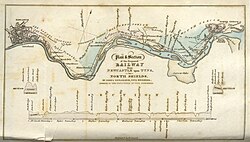
The network expanded rapidly to support the global export of goods via the Tyne and Sunderland Docks, as well as to supply the riverfront shipyards. Key routes included the Blyth and Tyne Railway, the York, Newcastle and Berwick Railway, and the Brandling Junction Railway, among many others. This infrastructure accelerated urbanisation and cemented the region's industrial dominance.
Trams and the Tyneside Electrics Era
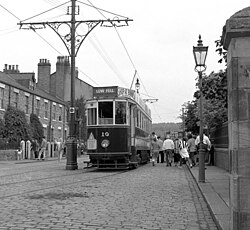
At the turn of the 20th century, electric trams emerged to connect city centres with expanding suburbs. The Newcastle Corporation Tramways began service on December 16, 1901, joining other networks like the Gateshead & District Tramways Company and the Sunderland Corporation Tramways. While these systems were largely dismantled by the 1950s due to the rise of the automobile, some heritage cars are preserved at the Beamish Museum.
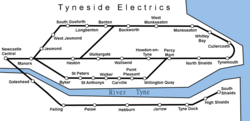
The popularity of trams caused a decline in traditional rail passenger numbers. In response, the Victorian network was consolidated and electrified in the 1910s under the Tyneside Electrics brand. This restructuring, combined with the East Coast Mainline's nonstop express services to London, Edinburgh, Durham, and Middlesbrough, created one of the UK's largest electrified commuter networks of the time.
De-electrification and the Birth of the Metro
The mid-20th century brought significant challenges. In the 1960s, Tyneside Electrics was integrated into British Rail, which subsequently transitioned the network to diesel power to combat rising costs and falling demand. The Newcastle–South Shields line lost electrification in 1963, followed by the north Tyneside routes in 1967.
The Beeching Act and the general trend of deindustrialisation led to numerous closures in the 1970s. However, these defunct lines provided the foundation for a new era of transport. Many former rights of way, including parts of the Newcastle and North Shields Railway, were converted into light rail. This culminated in the launch of the Tyne and Wear Metro on August 11, 1980.
The Modern Tyne and Wear Metro
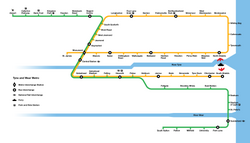
The Tyne and Wear Metro is a light rail system linking South Tyneside, Sunderland, Gateshead, Newcastle upon Tyne, North Tyneside, and Newcastle Airport. It is one of only two urban rail networks in the UK outside of London. Spanning 48 miles (77 km) with 60 stations, it is a critical artery for the region.
Between 2017 and 2018, the Metro recorded approximately 36.4 million passenger journeys, ranking it as the third-most-used light rail network in the UK, trailing only London's DLR and the Manchester Metrolink.
Metro Line Overview
- Green Line: Connects South Hylton and Sunderland to Newcastle City Centre, Regent Centre, and Newcastle Airport.
- Yellow Line: Connects South Shields to Newcastle City Centre, Whitley Bay, Wallsend, and St. James.
During the day (Monday to Saturday), trains run every 12 minutes on each line, providing a combined service every six minutes between Pelaw and South Gosforth.
National Rail Services
Beyond the Metro, the region is served by a robust National Rail network. As of March 2026, there are eight rail stations within Tyne and Wear: Blaydon, Dunston, Heworth, Manors, MetroCentre, Newcastle, Northumberland Park, and Sunderland.
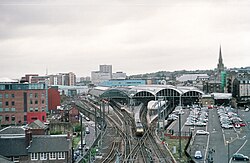
Newcastle Central Station remains the primary hub on the East Coast Main Line. It is served by several major operators:
- LNER: High-speed services to London King's Cross and Edinburgh.
- CrossCountry: Long-distance routes connecting the North East to the Midlands, South East, and South Coast.
- Northern: Local services to Morpeth, Carlisle, and the Durham Coast Line.
- TransPennine Express: Links to Yorkshire, Manchester, and Liverpool.
- Lumo: Limited-stop services between London and Edinburgh.
Sunderland station, opened in 1879, provides a multimodal link between the Metro and National Rail. It is served by Northern and the open-access operator Grand Central, which provides daily services to London King's Cross.
| System | Type | Key Feature | Primary Reach |
|---|---|---|---|
| Tyne and Wear Metro | Light Rail | 3rd most used in UK | Regional (Sunderland to Airport) |
| National Rail | Heavy Rail | East Coast Main Line | Intercity (London, Edinburgh, etc.) |
| Tyneside Electrics | Electric Rail (Historic) | Early 20th Century Hub | Commuter network (Defunct) |
| Wagonways | Industrial Rail (Historic) | Mineral transport | Coal mines to river barges |
Key Facts
- The Dunston wagonway was operational as early as 1671.
- Newcastle Central Station was completed in 1847.
- The Tyne and Wear Metro opened in stages starting August 11, 1980.
- The Metro network covers 48 miles (77 km) and serves 60 stations.
- Newcastle Central is a major stop on the East Coast Main Line.
- The Metro recorded 36.4 million journeys in 2017–2018.
Frequently Asked Questions
What is the Tyne and Wear Metro?
It is a light rail network that connects South Tyneside and Sunderland with Gateshead, Newcastle upon Tyne, North Tyneside, and Newcastle Airport, utilizing many former heavy rail rights of way.
How does the Metro compare to other UK light rail systems?
It is one of only two urban rail networks in the UK outside London and is the third-most-used light rail network in the country, following the DLR and Manchester Metrolink.
Which operators serve Newcastle Central Station?
The station is served by LNER, CrossCountry, Northern, TransPennine Express, and Lumo.
What happened to the Tyneside tram networks?
The tram systems were dismantled in the 1950s as automobiles and motorways became more popular, though some cars are now preserved at the Beamish Museum.
How often do Metro trains run?
During the day (Monday to Saturday), trains run every 12 minutes on each line, resulting in a combined frequency of every six minutes between Pelaw and South Gosforth.