TVR History: The Evolution of Romania's National Broadcaster
The story of TVR (Televiziunea Română) is more than just a chronicle of media development; it is a mirror reflecting the political and social upheavals of Romania over the last seven decades. From its humble beginnings in a deserted cinema to its role as a state mouthpiece and its eventual transition into a modern public broadcaster, TVR has remained at the center of the Romanian cultural landscape.
Early Years and Foundation
TVR was established in 1956, initiating test broadcasts on August 23 in Bucharest. The network officially launched its regular programming on New Year's Eve, December 31, broadcasting from a modest studio located at 2 Molière Street. This date established a long-standing tradition of hosting an annual New Year special, which serves as both a celebration of the year's achievements and an anniversary of television in Romania.
The Ceaușescu Era: Control and Constraints
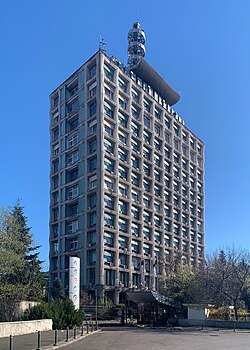
As the network grew, it required more sophisticated infrastructure. In 1969, TVR moved to a purpose-built television center on Calea Dorobanților, designed by architect Tiberiu Ricci. This facility continues to serve as the network's headquarters today.
Expansion and the Second Channel
In 1968, the network expanded with the creation of a second channel, initially called Programul 2 (later TVR 2), while the original channel became Programul 1. However, this expansion was short-lived. In 1985, as part of an "energy saving program" initiated by Nicolae Ceaușescu, TVR 2 was suspended. TVR 1 reverted to being the sole television station in the country until the 1989 Revolution.
Programming and the Shift to Color
Between 1966 and 1980, TVR maintained a relatively open program policy, airing various films, cartoons, and series from Western Europe and the United States. A major technical milestone occurred on August 23, 1983, when TVR became the first Romanian channel to broadcast in color. Notably, while other Eastern Bloc nations adopted the Soviet-backed SECAM system, Romania implemented the West German PAL system (Phase Alternating Line), a standard for color encoding.
The Era of Propaganda
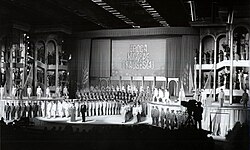
From 1985 to 1989, the "energy saving program" severely restricted broadcasting. Weekday schedules were slashed to just two hours (20:00 to 22:00), primarily dedicated to the cult of personality surrounding Nicolae and Elena Ceaușescu. By 1988, this was slightly extended to three hours. During this period, the US series Dallas was the only Western program aired in color.
The typical weekday schedule during this restrictive period was as follows:
- 19:53: National Anthem of the Socialist Republic of Romania
- 19:57: Anthem of the Democracy and Socialist Unity Front (FDUS)
- 19:59:30: Opening clock
- 20:00: News (Telejurnal)
- 20:20: Special programs dedicated to Ceaușescu
- 21:00: Theatre play, opera, or movie
- 21:50: News (Telejurnal)
- 21:58: Closing ("Hora Unirii")
The 1989 Revolution and Political Transition
TVR played a pivotal role during the Romanian Revolution. On December 22, 1989, rebels occupied the TVR building and announced the flight of the Ceaușescus. The station was briefly renamed Televiziunea Română Liberă (TVRL), or Free Romanian Television. TVR 2 resumed broadcasting on February 17, 1990, and TVRL became TVR 1.
Despite the change in regime, the network remained a tool for the National Salvation Front (FSN). The FSN used the broadcaster to discredit anti-communist protesters, labeling them "fascists," particularly during the June 1990 riots. Following public outcry, the "L" (Free) was dropped, and the station reverted to the name TVR.
Modernization and Expansion
The post-1990 era was marked by an identity crisis and frequent rebranding. On January 1, 1993, TVR became a full member of the European Broadcasting Union (EBU). The network expanded its reach with the launch of TVRi on December 1, 1995, and the renaming of TV Romania International in 1998.
Digital Evolution and New Channels
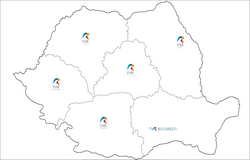
The early 2000s saw a push toward 24-hour programming, with TVR 2 starting round-the-clock broadcasts in March 2001, followed by TVR 1. Other specialized channels emerged, including TVR Cultural (launched 2002, closed 2012, revived 2022), TVR 3 (regional programming, launched 2008), and TVR Info (news and traffic, launched 2008).

High Definition and Global Events
TVR embraced high-definition (HD) broadcasting on June 1, 2008, transmitting major events like the 2008 Summer Olympics and Euro 2008. The network also hosted the Junior Eurovision Song Contest on December 2, 2006. In sports, TVR held the UEFA Champions League broadcasting rights for the 2009–10 through 2011–12 seasons.
Financial Struggles and Recent Developments
In 2016, TVR faced a severe crisis when the EBU threatened exclusion from the Eurovision Song Contest due to unpaid debts totaling 16 million Swiss francs (approximately 14.56 million euros). This led to a temporary withdrawal of EBU services, including news and sports exchanges. TVR resolved the debt and returned to the contest in 2017. Most recently, in 2025, the network expanded its digital presence by launching four new channels exclusive to TVR+.
Key Facts
- Founded: August 23, 1956 (test broadcasts).
- Technical Standard: Adopted the West German PAL system for color in 1983.
- Ceaușescu Era: Programming was restricted to roughly 2 hours per day between 1985 and 1989.
- Revolution Role: Occupied by rebels on December 22, 1989, to announce the fall of the regime.
- EBU Membership: Full active member since January 1, 1993.
- HD Launch: TVR HD began broadcasting on June 1, 2008.
| Channel/Entity | Key Date | Significance |
|---|---|---|
| TVR 1 | 1956 | Original national broadcast channel. |
| TVR 2 | 1968 | Second channel; suspended 1985, resumed 1990. |
| TVRi | 1995 | International broadcasting arm. |
| TVR HD | 2008 | Introduction of high-definition broadcasting. |
| TVR Info | 2008 | Dedicated news and traffic "must-carry" channel. |
| TVR+ Channels | 2025 | Four new exclusive digital channels. |
Frequently Asked Questions
Why did TVR choose the PAL system over SECAM?
While most Eastern Bloc countries used the Soviet-backed SECAM system, TVR opted for the West German PAL system when introducing color broadcasts in 1983.
What happened to TVR during the 1989 Revolution?
Rebels occupied the TVR building on December 22, 1989, and used the station to announce that Nicolae and Elena Ceaușescu had fled. The station was briefly renamed Televiziunea Română Liberă (TVRL).
How did the "energy saving program" affect television?
Between 1985 and 1989, broadcasting was limited to about two hours per day on weekdays, with the majority of the content focusing on propaganda for the Ceaușescu regime.
Why was Romania almost excluded from Eurovision in 2016?
The EBU withdrew member services and threatened exclusion because TVR had failed to pay debts totaling 16 million Swiss francs dating back to 2007.
When did TVR start broadcasting in high definition?
TVR HD was launched on June 1, 2008, allowing the network to transmit events like the 2008 Summer Olympics in HD.