Tungsten: The Heavy Metal of Extreme Heat and Strength
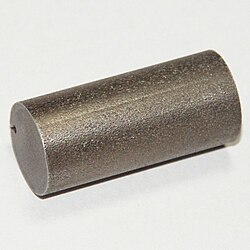
Tungsten, also known as wolfram, is a chemical element with the symbol W and atomic number 74. A lustrous, grayish-white metal, it is renowned for having the highest melting point of all pure metals. Found naturally on Earth almost exclusively in compounds, tungsten is a critical material for industries requiring extreme durability and heat resistance.
The element was identified as a distinct entity in 1781 and first isolated as a metal in 1783 by Juan José and Fausto Elhuyar. Its name is derived from the old Swedish name for the mineral scheelite, meaning "heavy stone," while its symbol W comes from the German Wolfram, which originates from the Middle High German wolf-rahm ("wolf's foam"), describing the mineral wolframite.

Key Facts
- Highest Melting Point: 3,422 °C (3,695 K), the highest of any pure metal.
- High Density: 19.254 g/cm³, making it nearly as dense as gold.
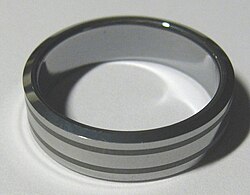
- Extreme Hardness: Often used in carbide form for cutting tools and jewelry.
- Biological Role: Essential for certain archaea (single-celled microorganisms).
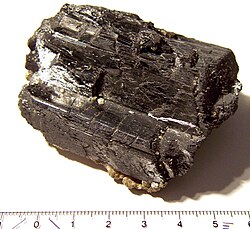
- Primary Ores: Scheelite and wolframite.
Physical and Atomic Properties
Tungsten is a transition metal located in group 6 and period 6 of the periodic table. It possesses a body-centered cubic (bcc) crystal structure and is paramagnetic. Its atomic weight is approximately 183.84 u.
One of its most striking characteristics is its thermal stability. With a boiling point of 5,930 °C (6,203 K), it remains solid under conditions that would vaporize most other materials. It also exhibits high Young's modulus (411 GPa) and significant hardness, measuring 7.5 on the Mohs scale.
Isotopes and Atomic Structure
Tungsten has several stable isotopes, with 184W (30.6%), 182W (26.5%), and 186W (28.4%) being the most abundant. While most isotopes are stable, some synthetic versions undergo beta decay to rhenium or epsilon decay to tantalum.
Chemical Characteristics and Compounds
Tungsten exhibits a wide range of oxidation states, most commonly +4 and +6. This versatility allows it to form various chemical compounds, including chlorides and oxides.
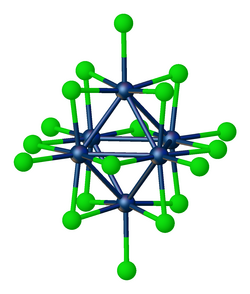
- Tungsten(II) chloride: Exists as the hexamer W6Cl12.
- Tungsten(III) chloride: Exists as the hexamer W6Cl18.
- Ammonium paratungstate: A critical raw material used to produce most other tungsten products.
![Structure of paratungstate [W12O42]12−. Ammonium paratungstate has been described as "the most important raw material for all other tungsten products."[24]](/images/ce/01/ce0150950d68d7e9576537a6be39553d34f44bdc814620b828a31e4fc2bdfb94.png)
Production and Occurrence
Tungsten is a primordial element found in the Earth's crust. It is primarily extracted from the minerals wolframite and scheelite. Mining operations, such as those in Rwanda, contribute significantly to the global supply and local economies.
![Tungsten mining in Rwanda forms an important part of the country's economy.[82]](/images/ba/03/ba03dbceff7dd150f2a8c52a8bfbc0328e2dc71846095050e6b26a7dc8aaa29d.jpg)

The production of pure tungsten typically involves the reduction of tungsten oxides or fluorides using hydrogen gas. For example, tungsten trioxide (WO3) is reacted with hydrogen to produce pure tungsten and water vapor.
Industrial and Specialized Applications
Due to its unique properties, tungsten is indispensable across several high-tech and industrial sectors.
Lighting and Electronics
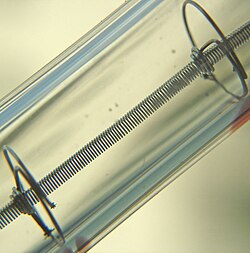
Tungsten's high melting point makes it the ideal material for filaments in incandescent lightbulbs and halogen lamps, where it is heated until it glows.

Manufacturing and Tools
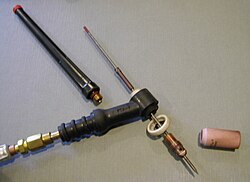
Tungsten carbide, a compound of tungsten and carbon, is used to create exceptionally hard tools for cutting, drilling, and machining. It is also used in gas tungsten arc welding (GTAW) electrodes.
Military and Aerospace
Because of its high density, tungsten is used in military applications, such as kinetic energy penetrators. It is also explored for use in fusion power research and the creation of nanowires for advanced electronics.
Biological Role and Health
While not essential for humans, tungsten is vital for some archaea. These microorganisms use tungsten-utilizing enzymes, such as aldehyde ferredoxin oxidoreductase (AOR), to facilitate metabolic processes. A specialized wtp system (consisting of WtpA, WtpB, and WtpC) is used to transport tungsten into the cell.
Regarding human health, tungsten is generally considered to have low toxicity, though industrial exposure to powders can be a concern. The NFPA 704 diamond classifies it with a health hazard level of 1, a flammability level of 3, and a reactivity level of 0.

Summary of Tungsten Properties
| Property | Value |
|---|---|
| Atomic Number | 74 |
| Melting Point | 3,422 °C (3,695 K) |
| Boiling Point | 5,930 °C (6,203 K) |
| Density | 19.254 g/cm³ |
| Mohs Hardness | 7.5 |
| Crystal Structure | Body-centered cubic (bcc) |
Frequently Asked Questions
Why is tungsten also called wolfram?
The name wolfram comes from the mineral wolframite, which was historically referred to in German as "wolf-rahm" (wolf's foam). The symbol "W" is retained from this German name.
What makes tungsten unique compared to other metals?
Tungsten is most notable for having the highest melting point of all pure metals, combined with a very high density and extreme hardness when processed as a carbide.
Is tungsten used in jewelry?
Yes, tungsten carbide is frequently used in jewelry, particularly for wedding bands, because it is highly resistant to scratching and maintains a permanent luster.
Does tungsten have any biological functions?
Yes, it is essential for certain hyperthermophilic archaea, where it serves as a cofactor for several enzymes involved in energy metabolism.
Can tungsten be patented?
No. While General Electric attempted to patent tungsten in 1913, a US court rejected the attempt in 1928, ruling that a naturally occurring element cannot be patented.