Trunk Roads: National Highway Systems and Classifications
A trunk road is a major highway with a specific legal classification used in several jurisdictions, most notably the United Kingdom, Sweden, and formerly Ireland. Unlike local roads, trunk roads are planned and managed at the national level. These critical arteries typically connect major cities, ports, and airports, serving as the primary recommended routes for long-distance travel and freight traffic.
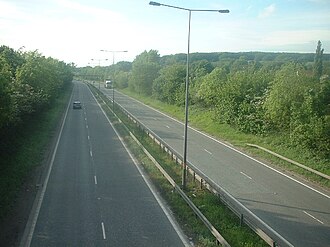
Depending on the region, trunk roads may feature segregated lanes in a dual carriageway (a road with a dividing strip between traffic moving in opposite directions) or be built to full motorway standards. While the term is often used as a formal legal designation, it is sometimes used generically to describe any major highway system.
Key Facts
- Management: Trunk roads are managed by national government bodies rather than local authorities.
- Purpose: They are designed to facilitate long-distance transit and heavy freight movement.
- UK Scale: As of 2004, Great Britain had 7,845 miles of trunk roads, including 2,161 miles of motorways.
- Sweden's Strategy: Swedish trunk roads are designated for long-distance traffic and strategic military logistics.
- De-trunking: The process of transferring a road from national to local management, often occurring after a new motorway is built.
Trunk Roads in the United Kingdom
The concept of trunk roads in Great Britain was formalized by the Trunk Roads Act 1936, which designated 30 major roads under the direct control of the Minister of Transport. This system began in England and Wales on April 1, 1937, and in Scotland on May 16, 1937. Northern Ireland maintained a separate system of road law.
Over time, the network expanded through the Trunk Roads Act 1946 and the construction of the motorway system. By 2004, the network spanned 7,845 miles (12,625 km). Today, management is divided by nation: National Highways manages roads in England, Transport Scotland handles Scotland's network, and the Welsh Government oversees roads in Wales.
Primary Routes and Signage
Most interurban trunk roads are classified as primary routes. While all trunk roads are funded by national bodies, not all primary routes are trunk roads; some are maintained by local councils. Primary routes are easily identified by green direction signs with white text and yellow route numbers.
Historically, maps used a "(T)" suffix to denote trunk roads. While this is no longer used on current Ordnance Survey maps, some roads upgraded to motorway standards retain their original "A" number with an "(M)" suffix, such as the A1(M) in England and the A74(M) in Scotland.
The Process of De-trunking
When a trunk road is superseded—often by a new motorway—it may undergo de-trunking. This legal process, executed via "Detrunking Orders," transfers responsibility to local councils. In England, this has been common since the late 1990s, allowing National Highways to focus on core dual carriageways and motorways.
The Swedish National Trunk Road System
In Sweden, the parliament designated specific roads as "national trunk roads" in 1982. These routes are managed by the Swedish Transport Administration and receive a larger budget than regional roads. Beyond civilian transport, these roads are strategically vital for the movement of heavy military vehicles and logistics during wartime.
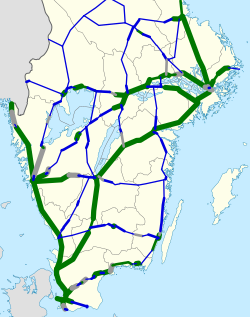
Interestingly, Swedish trunk roads do not have unique signage or numbering that distinguishes them from other national roads. However, all European routes (E-roads) in Sweden are automatically classified as trunk roads.
Major Swedish Trunk Roads
| Route Number | Connection Points |
|---|---|
| E4 | Haparanda to Helsingborg |
| E6 | Trelleborg to Svinesund |
| E20 | Malmö to Stockholm |
| Riksväg 40 | Gothenburg to Västervik |
| Riksväg 50 | Jönköping to Söderhamn |
International Equivalents
While the specific term "trunk road" is used in the UK and Sweden, other countries employ similar national highway models:
- Ireland: Previously used "T" prefixed trunk roads, now replaced by National Primary and Secondary ("N") roads managed by the National Roads Authority.
- France and Poland: Utilize the route nationale and national roads networks, respectively.
- United States: The Interstate and U.S. Highway systems serve a similar purpose, though states handle construction and maintenance with federal funding. Some states, like Michigan and Wisconsin, specifically use the term "state trunklines."
- Canada: The National Highway System provides strategic planning and federal funding, though provinces manage the roads.
- India and China: Both utilize extensive national highway and expressway systems to connect major hubs.
Frequently Asked Questions
What is the main difference between a trunk road and a primary route in the UK?
The primary difference is funding and management. Trunk roads are maintained and funded by national government bodies (like National Highways), whereas primary routes that are not trunk roads are maintained by local councils.
What happens when a road is "de-trunked"?
De-trunking is the legal transfer of a road from national management to local authority control. This often happens when a new motorway is built nearby, making the old road less critical for national long-distance traffic.
Are all Swedish national roads considered trunk roads?
No. Only specific roads designated by parliament are national trunk roads. For example, National Roads 73 and 75 are built to motorway standards but are not classified as trunk roads.
How can you identify a primary route on UK road signs?
Primary routes are identified by direction signs featuring white text on a green background, with the route numbers displayed in yellow.
Does Ireland still use the trunk road classification?
No, Ireland has transitioned to a newer system of National Primary and Secondary ("N") roads, Regional roads, and Local roads, although some old "T" prefixed signs may still exist.