Trogir: A Masterpiece of Romanesque-Gothic Architecture
With a continuous urban tradition spanning 2,300 years, Trogir stands as a living museum of Mediterranean history. Located on a small island, this settlement was shaped by the successive influences of the ancient Greeks, Romans, and Venetians. Its unique orthogonal street plan—a layout featuring streets that intersect at right angles—dates back to the Hellenistic period, providing the foundation for a city dense with palaces, churches, and fortifications.
In 1997, Trogir was inscribed as a UNESCO World Heritage Site. It is recognized as the best-preserved Romanesque-Gothic complex in Central Europe and the Adriatic, blending early medieval structures with the refined elegance of the Renaissance and Baroque eras.
Key Facts
- UNESCO Status: Inscribed in 1997 under cultural criteria ii and iv.
- Total Area: 6.4 hectares (16 acres).
- Architectural Significance: The most complete Romanesque-Gothic complex in Central Europe.
- Urban Layout: Orthogonal street plan originating from the Hellenistic period.
- Key Influence: Strong Venetian impact seen in its Renaissance and Baroque buildings.
The Architectural Heart of Trogir
The medieval core of Trogir is enclosed by 15th-century city walls and a 17th-century city gate. Within these defenses lies a concentrated collection of historical monuments, the most prominent being the Trogir Cathedral (Church of St. Lawrence). Built in the 13th century, the cathedral features the west portal created by Master Radovan, widely considered the most significant work of Romanesque-Gothic style in Croatia.
Beyond the cathedral, the city is defined by its civic and military structures. The 15th-century Fortress Kamerlengo stands as a testament to Venetian military engineering, while the 13th-century Duke's Palace represents the city's administrative history.
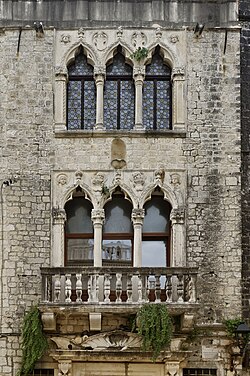
The city's residential grandeur is exemplified by the Cippico (Čipiko) palaces, both the big and small versions dating from the 15th century.
The Town Loggia
First recorded in the 13th century, the Town Loggia served as a public gathering space for legal services, contract signings, and official proclamations. The structure was renovated in 1892 and features a relief of a horseman depicting Petar Berislavić, the viceroy of Croatia (1513–1520), sculpted by Ivan Meštrović. The eastern wall once featured a relief of Justice depicting the Venetian lion, though the central lion was removed in 1932.
Sacred Art and Religious Sites
Trogir's spiritual landscape is marked by several historically significant churches:
- St. Peter Church: Formerly part of a women's Benedictine monastery, this church features a Baroque portal by Niccolo di Giovanni Fiorentino and a richly decorated 17th-century wooden ceiling. The pavement contains the tombs of the noble Andreis and Cipiko families.
- St. Sebastian's Church: Built in 1476 as a votive offering following a plague, this Renaissance building was also executed by Niccolo di Giovanni Fiorentino. It is topped by the town clock tower and contains a plaque honoring defenders of the Croatian War for Independence.
- Santa Maria de Platea: An early 9th-century hexafoil (six-lobed) church. Though demolished in the mid-19th century, it is remembered through 18th-century drawings by Ch. L. Clerisseau.
Museums and Galleries
The Museum of Sacred Art, housed in an 18th-century Late Baroque building, contains masterpieces by Gentile Bellini and Paolo Veneziano. Additionally, the Garagnin-Fanfogna Palace—a complex of Romanesque and Gothic buildings integrated in the 18th century by Ignacije Macanović—houses the Town Museum and the town lapidarium, which displays the walls of the Hellenistic Tragurion.
| Site Name | Century/Period | Key Feature |
|---|---|---|
| Trogir Cathedral | 13th Century | Portal of Master Radovan |
| Fortress Kamerlengo | 15th Century | Venetian military fortification |
| Duke's Palace | 13th Century | Medieval administrative center |
| St. Sebastian's Church | 15th Century | Renaissance votive church |
| Town Loggia | 13th Century (orig.) | Public legal and gathering space |
| Garagnin-Fanfogna Palace | 18th Century (ensemble) | Town Museum and Lapidarium |
Frequently Asked Questions
Why is Trogir a UNESCO World Heritage Site?
Trogir was inscribed in 1997 because it is an exceptionally well-preserved example of a Romanesque-Gothic complex. Its orthogonal street plan from the Hellenistic period and its concentration of fine public and domestic buildings make it unique in Central Europe.
Who was Master Radovan?
Master Radovan was a Dalmatian artist who created the main west portal of the Trogir Cathedral. His work is considered the most significant example of the Romanesque-Gothic style in Croatia.
What is the significance of the Town Loggia?
The Loggia served as the city's primary public space for legal proceedings, the signing of contracts, and the proclamation of laws, acting as a center for communal legal services.
What can be found in the Garagnin-Fanfogna Palace?
The palace houses the Town Museum, the Cata Dujšin-Ribar Gallery, and the town lapidarium, which showcases the city walls of the ancient Hellenistic Tragurion.
What was the purpose of St. Sebastian's Church?
It was built in 1476 as a votive church, meaning it was an offering given by the citizens of Trogir to express gratitude for being delivered from the plague.