Treinta y Tres Orientales: The Revolutionary Path to Uruguayan Independence
The Treinta y Tres Orientales (the Thirty-Three Orientals or Easterners) were a pivotal revolutionary group whose daring insurrection in 1825 laid the groundwork for the birth of modern Uruguay. Led by Juan Antonio Lavalleja and Manuel Oribe, this group—also known as the Thirty-Three Immortals—launched a campaign to liberate the Oriental Province from the control of the Empire of Brazil.
Key Facts
- Leaders: Juan Antonio Lavalleja and Manuel Oribe.
- Primary Goal: To expel Brazilian forces and initially unite the Oriental Province with the United Provinces of the Río de la Plata.
- Landing Date: April 19, 1825, at Agraciada Beach.
- Political Outcome: The declaration of independence on August 25, 1825, leading to the eventual creation of Uruguay in 1828.
- Composition: While officially numbering 33, the group included Argentines, Paraguayans, and one individual from Mozambique.
Historical Background: The Struggle for the Oriental Province
The conflict began long before the landing of the Thirty-Three. Between 1816 and 1820, the United Kingdom of Portugal, Brazil, and the Algarves invaded and occupied the post-Spanish Provincia Oriental (Oriental Province), a territory that today comprises Uruguay and parts of the Brazilian state of Rio Grande do Sul. During this period, the resistance led by José Gervasio Artigas was defeated, forcing Artigas into self-exile in Paraguay by 1820.
By February 1824, the newly independent Brazil formally annexed the region as the Cisplatina Province. This followed a failed separatist movement (1822–1823) backed by partisans of the United Provinces of the Río de la Plata (modern-day Argentina), who had sought to unify the region with their own provinces.
Organization and Strategic Alliances
Juan Antonio Lavalleja, a former comrade of Artigas, organized a new military expedition from the Buenos Aires Province to Cisplatina. The mission aimed to expel the Brazilian occupiers and achieve unification with the United Provinces of the Río de la Plata.
The expedition was not solely a military effort; it was supported by economic interests. Ranchers and beef-curers from Buenos Aires viewed the Brazilian occupation as a threat to their markets, as they faced stiff competition from neighbors in Rio Grande do Sul who were supplied by cattle from Cisplatina. Among these influential financiers was Juan Manuel de Rosas.
The Landing at Agraciada Beach
The operation began on April 1, 1825, when an advance party led by Manuel Oribe landed at Brazo Largo island on the Paraná River. The main force joined them on April 15 after delays caused by inclement weather.
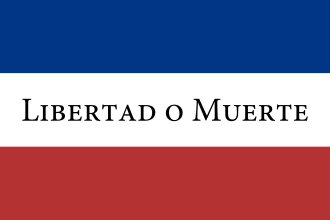
On the night of April 18, Lavalleja and his men navigated the Paraná Delta to evade the Brazilian flotilla. At dawn on April 19, they disembarked at Agraciada Beach (also known as "Arenal Grande"). Upon landing, they hoisted the Bandera de los Treinta y Tres Orientales, a tricolor flag of blue, white, and red horizontal bars—colors traditionally associated with Artigas and the Río de la Plata region.
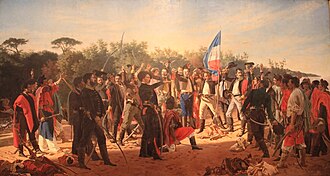
This historic moment was later immortalized in 1877 by painter Juan Manuel Blanes in his work El Juramento de los Treinta y Tres Orientales (Oath of the Thirty-Three Orientals). Blanes ensured historical accuracy by interviewing survivors and taking detailed notes to capture the protagonists' likenesses.
The Campaign and the Birth of a Nation
Following their landing, the group recruited local inhabitants and marched toward Montevideo, arriving on May 20, 1825. On June 14, they established a provisional government in the town of La Florida, creating the Florida Assembly (Representatives' Hall) to rewrite the laws of the province.
The assembly took a decisive step on August 25, 1825, declaring the independence of the Oriental Province from Brazil and pledging allegiance to the United Provinces of the Río de la Plata. Although the United Provinces recognized this incorporation on October 24, the Empire of Brazil declared war in December, sparking the Cisplatine War.
The war continued until August 1828. Through the mediation of British diplomat Viscount Ponsonby, the Preliminary Peace Convention was signed on August 27, 1828. This agreement established the Oriental Province as a sovereign state, independent of both Brazil and the United Provinces, forming the foundation of modern Uruguay.
The Mystery of the Thirty-Three
Despite the group's name, the exact number and identity of the members have been debated. Various lists published between 1825 and 1832 contain differing names, leading some historians to suggest that nicknames were used. In his 1946 study, ¿Cuántos eran los Treinta y Tres?, Jacinto Carranza noted that Santiago Gadea is the only name appearing on every single list.
Furthermore, the group was ethnically diverse. While called "Orientales," the ranks included Argentines from the Paraná islands, Paraguayans, and one individual born in Mozambique.
| Category | Details |
|---|---|
| Key Leaders | Juan Antonio Lavalleja, Manuel Oribe |
| Landing Site | Agraciada Beach (Arenal Grande) |
| Landing Date | April 19, 1825 |
| Political Body | Florida Assembly |
| Independence Date | August 25, 1825 |
| Final Outcome | Foundation of independent Uruguay (1828) |
Frequently Asked Questions
Who were the Treinta y Tres Orientales?
They were a revolutionary group led by Juan Antonio Lavalleja and Manuel Oribe who launched an insurrection in 1825 to liberate the Oriental Province from the Empire of Brazil, eventually leading to the creation of Uruguay.
What was the original goal of the expedition?
The initial objective was to expel the Brazilian forces from the Cisplatina Province and unite the territory with the United Provinces of the Río de la Plata (modern-day Argentina).
Where did the group land in 1825?
The group disembarked at Agraciada Beach, also known as "Arenal Grande," at dawn on April 19, 1825.
How did the Cisplatine War end?
The war ended in August 1828 following mediation by British diplomat Viscount Ponsonby. The resulting Preliminary Peace Convention established the region as an independent state, separate from both Brazil and the United Provinces.
Were all members of the group from the Oriental Province?
No. Although called "Orientales," the group included Argentines, Paraguayans, and one person born in Mozambique.