Trailers: A Comprehensive Guide to Commercial Hauling Equipment
In the world of logistics and freight, the trailer is the essential tool that determines what can be moved, how it is loaded, and where it can go. From simple enclosed boxes to highly specialized machinery for oversized loads, the variety of trailers available ensures that every type of cargo—whether liquid, livestock, or heavy machinery—can be transported efficiently across the road network.
Key Facts
- Dry Vans are the standard for general, non-climate controlled cargo.
- Flatbeds offer maximum flexibility for loading from the sides or top.
- Lowboys and Dropdecks are engineered to carry tall or overweight loads by lowering the center of gravity.
- Intermodal Containers allow seamless transport between ships, trains, and trucks.
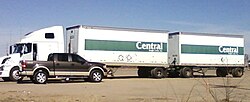
- Pup Trailers are short units (26–29 feet) designed for urban delivery or combined long-haul use.
General Purpose and Enclosed Trailers
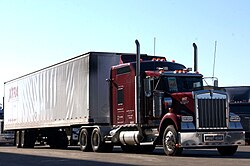
Enclosed trailers protect cargo from the elements and theft. The most common is the dry van, a rectangular, non-climate controlled trailer used for general goods like food. These typically require elevated access for forklifts to enter through the rear doors.
For temperature-sensitive goods, a refrigerated van (or reefer) provides an insulated, cooled environment. Other specialized enclosed options include the deep-drop van, which features a lowered floor and higher roof to maximize space for bulky but light items like electronics, and the double decker, which utilizes two floors to increase cargo capacity.
Specialized Enclosures
- Curtainside: A trailer with tarp sides that can be either a dry box or a flatbed with a movable frame.
- Covered Wagon: A flatbed equipped with a "side kit" consisting of side plates and curved ribs supporting a tarp.
- Chip Van: A bulk dry van with an open top specifically for wood byproducts.
- Live-bottom: A van featuring a mechanized floor for efficient unloading.
Open-Deck and Specialized Flatbeds
When cargo is too large for a box or needs to be loaded by a crane, open-deck trailers are used. A flatbed is a simple platform with no doors or enclosures, allowing for loading from the sides or above.
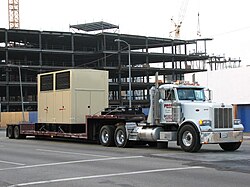
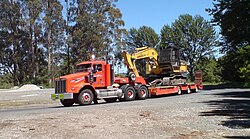
To accommodate taller loads, dropdeck (or stepdeck) trailers feature a lowered deck with a raised step at the front where the trailer attaches to the fifth wheel. For even more extreme dimensions, the gooseneck lowboy uses an arched coupling arm and a very low deck to transport oversized or overweight loads.
Bulk and Liquid Transport
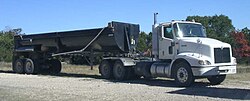
Transporting loose materials requires specialized shapes to facilitate loading and unloading. Dump trailers are bucket-like units used for dirt and gravel. These come in two primary styles: rear dumps, which pivot vertically to unload from the back, and bottom dumps, which use a funnel-shaped floor to release material from underneath.
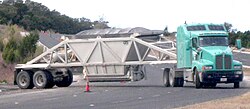
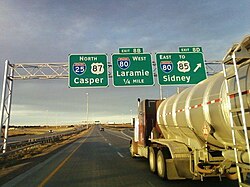
For liquids and powders, tank trailers are used. While standard tanks are cylindrical for liquids, dry bulk trailers (sometimes called "Teat Trucks") have funnel-shaped bottoms and use pneumatic force to unload dry powders. Similarly, grain or hopper-bottom trailers use a funnel design to move fertilizer or grain efficiently.
Intermodal and Specialized Hauling
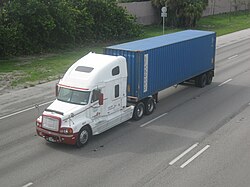
Intermodal containers are standardized enclosed boxes that can move between different modes of transport. These are often carried by a container skeletal carrier, which is a simple chassis designed specifically to mount the container. For more autonomy, a sideloader includes integrated cranes for on-the-spot loading.
Niche Transport Solutions
- Auto Transport: Specialized combinations used for hauling passenger vehicles (also known as car haulers or portable parking lots).
- Livestock Trailers: Rectangular enclosures with ventilation holes, multiple interior levels, and rear ramps for animals.
- Timber Trailers: Chassis with vertical stakes to secure logs. These include long wood trailers, double bunk (short wood) trailers, and piggyback trailers.
- Beverage Trailers: Short trailers (26–29 feet) known colloquially as sidebangers or route trailers.
Trailer Comparison Summary
| Trailer Type | Primary Cargo | Key Feature |
|---|---|---|
| Dry Van | General Freight | Enclosed, non-climate controlled |
| Reefer | Perishables | Insulated and refrigerated |
| Flatbed | Oversized/Industrial | No sides or roof |
| Lowboy | Heavy Machinery | Ultra-low deck height |
| Tanker | Liquids/Powders | Cylindrical or funnel-bottom |
| Hopper | Grain/Fertilizer | Funnel-shaped bottom |
| Pup | Urban Delivery | Short length (26-29 ft) |
Frequently Asked Questions
What is the difference between a dropdeck and a lowboy?
A dropdeck has a lowered deck with a step at the front, while a lowboy (specifically a gooseneck lowboy) is designed even lower to the ground with an arched coupling arm, specifically for oversized or overweight loads.
What is a pup trailer?
A pup is a trailer between 26 and 29 feet long. It can be used alone for deliveries in congested city areas or combined with another trailer for long-distance over-the-road transport.
How does a bottom dump trailer differ from a rear dump?
A rear dump raises the front of the cargo area to slide material out the back. A bottom dump uses a funnel-shaped floor to unload cargo through the bottom of the trailer.
What is an intermodal container skeletal carrier?
It is a specialized trailer consisting of a simple chassis designed specifically for mounting and transporting standardized intermodal containers.
What are the different types of timber trailers?
Timber trailers include long wood trailers (evenly spaced stakes for long logs), short wood trailers (double bunk with two sets of stakes), and piggyback trailers.