Traffic Systems and the Science of Lane Flow
For decades, the primary approach to improving road networks was the expansion of physical infrastructure. However, modern traffic management has shifted toward the integration of dynamic elements to optimize existing roads. By borrowing concepts from rail transport, engineers are now implementing intelligent transportation systems (ITS)—a collective term for the sensors and interconnected guidance systems used to manage vehicle movement in real-time.
These systems utilize sensors to measure traffic flows and speed, allowing operators to detect problems instantly. Once congestion is identified, operators can determine the cause and implement measures to minimize delays. Examples of these dynamic tools include automated traffic signs that change lane directions based on the time of day to accommodate shifting demand.
Key Facts
- Intelligent transportation systems use sensors and interconnected guidance to manage traffic flow.
- Lane flow is determined by the mathematical relationship between density and speed.
- Traffic speed remains stable as density increases until it reaches a critical breakpoint.
- Ramp meters are used to control the rate of vehicle entry to prevent highway bottlenecks.
The Mathematics of Lane Flow
To manage traffic effectively, engineers rely on the lane flow equation, which defines the relationship between three critical variables: lane flow (Q), space mean speed (V), and density (K). The formula is expressed as:
Q = KV
- Lane Flow (Q): The number of vehicles passing a point per hour.
- Space Mean Speed (V): The average speed of vehicles in kilometers per hour.
- Density (K): The number of vehicles per kilometer of road.
The Impact of Density on Speed
Observations of limited-access facilities reveal a specific pattern in how traffic behaves. Initially, as density increases, the speed of traffic does not necessarily decline, allowing the flow to reach a maximum. However, once traffic reaches a critical threshold known as the breakpoint (BP), any further increase in density causes vehicle speeds to drop.
If density continues to rise beyond a second threshold, the system reaches a point where increased density actually reduces the overall flow, leading to severe congestion and gridlock.
Managing Bottlenecks with Ramp Meters
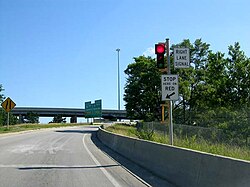
To prevent the system from hitting the breakpoint during peak periods, traffic managers must control the density of vehicles at known bottlenecks. This is achieved through the use of ramp meters.
Ramp meters are signals located on entrance ramps that regulate the rate at which vehicles are allowed to enter the mainline highway. By limiting the entry rate, these devices keep the mainline density below the critical threshold, ensuring that speeds and flow remain high for the majority of drivers, although this results in increased wait times for those on the ramps.
Traffic Flow Summary
| Variable | Symbol | Unit of Measure | Effect of Increase |
|---|---|---|---|
| Lane Flow | Q | Vehicles per hour | Increases until breakpoint is reached |
| Space Mean Speed | V | Kilometers per hour | Declines after the breakpoint (BP) |
| Density | K | Vehicles per kilometer | Reduces speed and flow beyond thresholds |
Frequently Asked Questions
What are intelligent transportation systems?
Intelligent transportation systems are integrated networks of sensors and automatic guidance systems, such as flow-measuring sensors and dynamic traffic signs, used to monitor and manage road traffic.
What is the breakpoint (BP) in traffic flow?
The breakpoint is the critical density threshold beyond which any further increase in the number of vehicles per kilometer causes the average speed of traffic to decline.
How does the lane flow equation work?
The equation Q = KV states that the total flow of vehicles (Q) is the product of the traffic density (K) and the space mean speed (V).
Why are ramp meters used if they cause delays?
Ramp meters cause delays for entering vehicles to prevent the mainline highway from exceeding its critical density. This ensures that the overall flow and speed on the highway remain high during peak periods.
What happens when density increases beyond the second threshold?
Beyond a certain density threshold, the increase in vehicles no longer just slows down traffic but actually reduces the total lane flow, exacerbating congestion.