Towpath History: The Evolution of Waterway Haulage
Before the era of motorized engines, moving heavy goods via inland waterways required immense physical effort and strategic engineering. The towpath—a path along the bank of a river or canal—served as the essential artery for this transport, allowing animals or humans to pull vessels against the current or through still waters.
Ancient Origins of Towpaths
The practice of constructing dedicated paths for towing dates back to some of the world's earliest empires. In 101 AD, the Roman emperor Trajan ordered a towpath to be cut through the Iron Gates, a gorge on the Danube river, to facilitate his invasion of Dacia. Similarly, in China, towpaths were utilized to overcome the challenges of treacherous river stretches.
During the reign of Emperor Gaozong of Tang (649–683), towpaths were carved along the Yellow River to improve the transport of grain upstream to Luoyang. Engineering projects at the Sanmenxia gorge on the Yellow River also featured towpaths during the Han and Tang dynasties. On the upper Yangtze River, development progressed through the Tang and Song dynasties, with further expansions in the 1300s, 1400s, 1700s, and 1800s to support the growing population of Sichuan and advancements in shipbuilding. Despite these efforts, early towpaths were often vulnerable to erosion caused by nearby agriculture during high-water seasons.
From Human Power to Horse Haulage
Early inland transport relied heavily on the river's natural flow. While barges used sails when winds were favorable or the river was wide enough for tacking (sailing in a zigzag pattern against the wind), many conditions made this impossible. In such cases, gangs of men performed bow-hauling, pulling the boats from the front.
Because river banks were frequently privately owned, bow-haulers often struggled to find a clear path. In the late 1700s, the British River Severn saw the emergence of towing path companies to solve this. Four companies developed a 24-mile (39 km) stretch between Bewdley and Coalbrookdale. However, these were not always welcomed, as the companies charged tolls to recover their capital costs, which angered those accustomed to free barge traffic.
Canal Engineering and Infrastructure
The rise of artificial canals brought a standardized approach to towpaths, most of which were designed specifically for horses. While some river improvements included artificial cuts that allowed for simultaneous towpath construction, progress was sometimes slow. For example, the River Don Navigation was improved from Tinsley to Rotherham in 1751, yet the horse towpath there was not finished until 1822. In contrast, the River Avon between Stratford-upon-Avon and Tewkesbury never had a towpath, relying on bow-hauling until steam tugs arrived in the 1860s.
Managing Path Transitions
Towpaths did not always stay on one side of the water. Landowner opposition often forced the path to switch banks. On the Chesterfield Canal, the path moves to the south bank to avoid passing too close to Osberton Hall, the residence of the Foljambes.
To move horses across the canal without detaching the towrope, engineers developed the roving bridge (or turnover bridge). This structure featured a ramp on one side and a circular ramp on the other, allowing the horse to cross and continue on the opposite bank while the rope remained attached. Similarly, the southern section of the Stratford-on-Avon Canal utilized split bridges at locks, where a small gap in the center of the bridge allowed the rope to pass through uninterrupted.
Wear and Tear
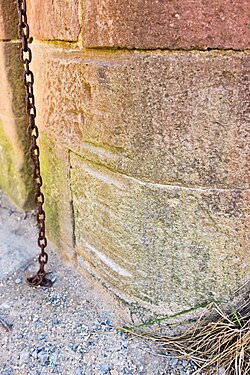
A recurring problem for towpath maintenance was rope abrasion. As ropes passed under bridge arches, they would cut deep grooves into the stonework. To prevent structural damage, cast iron plates were often attached to the faces of the arches. While these plates also developed grooves over time, they were far easier to replace than the bridge's stone masonry.
On wider navigable rivers where bridges were too expensive, horse ferries were used to transport animals to the next section of the path. Today, the absence of these ferries often creates gaps for modern walkers attempting to follow historic riverside routes.
Experimental Haulage and Modern Legacy
While horses were the standard, there were attempts to mechanize towing. In 1888, Francis W. Webb, a Mechanical Engineer for the London and North Western Railway, experimented on the Middlewich Branch of the Shropshire Union Canal. He laid a 1-mile (1.6 km) stretch of 18-inch (457 mm) gauge rails near Worleston and used a small steam locomotive to tow boats.
The locomotive, similar to the "Pet" preserved in the National Railway Museum at York, pulled trains of two to four boats at 7 mph (11 km/h), with some tests involving up to eight boats. Despite a cost report produced by engineer G. R. Webb, the project was abandoned as steam and diesel-powered boats provided a more efficient solution. A modern descendant of this concept can be seen in the "mules" used to assist ships through the locks of the Panama Canal.
Key Facts
- Ancient Use: Towpaths were utilized by the Roman Empire (Danube river) and ancient China (Yellow and Yangtze rivers).
- Bow-hauling: The practice of men pulling boats from the front before horse-drawn towpaths became common.
- Roving Bridges: Specialized bridges that allowed horses to switch sides of a canal without detaching the towrope.
- Infrastructure Protection: Cast iron plates were used on bridge arches to prevent rope abrasion from destroying stonework.
- Mechanical Experiments: A steam locomotive was briefly tested on the Shropshire Union Canal in 1888 to tow boats via rails.
| Method | Power Source | Key Characteristic | Example/Location |
|---|---|---|---|
| Bow-hauling | Human | Pulled from the front; often used on private banks | River Avon (until 1860s) |
| Horse Towing | Equine | Required dedicated paths and roving bridges | Chesterfield Canal |
| Steam Locomotive | Steam | Used rails along the towpath; experimental | Middlewich Branch (1888) |
| Modern Mules | Mechanical | Assists ships through lock systems | Panama Canal |
Frequently Asked Questions
What is a roving bridge?
A roving bridge, also known as a turnover bridge, is a structure that allows a towing horse to cross from one side of a canal to the other without the need to detach the towrope from the boat.
Why were cast iron plates added to bridge arches?
They were installed to protect the stonework of the bridge from abrasion. The towropes would rub against the arch, cutting deep grooves into the material; iron plates were used because they were easier to replace than stone.
How did bow-hauling differ from horse towing?
Bow-hauling involved gangs of men pulling the boat from the front (the bow), whereas horse towing involved animals pulling the boat from the bank via a long rope attached to the vessel.
Was steam power ever used on towpaths before motorized boats?
Yes, in 1888, an experiment on the Middlewich Branch of the Shropshire Union Canal used a small steam locomotive on 18-inch gauge rails to tow boats at speeds of 7 mph.
Why did some towpaths change sides?
Towpaths often switched banks due to the opposition of local landowners who did not want boatmen or horses passing too close to their private residences or estates.