Tonality Diamond: Harry Partch's Mathematical Approach to Tuning
In the realm of microtonal music, the tonality diamond serves as a sophisticated geometric and mathematical framework for organizing pitch classes. Developed by composer Harry Partch, this system moves beyond standard Western tuning to embrace ratios based on odd numbers, creating a structured map of harmonic relationships.
The diamond is defined by its odd limit (n), which is the highest odd number used in the ratios that define its pitches. The arrangement takes the shape of a rhombus, subdivided into (n+1)/4 smaller rhombuses. This structure allows musicians to visualize the relationship between different intervals and their harmonic identities.
How the Diamond is Constructed
The construction of the tonality diamond follows a strict mathematical logic to ensure all resulting ratios (r) fall within a single octave, specifically where 1 ≤ r < 2.
- Upper Left Edge: These rhombuses contain ratios where the numerators (overnumbers) are odd numbers from 1 to n. The denominators (undernumbers) are the minimum integer power of 2 required to keep the ratio within the 1 to 2 range. For example, ratios like 1/1, 5/4, and 3/2 are sorted in ascending order here.
- Lower Left Edge: These contain the reciprocal ratios. Here, the denominators are the odd numbers from 1 to n, and the numerators are powers of 2 that maintain the 1 ≤ r < 2 range (e.g., 1/1, 8/5, 4/3).
- Internal Rhombuses: The remaining spaces are filled with the products of the ratios from the upper-left and lower-left edges, again adjusted to fit within the single octave.
This geometric layout creates two distinct types of harmonic progressions: Otonalities, which form diagonals sloping in one direction, and Utonalities, which form diagonals sloping in the opposite direction.

The Concept of the Numerary Nexus
Central to the tonality diamond is the numerary nexus. A numerary nexus is a shared identity—either a numerator or a denominator—common to two or more interval ratios, while the other part of the ratio differs.
For instance, in an Otonality, if the denominator is always 1 (e.g., 1/1, 2/1, 3/1, 4/1, 5/1), then 1 is the numerary nexus. Conversely, in a Utonality, if the numerator is always 1 (e.g., 1/1, 1/2, 1/3, 1/4, 1/5), the numerary nexus is also 1.
In a practical tonality diamond, such as Partch's 11-limit system, these nexuses define the rows. Ratios in a right-slanting row share a numerator, while those in a left-slanting row share a denominator. For example, every ratio in the upper left row shares 7 as a denominator, whereas those in the upper right row share 7 (or 14) as a numerator.
Scaling the Limit: From 5 to 15
The complexity of the diamond increases as the odd limit (n) rises, introducing more identities and a denser web of intervals.
5-Limit and 7-Limit Diamonds
A 5-limit diamond is relatively simple, containing three identities: 1, 3, and 5. It includes ratios such as 3/2, 5/4, 6/5, 1/1, 8/5, 5/3, and 4/3. Expanding to a 7-limit diamond introduces a fourth identity (7), adding ratios like 7/4, 7/5, 7/6, 12/7, 10/7, and 8/7.
11-Limit and 15-Limit Diamonds
Harry Partch famously utilized the 11-limit tonality diamond, which contains six identities (1, 3, 5, 7, 9, 11). Interestingly, Partch rotated his version of this diamond 90 degrees for his specific applications. The 15-limit diamond is significantly more complex, containing eight identities (1, 3, 5, 7, 9, 11, 13, 15) and a vast array of ratios including 15/8, 13/8, 14/11, and 16/15.
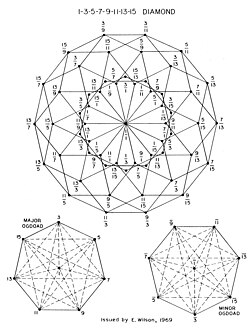
Summary of Tonality Diamond Limits
The following table summarizes the relationship between the odd limit and the number of identities present in the diamond.
| Odd Limit (n) | Number of Identities | Identities Included |
|---|---|---|
| 5 | 3 | 1, 3, 5 |
| 7 | 4 | 1, 3, 5, 7 |
| 11 | 6 | 1, 3, 5, 7, 9, 11 |
| 15 | 8 | 1, 3, 5, 7, 9, 11, 13, 15 |
Key Facts
- The tonality diamond is a rhombus-shaped arrangement of pitch ratios based on an odd limit (n).
- All ratios in the diamond are normalized to fit within a single octave (1 ≤ r < 2).
- Otonalities and Utonalities are formed by the opposing diagonals of the diamond.
- A numerary nexus is a shared numerator or denominator among different ratios.
- Harry Partch applied the 11-limit diamond to the design of the diamond marimba.
Frequently Asked Questions
What is the purpose of the odd limit in a tonality diamond?
The odd limit (n) determines the highest odd number used in the ratios of the diamond, which in turn dictates the number of identities and the overall complexity and size of the tuning system.
How do Otonalities differ from Utonalities?
Otonalities are formed by diagonals sloping in one direction and are characterized by shared numerators (or a shared numerary nexus in the denominator), while Utonalities slope in the opposite direction and are characterized by shared denominators.
What is a numerary nexus?
A numerary nexus is a mathematical identity shared by two or more interval ratios in either their numerator or denominator, while the other value remains different.
Which limit did Harry Partch use for his instruments?
Harry Partch used the 11-limit tonality diamond, though he rotated the arrangement 90 degrees for his practical application, including the construction of the diamond marimba.
How are the ratios on the edges of the diamond determined?
The upper left edge uses odd numbers as numerators, and the lower left edge uses odd numbers as denominators. In both cases, the opposite number is a power of 2 chosen to keep the resulting ratio between 1 and 2.