Tom Corbett: The Governorship of Pennsylvania (2011–2015)
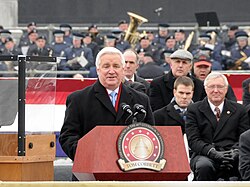
Tom Corbett assumed the office of Governor of Pennsylvania on January 18, 2011, succeeding the term-limited Democratic Governor Ed Rendell. Throughout his tenure, Corbett maintained a conservative profile, characterized by a focus on spending reductions, tax cuts, and an endorsement of Mitt Romney during the 2012 U.S. presidential election.
Key Facts
- Term: Served as Governor from January 18, 2011, to January 2015.
- Economic Policy: Focused on spending cuts and tax reductions; proposed a $1.6 billion incentive package for Shell Oil.
- Education: Initially proposed a 50% cut to state-supported higher education funding.
- Energy: Signed the Marcellus Shale Law (House Bill 1950) to regulate hydraulic fracturing.
- Election History: The first incumbent governor to lose a re-election bid under the 1968 constitution.
Economic Performance and Industrial Policy
Between January 2011 and June 2014, Pennsylvania saw a net gain of 124,800 jobs. According to the federal Bureau of Labor Statistics, this performance ranked the state 47th in the nation for job creation, trailing most states except New Mexico, Alaska, and Arkansas. Economist Tara Sinclair suggested this "less robust recovery" may have been because Pennsylvania suffered fewer job losses during the 2008–2010 recession. Additionally, state government employment decreased by 7% during Corbett's term.
In 2012, Corbett proposed a significant incentive package for Shell Oil to build a polymer manufacturing plant in Beaver County. The proposal included tax incentives exceeding $1.6 billion over 25 years and exemptions from most state and local taxes. While proponents argued the investment would boost the economy, independent researchers questioned the adequacy of the methodology used in economic benefit studies provided by Shell.
Budgetary Decisions and Public Education
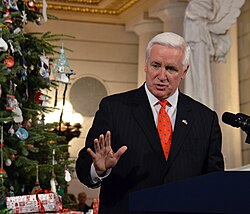
Early in his term, Corbett proposed a state budget aimed at decreasing spending by 3%. This plan drew heavy criticism for proposing a 50% reduction in funding for state-supported higher education, totaling a $625 million cut affecting the 14 universities of the Pennsylvania State System of Higher Education and state-related institutions including Penn State, Pittsburgh, Temple, and Lincoln. Despite these cuts, Corbett declined to limit collective bargaining, diverging from the paths taken by Republican governors in Ohio and Wisconsin.
Later adjustments were made in the 2013–14 budget, which included a $90 million increase for basic education and expanded funding for programs supporting individuals with physical and mental disabilities.
Natural Gas and the Marcellus Shale Law
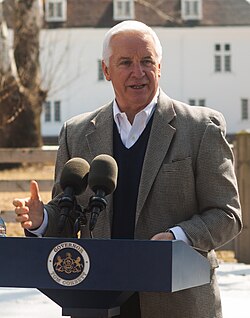
Corbett opposed a natural gas extraction tax, citing the state's high corporate net income tax. In February 2011, he repealed regulations on natural gas drilling—specifically hydraulic fracturing (the process of injecting liquid at high pressure into subterranean rocks to extract gas)—in park lands. This move was criticized by the Pennsylvania Democratic Party as a payoff to campaign donors, a claim Corbett denied.
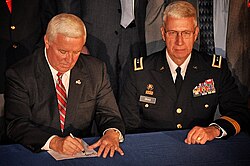
On February 17, 2012, he signed the Marcellus Shale Law (House Bill 1950). This legislation replaced an extraction tax with an impact fee to offset environmental and community effects, generating over $200 million for municipalities in 2012. The law also mandated that municipalities allow drilling and the placement of pipelines and wastewater pits in all zoning districts, including residential areas.
A controversial provision of House Bill 1950 allowed doctors access to the chemicals used in fracturing fluid only during emergencies, while forbidding them from sharing this information with patients. The law also limited the legal liability of operators and vendors regarding the contents of the fluid.
Public Opinion and Social Issues
Public approval for Governor Corbett fluctuated and eventually declined. While an October 2011 Quinnipiac poll showed a 50% approval rating following the response to Tropical Storm Lee, later polls were more critical. By August 2013, a Franklin & Marshall College poll found only 17% of voters viewed his performance as "excellent" or "good." In November 2013, Public Policy Polling labeled him the most unpopular governor in the U.S., with 65% of registered voters disapproving of his performance.
Corbett faced criticism for accepting gifts and for a 2013 interview regarding same-sex marriage. During the interview, he suggested that an analogy comparing gay couples to 12-year-olds was inappropriate and proposed an analogy involving siblings instead. He later apologized, stating he was merely citing categories of individuals unable to obtain marriage licenses under state law. A federal judge eventually struck down Pennsylvania's ban on same-sex marriage in May 2014.
On other policy fronts, Corbett sought to privatize state-run wine and spirits stores to raise an estimated $800 million to $1 billion for educational grants. He also remained a staunch opponent of both medical and recreational cannabis, describing it as a "gateway drug."
The 2014 Gubernatorial Election
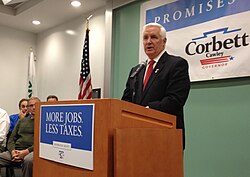
Corbett announced his bid for reelection on November 8, 2013. Despite his low approval ratings and being labeled the most vulnerable incumbent by Politico, he ran unopposed in the Republican primary after the state Supreme Court removed challenger Bob Guzzardi from the ballot.
In the general election, Corbett faced Democratic nominee Tom Wolf. Polling consistently showed Wolf with a significant lead. On November 4, 2014, Wolf won the election with 55% of the vote to Corbett's 45%, a margin of 344,844 votes. This result made Corbett the first incumbent governor to lose a reelection bid under the 1968 constitution.
| Category | Key Action/Outcome |
|---|---|
| Job Growth | Net gain of 124,800 jobs (Ranked 47th nationally) |
| Higher Education | Proposed 50% funding cut ($625 million) |
| Energy Legislation | Signed Marcellus Shale Law (House Bill 1950) |
| Liquor Stores | Proposed privatization to fund education grants |
| 2014 Election | Lost to Tom Wolf (45% to 55%) |
Frequently Asked Questions
What was the Marcellus Shale Law?
The Marcellus Shale Law (House Bill 1950) was a 2012 piece of legislation that implemented an impact fee for natural gas drillers to offset community and environmental impacts. It also mandated that municipalities allow drilling and related infrastructure in all zoning districts, including residential areas.
How did Tom Corbett's budget affect education?
Corbett initially proposed a budget that cut state-supported higher education funding by 50%, totaling $625 million. However, his 2013–14 budget later included a $90 million increase for basic education.
Why was Tom Corbett's 2014 election loss significant?
His loss was historic because he became the first incumbent governor of Pennsylvania to lose a bid for re-election under the state's 1968 constitution.
What was Corbett's stance on cannabis?
Governor Corbett opposed both the legalization of medical cannabis and the decriminalization of recreational cannabis, arguing that it serves as a gateway drug.
How did the public view Governor Corbett's performance?
While he had moderate approval early in his term, he eventually became one of the least popular governors in the state's history, with some polls in 2013 showing a 65% disapproval rating among registered voters.