Toes: Anatomy, Function, and Clinical Variations
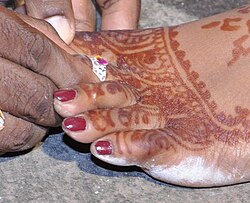
Toes are the digits located at the end of the foot in tetrapods (four-limbed vertebrates). In humans, these structures are essential for maintaining balance, supporting body weight, and providing the necessary thrust during walking. While often overlooked, the complex arrangement of bones, muscles, and nerves in the toes allows for the stability required for an upright gait.
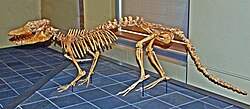
Animals are categorized by how they walk: plantigrade animals, such as humans, walk on the soles of their feet; digitigrade animals, like cats, walk on their toes; and unguligrade animals walk on hooves at the tips of their toes.
Key Facts
- Humans typically have five toes per foot, consisting of a hallux (big toe) and four smaller toes.
- Most toes contain three phalanx bones, while the hallux contains only two.
- The hallux and the little toe possess unique muscles for specialized movement.
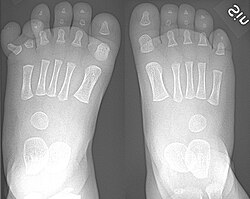
- Polydactyly is the condition of having more than five toes.
- Toes provide critical balance and propulsion during the human gait.
Anatomical Structure
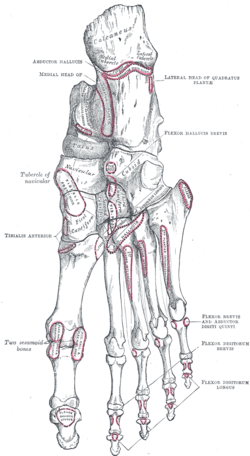
The human toe is composed of phalanx bones (singular: phalanx). In the second, third, and fourth toes, there are three bones: the proximal, middle, and distal phalanx. The fifth toe (little toe) also typically has three, though some individuals lack the middle bone. The hallux, or big toe, is unique in that it contains only two: the proximal and distal phalanx.
The joints connecting these bones are known as interphalangeal joints. Each toe connects to the foot's metatarsal bone at the metatarsophalangeal joint. Every toe is encased in skin and topped with a toenail.
The Five Toes
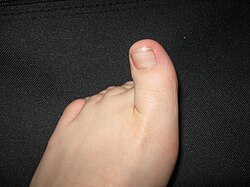
From the medial (innermost) to the lateral (outermost) side, the toes are identified as:
- First toe: The hallux, also known as the big toe or great toe.
- Second toe: Often called the index or pointer toe.
- Third toe: The middle toe.
- Fourth toe: The ring toe.
- Fifth toe: The baby, little, or pinky toe.
Muscles, Blood, and Nerve Supply
Toe movement primarily involves flexion (bending toward the sole) and extension (bending toward the back of the foot). Most toes are controlled by the flexor digitorum brevis and extensor digitorum brevis muscles. Because these muscles attach to the sides of the bones, humans cannot move the middle toes independently.
The hallux and little toe have specialized control. The hallux is primarily flexed by the flexor hallucis longus and flexor hallucis brevis, and extended by the abductor and adductor hallucis muscles. The little toe is managed by the flexor and abductor digiti minimi.
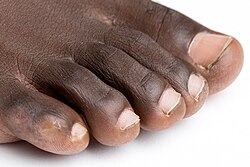
Blood is supplied to the toes via the digital branches of the plantar metatarsal arteries and drains through the dorsal venous arch. Sensation is managed by five distinct nerves: the superficial fibular nerve (top of toes), the deep fibular nerve (between the hallux and second toe), the sural nerve (outer fifth toe), and the medial and lateral plantar nerves (bottom of the toes).
Variations and Genetic Traits
While five toes are standard, variations occur. Polydactyly refers to having extra digits, while syndactyly involves fused digits and arachnodactyly refers to abnormally long, slender digits.
Toe length also varies. While the hallux is usually the longest, some people possess Morton's toe (Greek foot), a dominant genetic trait where the second toe is longer than the first. Conversely, those with fibrodysplasia ossificans progressiva often have a short hallux that turns inward.
Clinical Significance and Deformities
Common injuries include "stubbed toes" (sprains of the interphalangeal joints) and "turf toe" (sprains where the toe joins the foot). Long-term use of ill-fitting shoes can lead to misalignment or deformities such as hammer toe (buckling of the toe), trigger toe, or claw toe. These conditions can be exacerbated by diabetes mellitus or rheumatoid arthritis.
Other common issues include:
- Bunions: Structural deformities of the joint between the foot and the big toe. A similar condition on the fifth toe is called a bunionette or tailor's bunion.
- Morton's neuroma: Pain and numbness between the third and fourth toes caused by nerve irritation.
- Gout: The proximal phalanx joint of the big toe is the most frequent site for gout attacks.
Surgical Reconstruction
In cases of severe hand injury or multiple digit amputations, toes can be transplanted to the hand. Common viable options include the transplantation of the second and third toes, or the third and fourth toes, to replace lost fingers.
Summary of Toe Anatomy
| Feature | Hallux (Big Toe) | Lesser Toes (2nd-5th) |
|---|---|---|
| Number of Phalanges | 2 (Proximal, Distal) | Typically 3 (Proximal, Middle, Distal) |
| Primary Function | Balance and Thrust | Stability and Weight-bearing |
| Muscle Control | Unique (e.g., Flexor hallucis longus) | Shared (Flexor/Extensor digitorum brevis) |
| Common Deformities | Bunions, Gout | Hammer toe, Bunionettes |
Frequently Asked Questions
What is the difference between plantigrade and digitigrade?
Plantigrade animals, like humans, walk with the entire sole of the foot touching the ground. Digitigrade animals, such as cats, walk primarily on their toes.
What is Morton's toe?
Morton's toe is an inherited genetic trait where the second toe is longer than the first toe (the hallux).
Why can't I move my middle toes independently?
This is because the muscles governing the second, third, and fourth toes (flexor and extensor digitorum brevis) attach to the sides of the bones and are connected by tendons, preventing individual actuation.
What is the difference between a bunion and a bunionette?
A bunion is a structural deformity at the joint of the big toe, whereas a bunionette (or tailor's bunion) is a similar deformity occurring at the base of the fifth toe.
Can toes be used to replace fingers?
Yes, in reconstructive surgery, the second, third, or fourth toes are sometimes transplanted to the hand to replace missing fingers.