Titus Andronicus: The Conflict Between Civilisation and Barbarism
In the violent world of Titus Andronicus, the boundary between the refined and the savage is a central point of contention. For many characters, Rome represents the peak of a civilised society, while everything beyond its borders is dismissed as barbaric. However, as the play unfolds, this rigid binary dissolves, suggesting that the line between civilisation and barbarism is far narrower—and more permeable—than the characters believe.
The Roman Ideal of Civility
Initially, the play presents Rome as the bastion of order and law. Marcus Andronicus emerges as the primary champion of this civility. He attempts to mediate disputes through peaceful plea and honour, urging rivals to resolve their conflicts in the Capitol and senate rather than through violence. To Marcus, being a Roman means rejecting barbaric impulses in favour of virtue and dignity.
This commitment to civility is most evident when Marcus pleads for the burial of Mutius in the family tomb. He argues that as a Roman, Titus should not be barbarous, citing the example of the Greeks who buried Ajax despite his suicide. In this framework, the act of providing a proper burial is a hallmark of a civilised culture.
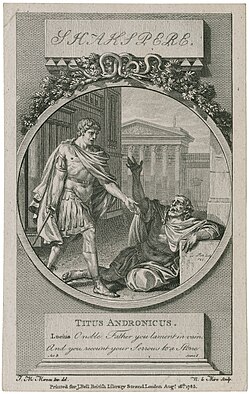
Challenging the Roman Narrative
Not all characters accept the premise that Rome is inherently civilised. When Titus refuses to spare the life of Alarbus, Tamora and her sons, Chiron and Demetrius, challenge this notion. Demetrius explicitly warns against opposing Scythia to an "ambitious Rome," suggesting that Roman ambition is its own form of savagery.
Aaron takes this critique further, viewing Roman civility as a foolish facade. He mocks the Roman tendency to keep oaths, comparing it to an idiot who treats a bauble as a god. By the end of the play, Aaron openly glorifies his embrace of barbarism, repenting only for any good deeds he may have performed.
The Ambiguity of the Goths
The play's conclusion complicates the distinction between the "civilised" Romans and "barbarous" Goths. The Romans eventually ally with the Goths, leading critics to debate the nature of these outsiders.
- Jonathan Bate suggests a distinction between "evil" Goths (led by Tamora) and "good" Goths (who follow Lucius). He argues that the later Goths share a language of honour and valour with Lucius, serving as a rebuke to Rome's decadence.
- Jacques Berthoud proposes an ethnic distinction, arguing that Tamora's Goths are Asiatic and "socially moronic," whereas the Goths at the end are Germanic and have assimilated a real, if unsophisticated, culture.
- Anthony Brian Taylor offers a darker reading, suggesting that the Goths' alliance with Lucius is not born of altruism, but a strategic desire for revenge against Rome.
Is Rome Truly Civilised?
A recurring question among scholars is whether the Rome depicted in the play is civilised at all. Robert Miola argues that Rome is a society that "devours its children," both figuratively through the family tomb and literally through the play's infamous bloody banquet.
The irony is most visible in Titus himself. While he maintains a veneer of civility when burying his sons, he displays unfeeling cruelty toward Tamora's son, contradicting his own claim that "sweet mercy is nobility's true badge."
The "Cultural Gloss" Theory
Markus Marti suggests that Rome's cultural achievements—its law, literature, and empire—are merely a "superstructure" or a thin layer of gloss hiding an ugly material base. He argues that because Rome was founded on murder and rape, all subsequent cultural achievements are rooted in origins that are inhuman and beastly.
The Descent into Barbarism
Jonathan Bate and Anthony Brian Taylor both argue that the play depicts Rome's actual conversion into barbarism. This is exemplified when Lucius demands the ritual killing and consumption of a Goth prisoner to appease the shadows. In this reversal, the "barbaric" Queen Tamora speaks the language of nobility, while the "civilised" Roman warriors engage in ritual slaughter.
Taylor views Lucius as a deeply flawed Roman whose readiness to commit atrocities is irreconcilable with the values he claims to uphold, making him a mirror of his father's contradictions.
Key Facts
- Central Conflict: The tension between the perceived civility of Rome and the perceived barbarism of the Goths.
- The Roman Perspective: Represented by Marcus, who views law, senate rights, and proper burial as markers of civilisation.
- The Counter-Perspective: Aaron and Tamora view Roman "civility" as either a foolish delusion or a mask for ambition.
- The Paradox: The play ends with Romans performing barbaric rituals (human sacrifice/cannibalism) while Goths exhibit traits of honour.
- Critical View: Scholars like Markus Marti argue that civilisation is a "gloss" hiding a foundation of violence.
| Character/Critic | View of Rome | View of Barbarism |
|---|---|---|
| Marcus Andronicus | The epitome of a civilised society. | Something to be avoided through virtue. |
| Aaron | A collection of idiots following foolish oaths. | A state to be embraced and glorified. |
| Jonathan Bate | A city that descends into barbarism. | Divided between "evil" and "good" Goths. |
| Markus Marti | A cultural superstructure hiding a violent base. | The true root of all human cultural achievement. |
Frequently Asked Questions
How does Marcus Andronicus define civility?
Marcus defines civility through adherence to social order, the use of peaceful plea in the senate, and the practice of virtuous rituals, such as providing proper burials for the dead.
Why does Aaron despise Roman civility?
Aaron views Roman civility as a facade. He believes those who strictly adhere to oaths and social codes are like idiots who worship baubles, seeing their "civilised" nature as a sign of weakness or foolishness.
What is the significance of the Goths at the end of the play?
The Goths' alliance with Lucius suggests a dissolution of the binary between Rome and the "barbarians." Depending on the critic, they represent either a more honest form of honour or a strategic pursuit of revenge.
Does the play suggest that civilisation is a lie?
Yes, through critics like Markus Marti, the play suggests that cultural achievements (law, language, empire) are a "gloss" used to hide a foundation of violence, rape, and murder.
How does Lucius embody the theme of barbarism?
Lucius demonstrates the transition from civility to barbarism by ordering the ritual execution and consumption of a prisoner, showing that he has adopted the very savagery he once attributed to the Goths.
What role does rhetoric play in the play's themes?
Darragh Greene argues that the mastery of rhetoric by characters like Marcus and Lucius allows them to manipulate language to shape perception, effectively redefining "civilised order" to suit their own purposes.