Three-Tier Education in England: History and Structure
While most students in England follow a two-tier system of primary and secondary education, some regions utilize three-tier education. This structural approach divides compulsory schooling into three distinct stages, allowing pupils to transition through different school types as they mature.
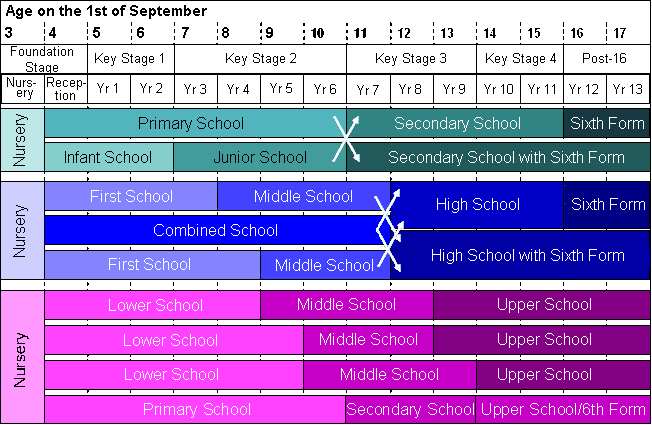
In a three-tier system, the educational journey is split as follows:
- First School (or Lower School): Caters to children up to the age of 8 or 9.
- Middle School: Caters to children from age 9 up to age 13 or 14.
- Upper School (or High School): Covers the remainder of compulsory education, sometimes extending into the sixth form.
Key Facts
- The first middle school in England opened in 1968 in the Hemsworth division of the West Riding of Yorkshire.
- Middle school numbers peaked in 1982 with over 1,400 institutions.
- By 2019, only 107 middle schools remained across 14 local authority areas.
- The 1967 Plowden Report was a pivotal document recommending the introduction of first and middle schools.
- As of 2006, Bedfordshire, Northumberland, and the Isle of Wight were the only local education authorities (LEAs) using the system exclusively.
The Evolution of the Three-Tier System
Early Concepts and Implementation
The concept of middle schools appeared in UK Government publications as early as 1856 and was mentioned in the educational reports of William Henry Hadow. However, formal implementation began much later. In 1963, the West Riding of Yorkshire first proposed a system spanning ages 5–9, 9–13, and 13–18.
The Education Act 1964 gave local authorities the legal permission to introduce these schools. This was further supported by the Plowden Report of 1967, which suggested that first and middle schools should replace the traditional infant and junior school model, recommending that middle schools specifically serve children aged 8 to 12.
Rapid Growth and Peak
Following the first opening in 1968, authority-wide systems were established in Southampton and Stoke-on-Trent by 1970. Over a thousand middle schools opened within a decade. This growth was driven by several factors, including capacity issues caused by the raising of the school leaving age to 16 in 1972 and the shift toward comprehensive education, which allowed schools to bypass the traditional Eleven-plus exam.
The Decline of Middle Schools
After peaking in 1982, the number of middle schools declined sharply. By 2017, only 121 remained. Several systemic and practical challenges contributed to this reversion to a two-tier model:
- Curriculum Alignment: The introduction of the National Curriculum created issues because students often changed schools in the middle of a Key Stage (a defined stage of the National Curriculum), which some officials argued disadvantaged the children.
- Identity and Training: Middle schools often lacked a clear identity, with the Department for Education and Science classifying them inconsistently as either primary or secondary. Additionally, there was a shortage of teachers specifically trained for the middle-school age bracket.
- Institutional Autonomy: Increased autonomy allowed upper and lower schools to expand their age ranges, absorbing the middle tier.
- Financial Incentives: In some areas, such as Northumberland, closing middle schools allowed local councils to sell buildings to fund repairs across the rest of their school estate.
Comparison of Schooling Tiers
| Feature | Three-Tier System | Two-Tier System |
|---|---|---|
| School Stages | First, Middle, Upper | Primary, Secondary |
| Middle Transition | Age 9 to 13/14 | N/A |
| Key Stage Impact | May split a Key Stage between schools | Generally aligns with Key Stages |
| Prevalence | Rare (107 schools in 2019) | Standard across most of England |
Similar Systems Globally and Privately
The three-tier concept is not exclusive to the English state sector. In Scotland, Grangemouth operated middle schools from 1974 to 1988. Internationally, Gibraltar utilizes a system of first, middle, and secondary schools.
In the private sector, some prep schools educate pupils up to age 13, and certain private secondary or public schools admit students at age 13, often utilizing the Common Entrance exam.
Frequently Asked Questions
What is the main difference between a two-tier and three-tier system?
A two-tier system consists of primary and secondary schools, whereas a three-tier system introduces a middle school between the first (lower) and upper (high) schools.
Why did the number of middle schools decrease in England?
The decline was caused by the introduction of the National Curriculum, a lack of specialized teacher training, identity confusion between primary and secondary labels, and local authority financial decisions.
What was the Plowden Report?
The Plowden Report of 1967 was a significant educational document that proposed the introduction of first and middle schools to replace infant and junior schools.
Does the UK government plan to ban the remaining middle schools?
No. In 2016, the schools minister, Nick Gibb, stated that the Government had no plans to abolish the three-tier system in areas that choose to retain it.
Which local authorities were exclusively three-tier as of 2006?
As of 2006, Bedfordshire, Northumberland, and the Isle of Wight were reported as the only LEAs exclusively using the three-tier system.