Three Gorges Dam: Engineering, Power, and Environmental Impact
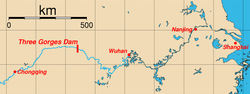
The Three Gorges Dam is a colossal gravity dam spanning the Yangtze River in the Yiling District of Hubei Province, China. As one of the most ambitious engineering projects in human history, it was designed to serve three primary purposes: flood control, hydroelectric power generation, and the improvement of river navigation. Its scale is immense, not only in physical dimensions but also in its socio-economic and environmental influence on the region.
The vision for such a structure was echoed in the poetry of Mao Zedong, who envisioned a great stone wall to catch the rains of Wushan, leading to the rise of a great lake upon the gorge.
![In his poem "Swimming" (1956), engraved on the 1954 Flood Memorial in Wuhan, Mao Zedong envisions "A Great Stone Wall, to catch the clouds and rains of Wushan as the fall" as "A Great lake shall rise upon the gorge!".[31]](/images/49/1b/491bea42ad2c3f083e3b038cac7292515d8e774f62456b55e85272fa6fea3deb.jpg)
Key Facts
- Location: Sandouping, Yiling District, Hubei, China.
- Installed Capacity: 22,500 MW.
- Dam Type: Gravity dam.
- Construction Period: Began December 14, 1994; opened in 2003.
- Total Cost: Approximately ¥203 billion (US$31.765 billion).
- Primary Purpose: Flood control, power generation, and navigation.
Composition and Dimensions
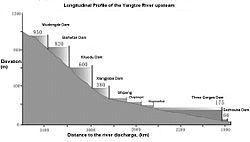
The dam is a gravity dam, a structure that relies on its own massive weight to resist the horizontal pressure of the impounded water. Standing 181 meters (594 ft) high and stretching 2,335 meters (7,661 ft) in length, the structure contains 27.2 million cubic meters of material.
The dam creates the Three Gorges Reservoir, a massive body of water with a total capacity of 39.3 cubic kilometers and a surface area of 1,084 square kilometers. At its maximum length, the reservoir extends 600 kilometers upstream.
Power Generation and Distribution
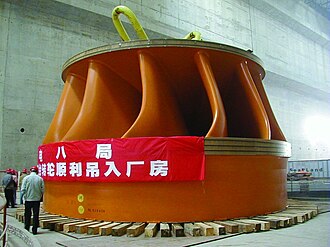
The Three Gorges Dam is a powerhouse of renewable energy. It utilizes 32 Francis turbines (each with a 700 MW capacity) and two smaller 50 MW units. A Francis turbine is a reaction turbine that combines radial and axial flow to efficiently convert water pressure into electricity.
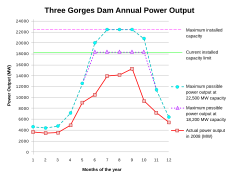
The facility has an installed capacity of 22,500 MW. While its capacity factor is approximately 45%, it remains a cornerstone of China's energy grid. In 2018, the dam generated 101.6 TWh of electricity.
Annual Electricity Production (2003–2025)
The ramp-up of power production followed the phased installation of generating units. Production peaked in 2020 at 111.8 TWh, though it has fluctuated in subsequent years based on water inflow and operational needs.
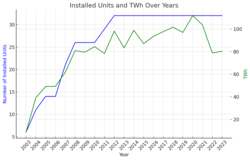
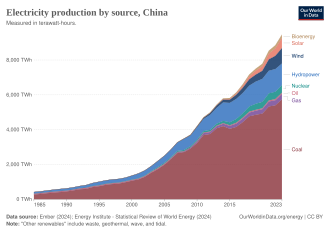
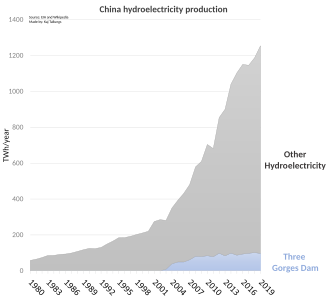
When compared to other sources of electricity in China, the Three Gorges Dam represents a significant portion of the nation's hydroelectric output, contributing roughly 100 TWh annually upon full completion.
Navigation and River Traffic
To ensure that the dam does not block the vital trade artery of the Yangtze River, a sophisticated system of locks and lifts was implemented. Ship locks act as water elevators, allowing vessels to move between the different water levels of the reservoir and the downstream river.
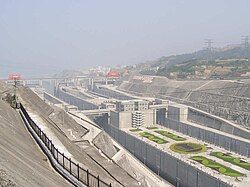
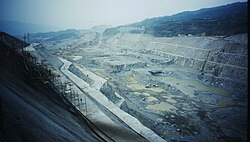
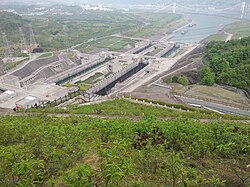
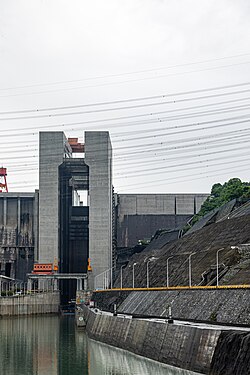
In addition to the locks, the project features a ship lift, a high-capacity elevator capable of lifting vessels up to 3,000 tonnes. This system allows ships to bypass the dam in a fraction of the time required by the staircase locks.
Environmental and Social Impact
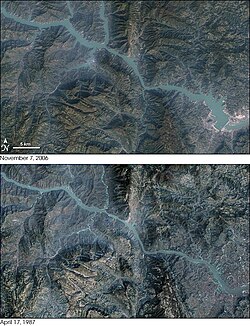
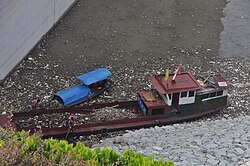
The creation of the Three Gorges Reservoir has led to significant environmental and social changes. The flooding of the valley resulted in the displacement of millions of residents and the submergence of vast areas of land.
Ecological Concerns
- Sedimentation: The dam traps silt, which can lead to erosion downstream and a loss of nutrient-rich deposits for agriculture.
- Wildlife: The alteration of the river's flow has impacted aquatic species, including the now-extinct Chinese Paddlefish.
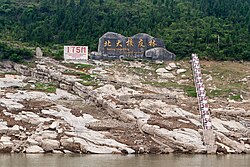
- Geological Stability: The weight of the reservoir and changes in water levels have been linked to increased seismic activity and landslides in the surrounding gorges.
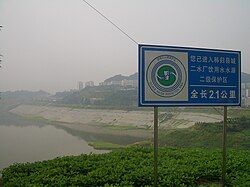
- Forest Cover: Forestation in the area dropped from 20% in the 1950s to 10% by 1997.
Flood Control and Water Management
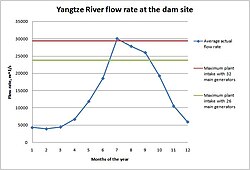
One of the primary justifications for the dam was the mitigation of the Yangtze's devastating floods. By regulating the flow of the river, the dam protects millions of people and vast tracts of farmland downstream.
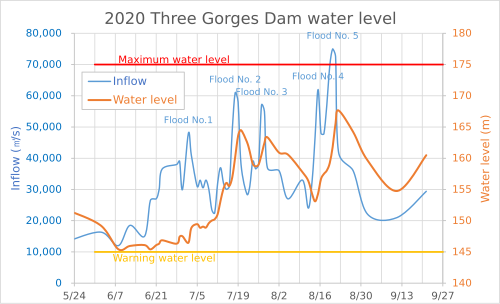
During extreme weather events, such as the 2020 China floods, the dam's ability to manage massive inflows is critical to preventing catastrophic flooding in lower reaches of the river.
Summary of Technical Specifications
| Feature | Specification |
|---|---|
| Dam Height | 181 m (594 ft) |
| Dam Length | 2,335 m (7,661 ft) |
| Installed Capacity | 22,500 MW |
| Turbine Type | Francis-type |
| Reservoir Surface Area | 1,084 km² |
| Construction Cost | ¥ 203 billion |
Frequently Asked Questions
What is the main purpose of the Three Gorges Dam?
The dam was built for three primary reasons: to control the frequent and devastating floods of the Yangtze River, to generate massive amounts of hydroelectric power, and to improve the navigability of the river for commercial shipping.
How does the dam generate electricity?
It uses the force of falling water from the reservoir to spin 32 large Francis turbines, which then drive generators to produce electricity. The total installed capacity is 22,500 MW.
How do ships get past the dam?
Ships use a system of staircase locks to move up and down the elevation change. Additionally, a massive ship lift acts as an elevator for vessels up to 3,000 tonnes, significantly speeding up the transit process.
What are the main environmental concerns associated with the dam?
Key concerns include the displacement of millions of people, the loss of biodiversity (such as the Chinese Paddlefish), increased risk of landslides and seismic activity, and the trapping of silt which affects downstream ecosystems.
When was the dam completed?
Construction began on December 14, 1994, and the dam officially opened in 2003, with the power station reaching full capacity between 2003 and 2012.