Thousand Island Park: A History of Architecture and Community
Founded in 1875 by Rev. J.F. Dayan, Thousand Island Park began as a Methodist summer community designed as a salubrious retreat for families. Modeled after the Chautauqua movement—an adult education movement focusing on lifelong learning—the Park provided a cool, beautiful environment where families could secure lots for tents or cottages. While religious purposes were a component, the primary goal was to offer a refreshing summer escape.
The Golden Era (1875–1912)
The early years of the Park were defined by a transition from a temporary "tent city" to a permanent village. At the heart of this community was the Tabernacle, located prominently at the head of the Park on St. Lawrence Ave. The Tabernacle served as the social and intellectual hub, hosting Sunday school institutes, religious studies, travel lectures, temperance rallies, and discussions on social reform.
Initially, campers leased prime lots closest to the Tabernacle to set up tents. Over time, these evolved into diminutive wood-framed cottages built on original wooden tent platforms. Some owners created "Landmark Shop" hybrids, embellishing these small structures with fanciful gingerbread trim.
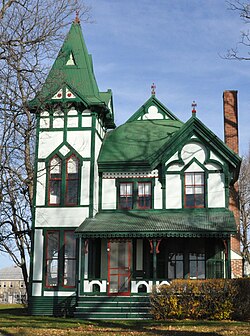
As the community grew, architectural tastes shifted toward larger, more elaborate Victorian styles. The Park became a showcase of 19th-century design, featuring Gothic Revival, Eastlake, Stick, Shingle, and Queen Anne styles. By 1890, the Park had flourished into a significant resort with nearly 600 cottages and 7,000 summer residents. During this time, policies relaxed regarding alcohol, cards, and curfews, shifting the atmosphere from a strict retreat to a more liberal resort.
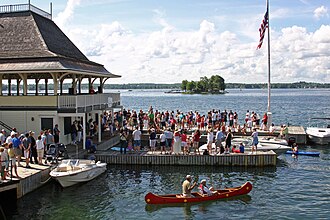
The Pavilion served as the primary gateway for visitors arriving by water, accommodating the large steamships that brought guests to Wellesley Island for entertainment and intellectual pursuits.
The Golden Era came to an abrupt end in 1912 when a devastating fire destroyed the business district, 99 cottages, and the Park's last great hotel, The Columbian.
Mid-Century Decline and Transition (1913–1974)
The aftermath of the 1912 fire, coupled with the onset of the Great Depression, led to a slow decline in regional tourism. Occupancy rates plummeted, and approximately 200 cottages were eventually demolished.
Financial instability led to the foreclosure of the Thousand Island Park Association in 1933, with the property being sold to Wellesley Island Park Inc. By 1950, the community had shrunk to 320 cottages and only 12 active businesses. In 1953, the entity was renamed the Thousand Island Park Corporation. By the 1960s and '70s, the community had transitioned into a mostly non-religious summer destination.
Historic Preservation and Modern Revival (1975–Present)
A turning point occurred in 1975 during the Centennial Celebration, which renewed appreciation for the Park's unique architectural charm. This momentum led to the formation of the Landmark Society in 1976, a group dedicated to restoring the Park's architectural integrity.
Through the efforts of the Landmark Society, Thousand Island Park was officially added to the National Register of Historic Places in 1982. Preservation efforts continued well into the 21st century.
Despite its revival, the Park faced another crisis in 2014 when a fire destroyed the community's "four corners" building, which housed the post office, the volunteer fire department, a grocery store, and several small businesses. A smaller replacement building was successfully constructed and opened in 2017.
Key Facts
- Founded: 1875 by Rev. J.F. Dayan.
- Peak Population: Approximately 7,000 summer inhabitants by 1890.
- Architectural Styles: Includes Gothic Revival, Eastlake, Stick, Shingle, Queen Anne, Bungalow/Craftsman, and Neoclassical Revival.
- Historic Status: Listed on the National Register of Historic Places in 1982.
- Major Setbacks: Devastating fires in 1912 and 2014.
| Era | Primary Character | Key Infrastructure/Events | Approx. Cottages |
|---|---|---|---|
| 1875–1912 | Golden Era / Methodist Retreat | The Tabernacle & The Pavilion | ~600 |
| 1913–1974 | Mid-Century Decline | 1912 Fire & Great Depression | ~320 (by 1950) |
| 1975–Present | Preservation & Revival | National Register Listing (1982) | Ongoing Restoration |
Frequently Asked Questions
What was the original purpose of Thousand Island Park?
It was founded as a Methodist summer community, similar to a Chautauqua, to provide families with a healthy, cool environment for summer stays, with religious activities serving as a secondary purpose.
What architectural styles can be found in the Park?
The Park features a wide array of styles, including early Gothic Tent cottages, Gothic Revival, Eastlake, Stick, Shingle, and Queen Anne. Later additions include Bungalow/Craftsman, Neoclassical Revival, and vernacular styles.
What was the role of the Tabernacle?
The Tabernacle was the center of socialization and education, hosting programs such as religious studies, travel lectures, Sunday school institutes, and discussions on social reform.
How did the Park achieve its historic preservation status?
Following the 1975 Centennial Celebration, the Landmark Society was formed in 1976. Their efforts led to the Park's nomination and eventual inclusion in the National Register of Historic Places in 1982.
What happened to the business district in 2014?
A serious fire destroyed the building at the community's four corners, which housed the post office, grocery store, and volunteer fire department. A replacement building was opened in 2017.