Thermoelectric Effects: Converting Temperature Differences into Electricity
The thermoelectric effect is a physical phenomenon that allows for the direct conversion of temperature differences into electric voltage, and vice versa. This process occurs via a thermocouple—a device consisting of two different conductive materials joined together. When a temperature gradient exists across the device, it generates a voltage; conversely, applying a voltage can force heat to move from one side to the other, creating a temperature difference.
Because the direction of heating and cooling is determined by the polarity of the applied voltage, these devices are highly effective as temperature controllers. They are widely used to generate electricity from waste heat, measure precise temperatures, or actively cool electronic components.
Key Facts
- Three Core Effects: Thermoelectricity comprises the Seebeck, Peltier, and Thomson effects.
- Reversibility: Unlike Joule heating (which is irreversible), the Peltier-Seebeck and Thomson effects are thermodynamically reversible.
- Efficiency: Most thermoelectric devices operate with efficiencies ranging from approximately 5% to 12%.
- Versatility: These effects enable the creation of solid-state refrigerators with no moving parts or circulating fluids.
The Three Pillars of Thermoelectricity
While often grouped together, the thermoelectric effect consists of three distinct physical processes. The Seebeck and Peltier effects are essentially two sides of the same coin, often referred to as the Peltier–Seebeck effect, while the Thomson effect extends this model to account for temperature variations within a single material.
The Seebeck Effect
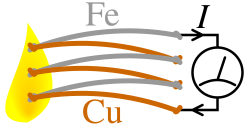
The Seebeck effect occurs when a temperature difference between two points in an electrically conducting material creates an electromotive force (EMF). This resulting voltage is known as the Seebeck EMF. The ratio between this voltage and the temperature difference is defined as the Seebeck coefficient (or thermopower).
First observed by Alessandro Volta in 1794 and later rediscovered by Thomas Johann Seebeck in 1821, this effect is the foundation of temperature sensing. In a thermocouple, the potential difference between the hot and cold ends of two dissimilar materials is proportional to the temperature difference between them.
The Peltier Effect
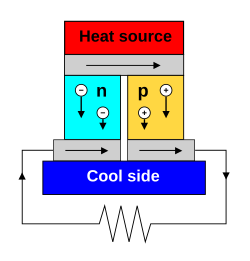
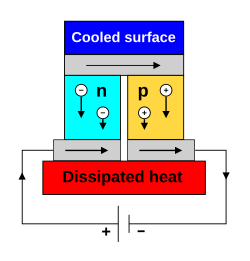
The Peltier effect is the functional opposite of the Seebeck effect. When an electric current is passed through a thermocouple, heat is absorbed at one junction and released at the other. Discovered by Jean Charles Athanase Peltier in 1834, this effect allows for the precise movement of heat using electricity.
The amount of heat generated or removed per unit time depends on the Peltier coefficients of the two conductors and the electric current. This principle is used to create thermoelectric heat pumps and compact refrigerators that lack moving parts.
The Thomson Effect
The Thomson effect, predicted and observed by Lord Kelvin (William Thomson) in 1851, describes the heating or cooling of a current-carrying conductor that possesses a temperature gradient. Unlike the Seebeck and Peltier effects, which occur at the junction of two different materials, the Thomson effect occurs within a single homogeneous conductor.
It occurs because the Seebeck coefficient of a material can vary with temperature. As electrical carriers move through a temperature gradient, they either absorb energy (increasing potential energy) or liberate heat, depending on the direction of their flow relative to the thermal gradient.
Technical Summary and Relations
Lord Kelvin established the Thomson relations in 1854, proving that these three effects are different manifestations of a single physical process. The Thomson coefficient is particularly valuable because it is the only one of the three that can be directly measured for an individual material, rather than requiring a pair of materials.
| Effect | Primary Driver | Result | Primary Application |
|---|---|---|---|
| Seebeck | Temperature Difference | Electric Voltage (EMF) | Temperature Sensors / Power Generation |
| Peltier | Electric Current | Heat Transfer (Hot/Cold Junctions) | Solid-state Cooling / Heat Pumps |
| Thomson | Current + Temp Gradient | Internal Heating/Cooling | Material Characterization |
Practical Applications
Power Generation and Sensing
Thermoelectric generators use the Seebeck effect to convert waste heat into usable electricity. Additionally, thermoelectric sorting uses a probe of known composition to measure the Seebeck coefficient of an unknown sample, helping scientists distinguish between different metals and alloys.
Active Cooling and Climate Control
Peltier cells are used in specialized refrigerators and dehumidifiers. Because they have no circulating fluids or moving parts, they are ideal for compact applications where reliability and size are more critical than high energy efficiency.
Frequently Asked Questions
What is the difference between the Seebeck and Peltier effects?
The Seebeck effect converts a temperature difference into electricity, while the Peltier effect uses electricity to create a temperature difference.
Is Joule heating a thermoelectric effect?
No. Joule heating is the heat generated by current passing through any conductor. Unlike the Peltier-Seebeck and Thomson effects, Joule heating is not thermodynamically reversible.
How efficient are thermoelectric devices?
They generally have low efficiency, typically operating between 5% and 12%, depending on the materials and environment.
What is a thermocouple?
A thermocouple is a device made of two dissimilar conductive materials joined at one end, used to measure temperature by detecting the voltage generated by the Seebeck effect.
Why is the Thomson coefficient important?
The Thomson coefficient is the only thermoelectric coefficient that can be measured for a single material. This allows researchers to calculate the absolute Seebeck and Peltier coefficients for that material.