Thermal Radiation: The Science of Heat and Light
Thermal radiation is a fundamental mechanism of heat transfer, occurring when electromagnetic radiation is emitted due to the thermal motion of particles within matter. Unlike conduction or convection, which require a medium to transfer energy, thermal radiation can travel through a vacuum. Every object with a temperature above absolute zero emits this energy, driven by a combination of electronic, molecular, and lattice oscillations.
At room temperature, most of this emission falls within the infrared (IR) spectrum, which is invisible to the human eye. However, as an object heats up, its emission shifts. Once a material reaches approximately 525 °C (977 °F), it begins to emit enough visible light to glow—a phenomenon known as incandescence.

The relationship between temperature and light is a cornerstone of modern physics. For instance, the Sun transfers heat to Earth primarily through thermal radiation. While much of this energy is absorbed or scattered by our atmosphere—a process that makes the sky appear blue—a significant portion reaches the surface to drive life and climate.
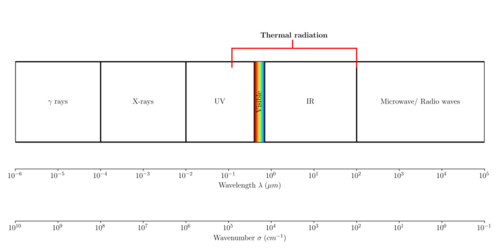
Key Facts
- All matter above absolute zero emits thermal radiation.
- The Draper point (525 °C / 977 °F) is the temperature at which objects begin to glow visibly.
- Thermal radiation is one of the three primary methods of heat transfer, alongside conduction and convection.
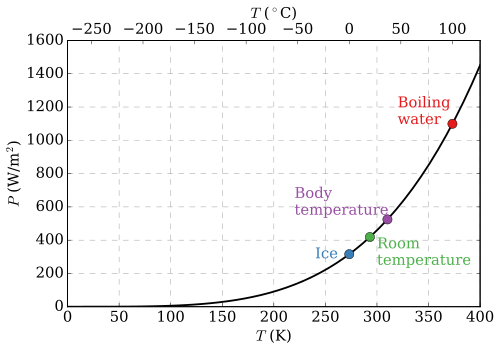
- The total intensity of radiation increases as the fourth power of the absolute temperature (Stefan–Boltzmann law).
- Human skin has an emissivity very close to 1.0, meaning it is a highly efficient radiator of infrared energy.
The Physics of Blackbody Radiation
To understand how radiation works, scientists use the concept of a blackbody—an idealized object that absorbs all incoming radiation and emits energy based solely on its temperature. The distribution of this power is described by Planck's law.
Two critical laws govern how this radiation behaves:
- Wien's displacement law: This states that the peak wavelength of emitted radiation is inversely proportional to the absolute temperature. As an object gets hotter, the peak wavelength shifts toward shorter, more energetic wavelengths (like visible light).
- Stefan–Boltzmann law: This describes how the total power emitted by a blackbody increases rapidly with temperature. For example, doubling the absolute temperature of an object increases its radiated power by 16 times.
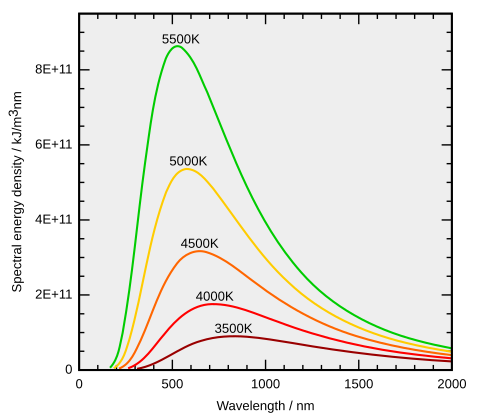
The history of these discoveries spans centuries, from ancient Greek mentions of "burning glasses" to the revolutionary quantum theories of Max Planck in 1901.

Mathematical Foundations
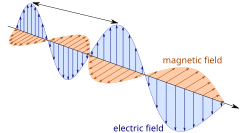
The behavior of electromagnetic waves involves perpendicular electric and magnetic components, as illustrated below:
| Symbol | Constant Name | Value (SI Units) |
|---|---|---|
| h | Planck constant | 6.626 069 3(11)×10⁻³⁴ J·s |
| c | Speed of light | 299 792 458 m/s |
| k | Boltzmann constant | 1.380 650 5(24)×10⁻²³ J/K |
| σ | Stefan–Boltzmann constant | 5.670 373 (21)×10⁻⁸ W·m⁻²·K⁻⁴ |
| b | Wien's displacement constant | 2.897 768 5(51)×10⁻³ m·K |
Thermal Radiation in the Real World
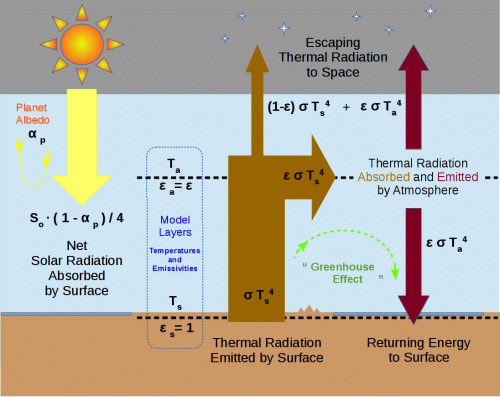
Thermal radiation affects everything from planetary climates to human safety. In the context of Earth, the atmosphere is partly transparent to visible light but largely opaque to the lower-frequency infrared radiation emitted by the Earth's surface. This selectivity is responsible for the greenhouse effect, which is vital for climate stability but also drives global warming when atmospheric composition changes.
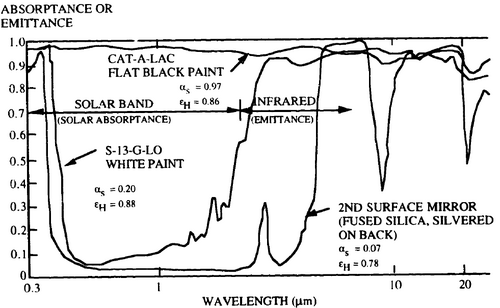
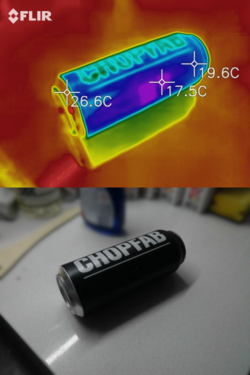
In industrial and domestic settings, emissivity—the efficiency with which a surface emits radiation—plays a major role. Different materials, such as paints or mirrors, respond differently to infrared light, which can be seen when imaging objects with thermal cameras.
Human Thermal Regulation and Safety
Humans are significant radiators of infrared energy. A person with a surface area of roughly 2 m² at a temperature of 307 K continuously radiates approximately 1000 W. In an indoor environment, much of this is regained by absorbing radiation from surrounding walls, resulting in a net loss.
Understanding radiant flux is also critical for safety. High levels of radiation can cause rapid injury. For instance, a radiant flux of 16 kW/m² can cause second-degree burns on human skin in just 5 seconds.

Frequently Asked Questions
What is the difference between incandescence and thermal radiation?
Thermal radiation is the broad term for all electromagnetic energy emitted due to heat. Incandescence is a specific subset of thermal radiation where the temperature is high enough that the emitted light enters the visible spectrum, causing the object to glow.
Why can't we see thermal radiation at room temperature?
At room temperature, the peak wavelength of thermal radiation is in the infrared part of the electromagnetic spectrum. Human eyes are only evolved to detect a specific range of visible wavelengths, leaving infrared radiation invisible to us.
How does temperature affect the color of a glowing object?
According to Wien's displacement law, as temperature increases, the peak wavelength shifts toward the blue end of the spectrum. This is why objects transition from a faint red glow to bright orange, yellow, and eventually white as they get hotter.
What is a blackbody?
A blackbody is a theoretical, idealized object that absorbs all incident electromagnetic radiation and is a perfect, diffuse emitter. It serves as a standard in physics for studying how energy is distributed across different frequencies at a given temperature.
How does the greenhouse effect relate to thermal radiation?
The greenhouse effect occurs because certain atmospheric gases are transparent to incoming short-wave solar radiation but absorb the long-wave infrared radiation emitted by the Earth's surface. This trapped energy warms the planet.