Thelarche: The Process of Early Breast Development in Puberty
Thelarche, commonly referred to as breast budding, marks the onset of secondary breast development. For most females, this process represents the first visible sign of pubertal development, signaling the transition from childhood to adolescence. While the initial growth of breast tissue actually begins during fetal development, thelarche is the stage where male and female breasts begin to differentiate due to shifting hormone levels.
While primarily associated with female puberty, some males may experience breast development, a condition known as gynecomastia.
Key Facts
- Thelarche typically occurs between the ages of 8 and 13.
- It is usually the first sign of puberty in females, though it may occasionally follow pubarche (the growth of pubic hair).
- Menarche (the first menstrual period) generally occurs about two years after thelarche begins.
- Breast development is measured by shape and progression using the Tanner scale, not by overall size.
- Estrogen and progesterone, produced by the ovaries, are the primary hormones driving these changes.
The Timeline of Development
The timing of thelarche varies significantly between individuals. While the standard window is between 8 and 13 years of age, the progression toward adult breasts typically takes between 2 and 4 years, though development can continue until age 18.
Medical professionals monitor these timelines to identify potential developmental irregularities:
- Precocious Puberty: Secondary breast development occurring before age 7 may indicate premature thelarche or precocious puberty.
- Delayed Puberty: Puberty is considered delayed if breast development has not started by age 13, or if menarche does not occur within three years of the onset of thelarche.
- Transient Thelarche: In some cases, a girl may experience initial breast development that subsequently regresses, only for normal growth to resume months or years later alongside other pubertal changes.
Measuring Progress: The Tanner Scale
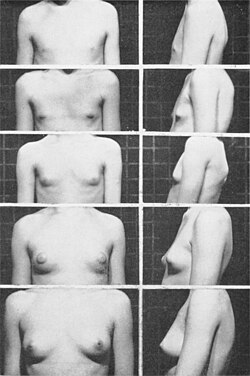
To objectively track pubertal changes, clinicians use the Tanner scale (also known as the Sexual Maturity Rating Scale). Rather than focusing on breast size, this system examines the shape of the breasts, nipples, and areolae (the pigmented area surrounding the nipple).
The scale is divided into five distinct stages:
- Stage 1: Pre-pubertal; no glandular tissue.
- Stage 2: Thelarche or breast budding.
- Stage 3: Continued breast growth and areolar development.
- Stage 4: Further growth and development of the areola.
- Stage 5: Completion of adult breast development.
The Hormonal Drivers of Growth
The physical changes associated with thelarche are the result of complex interactions between hormones produced by the ovaries. Two primary hormones drive this process:
- Estrogen: Responsible for the growth and accumulation of adipose (fat) tissue in the breasts.
- Progesterone: Drives the development of the areolae and mammary glands.
Because hormone levels can fluctuate and shift, it is common for breasts to develop asymmetrically during puberty. In many instances, this inequality in size or shape persists into adulthood.
| Feature | Details |
|---|---|
| Typical Age Range | 8 to 13 years |
| Primary Hormones | Estrogen and Progesterone |
| Assessment Tool | Tanner Scale (Stages 1-5) |
| Time to Adult Stage | 2 to 4 years (up to age 18) |
| Relation to Menarche | Usually occurs ~2 years after thelarche |
Frequently Asked Questions
What is the difference between thelarche and menarche?
Thelarche is the beginning of secondary breast development (breast budding), while menarche is the occurrence of the first menstrual period. Menarche typically follows thelarche by approximately two years.
Is it normal for breasts to grow at different rates?
Yes. Due to changes in hormone levels, breasts often develop asymmetrically during puberty, and they may remain unequal in size or shape in adulthood.
What is transient thelarche?
Transient thelarche occurs when a girl experiences initial breast development that later regresses, followed by a restart of normal breast growth and pubertal changes months or years later.
When should I be concerned about the timing of breast development?
Consult a healthcare provider if breast development begins before age 7 (potential precocious puberty) or if it has not started by age 13 (potential delayed puberty).
How does the Tanner scale determine the stage of development?
The Tanner scale does not use breast size. Instead, it evaluates the specific shape and progression of the breasts, nipples, and areolae to categorize development from stage 1 through stage 5.