The Open University: Academic Profile and Educational Framework
The Open University (OU) stands as a pioneer in distance learning, utilizing a diverse array of teaching methodologies to make higher education accessible to a global audience. From its early reliance on printed materials and BBC television broadcasts to its current status as a fully online teaching institution, the OU has consistently evolved its pedagogical approach to meet the needs of modern learners.
Originally, the university integrated written and audio materials, disc-based software, and television programs. While course-based BBC broadcasts began in 1971, they ceased in December 2006 as the university shifted toward semi-academic programming on channels like BBC Four. Today, the university has transitioned entirely to online teaching, removing all in-person tutorials.
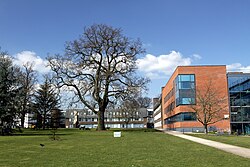
Key Facts
- Teaching Model: Fully online delivery with support from associate lecturers (tutors) and moderators.
- Flagship Qualification: The "Open" degree is the most popular qualification, with approximately 20,000 students enrolled.
- Digital Innovation: Launched FutureLearn in 2013, the UK's largest provider of free online courses.
- Open Access: Established OpenLearn in 2006 to provide free educational resources under Creative Commons licenses.
- Research Excellence: Operates the Planetary and Space Sciences Research Institute and the Open Research Online (ORO) repository.
Teaching and Learning Methodologies
The OU employs a robust support system for its students. Most modules are supported by associate lecturers who provide feedback and guidance via the internet or telephone. For shorter ten-credit courses, students utilize online conferencing services managed by moderators.
The university has a history of digital experimentation, including the use of virtual worlds in Second Life during the early 2000s and leading the way in downloads on iTunes U, surpassing 20 million downloads by 2010. Currently, the university utilizes Moodle as its Virtual Learning Environment (VLE), enhanced by custom-developed plugins.

Open Educational Resources
Through OpenLearn, the university contributes to the open educational resources movement, offering free access to course materials that educators can modify using the Creative Commons BY-NC-SA licence.
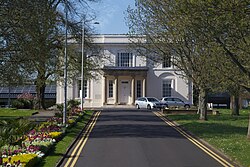
Academic Qualifications and Credits
The OU uses the Credit Accumulation and Transfer Scheme (CATS) to measure study volume. Typically, 120 credits equate to one year of full-time study. Modules are generally assigned 30 or 60 credits and are categorized by levels (1 through 4) based on complexity.
Undergraduate Degrees
Undergraduate qualifications include certificates, diplomas, and bachelor's degrees. A standard degree requires 300 credits, while an honours degree requires 360. The university offers named degrees in Arts (BA), Science (BSc), Laws (LLB), and Engineering (BEng), as well as unnamed degrees where students construct their own syllabus.
The Open degree is a multidisciplinary option allowing students to personalize their curriculum. It is the university's most popular offering, with over 236,000 alumni as of 2018.
Postgraduate and Professional Study
The OU provides a wide range of postgraduate options, including Master's degrees (MBA, MPA, MSc, MA, MEd, MRes) and doctoral programs (PhD, EdD, and a professional doctorate for healthcare workers). To bridge the gap between undergraduate and postgraduate study, the university offers "Advanced Diplomas" consisting of 60 credits at each level.
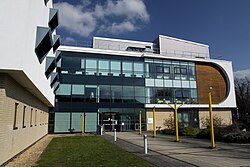
Assessment and Grading
Assessment is typically a balance of coursework and examinations. Coursework consists of Tutor-Marked Assignments (TMAs) and interactive computer-marked assignments (iCMAs). The final component is usually a three-hour invigilated exam or an End of Module Assessment (EMA) completed at home.
Grading is based on a scale from 1 (Distinction, 85%+) to 4 (Pass, 40-54%), with scores below 40% resulting in a fail. The final grade is determined by the lower of the overall continuous assessment score (OCAS) and the overall examination score (OES).
University Rankings and Research
The Open University is recognized in global rankings including the Times Higher Education (THE) and U.S. News & World Report. In 2023, it received a Gold rating in the Teaching Excellence Framework (TEF) for England.
Research is a core pillar of the institution, with over 500 researchers and 1,200 research students. A notable achievement is the work of the Planetary and Space Sciences Research Institute, specifically the Cassini-Huygens mission. Led by Professor John Zarnecki, the team built the Surface Science Package that first touched Saturn's moon, Titan.
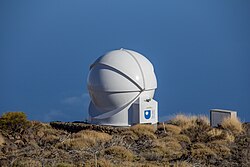
Observatories and Open Science
The university maintains a presence in Tenerife at the Observatorio del Teide, where it operates the COmpletely Autonomous Service Telescope (COAST) and the Physics Innovations Robotic Telescope Explorer (PIRATE).
Degree Ceremonies and Academic Dress
Unlike traditional UK universities, the OU's ceremonies are "Presentations of Graduates." Degrees are formally conferred in absentia during a separate meeting of the council and senate. The ceremonies themselves are celebratory events held at venues such as The Barbican Centre in London.
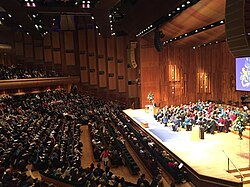
Academic dress is characterized by blue and gold colors, and notably, no headwear is worn. The specific colors of the gown and hood vary by degree level, with royal blue and gold dominating the doctoral regalia.
| Qualification | Typical Credit Requirement | Level/Description |
|---|---|---|
| Undergraduate Certificate | 120 CATS | Level 1 |
| Undergraduate Diploma | 240 CATS | Level 1 & 2 |
| Bachelor's Degree | 300 - 360 CATS | Levels 1, 2, & 3 |
| Postgraduate Certificate | 120 CATS | Master's Level |
| Postgraduate Diploma | 240 CATS | Master's Level |
Frequently Asked Questions
How long does it typically take to complete an undergraduate degree at the OU?
Because students are generally advised not to exceed 60 credits per year, a standard undergraduate degree typically takes six years to complete.
What is an "Open" degree?
An Open degree is a multidisciplinary qualification that allows students to create a personalized curriculum by choosing from a wide variety of subjects to meet their specific vocational or personal interests.
How are students assessed in their modules?
Assessment usually involves a combination of Tutor-Marked Assignments (TMAs), interactive computer-marked assignments (iCMAs), and either a final invigilated examination or an End of Module Assessment (EMA).
Does the Open University still offer face-to-face tutorials?
No, the university no longer offers in-person tutorials; all teaching is now conducted online.
What is the difference between the degree ceremony and graduation?
At the OU, graduation (the formal conferring of the degree) happens in absentia at a meeting of the council and senate. The degree ceremony is a "Presentation of Graduates" where students are presented to the Chancellor.