The Hop Milwaukee: The Evolution of the City's Modern Streetcar System
Milwaukee's relationship with the streetcar is a story of innovation, decline, and eventual rebirth. From the horse-drawn carriages of the 19th century to the sleek, modern cars of The Hop, the city has continuously navigated the balance between urban mobility and changing transportation trends.
The Rise and Fall of Early Milwaukee Streetcars
The city's transit journey began in 1860 with the opening of its first horse-drawn streetcar line. Over the following decades, the system expanded significantly, eventually evolving into a comprehensive network of electric streetcar lines that served as the backbone of city travel into the early 20th century.
However, the post-World War II era brought a shift in priorities. The federal government's heavy investment in the interstate highway system, coupled with increased taxes on private railway and streetcar operators, fueled urban sprawl and a growing dependency on private automobiles. This trend was so destructive to urban cores that philosopher and planner Lewis Mumford remarked that the Interstate Highway Act would cause more damage to American cities in a decade than the German bombing of European cities during World War II. This era of decline culminated on March 2, 1958, when Milwaukee's final streetcar route was closed.
The Path to Modernization: From Light Rail to The Hop
The modern streetcar system emerged from a complex political and financial struggle. In 1997, the region was awarded $289 million for a plan that included a light rail system, expanded bus services in Waukesha County, and improvements to Interstate 94. However, the light rail portion was blocked by Governor Tommy Thompson and other Republican leaders.
This decision led to a legal challenge led by future-alderman Robert Bauman, who argued that the ban on light rail disproportionately affected carless African American residents. The US Department of Transportation (DOT) ruled in favor of Bauman's group, resulting in a split of the funds between the City of Milwaukee and the Wisconsin DOT. Eventually, the city utilized $54 million of these funds, along with $10 million from a tax increment financing (TIF) district—a public financing method used as a stimulus for urban development—to secure a federal grant for a new streetcar system.
Funding and Approval
In 2015, the total construction cost was estimated at US$123.9 million. The Milwaukee Common Council approved the project on January 21, 2015, and upheld the decision on February 10 with a 10-5 vote. A federal grant later covered approximately half the cost of a spur extending to the lakefront.
Initial plans for the route involved a split system, with northbound travel on Van Buren Street and southbound travel on Jackson Street. To lower utility relocation costs, this split was removed in February 2016. By June 1, 2016, the city had invited bids for the first phase of construction.
Construction and the Birth of "The Hop"
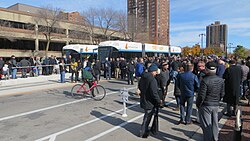
Kiewit Infrastructure, an Omaha-based contractor, was awarded the contract to build the line and carhouse on August 19, 2016. Track installation began in May 2017, and by March 2018, over 90% of the initial line was complete. To manage the system, the city signed a five-year operation and maintenance contract with Transdev in mid-2017.
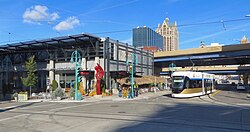
The system gained its distinctive name through a 12-year sponsorship deal with the Potawatomi Native American community. In exchange for $10 million in funding, the system was renamed "The Hop, presented by Potawatomi Hotel & Casino." This sponsorship also allowed the city to offer free service to the public for the first year of operation.
Expanding the Network: L-Line and F-Line
The expansion of the system faced several hurdles. The L-Line experienced significant delays due to construction timing at The Couture, pushing its opening back several times. It finally opened in a reduced capacity on October 29, 2023, with full daily service—including access to The Couture's transit concourse—beginning on April 11, 2024.
In June 2024, the city introduced a temporary "Festival Line" (F-Line) to coincide with Summerfest. This arrangement merged the two separate lines into one, allowing all trains to serve all stations to reduce confusion for visitors and increase access to the Lakefront stop. While originally intended to be short-term, the F-Line was extended through the summer before the Common Council voted to return to normal two-line operations in late July.
Key Facts
- First Streetcar: Milwaukee's original system began with horse-drawn cars in 1860.
- Closure: The original streetcar network completely ceased operations on March 2, 1958.
- Naming Rights: The system is named "The Hop" via a $10 million sponsorship from Potawatomi Hotel & Casino.
- L-Line Full Service: Full daily service to The Couture began on April 11, 2024.
- Funding: The project utilized a mix of federal grants, TIF funds, and corporate sponsorship.
| Feature | Details |
|---|---|
| Estimated Construction Cost (2015) | $123.9 Million |
| Primary Operator | Transdev |
| Major Lines | M-Line and L-Line |
| Sponsorship Partner | Potawatomi Hotel & Casino |
| Key Transit Hubs | The Couture, Lakefront, and Downtown Milwaukee |
Future Outlook and Challenges
Plans for further expansion include a northern extension past Fiserv Forum into Bronzeville and a southern branch from the Third Ward to Walker's Point. However, these projects have faced political hurdles; a previous attempt to bundle these extensions was scuttled due to controversy over the Walker's Point terminal location.
The city has applied for a TIGER Grant to fund 50% of the extension toward the Bronzeville neighborhood and Fiserv Forum. However, legislative challenges remain. 2023 Wisconsin Act 12 now restricts the city from using taxes or TIF districts to operate or expand The Hop. Because Milwaukee relied heavily on TIF funds for initial construction, the city must now find alternative ways to provide the local match required for future federal grants.
Frequently Asked Questions
Why is the streetcar called "The Hop"?
The system was renamed "The Hop" as part of a 12-year sponsorship and naming rights agreement with the Potawatomi Native American community, which provided $10 million in funding.
When did Milwaukee's original streetcar system end?
The last route of the original streetcar system was closed on March 2, 1958, following a national trend toward car dependency and highway expansion.
What is the L-Line and when did it open?
The L-Line is a segment of the streetcar system that connects to the lakefront. It opened in a reduced capacity on October 29, 2023, and began full daily service on April 11, 2024.
What was the "Festival Line" (F-Line)?
The F-Line was a temporary operational arrangement in the summer of 2024 that merged the M-Line and L-Line into a single route to better serve Summerfest attendees.
What are the current obstacles to expanding The Hop?
Expansion is currently hindered by 2023 Wisconsin Act 12, which prohibits the use of tax increment financing (TIF) and other taxes for the operation or expansion of the system, making it difficult to secure local matching funds for grants.