The Hand of God: Diego Maradona's Most Controversial Goal
In the annals of sporting history, few moments are as debated or as legendary as the Hand of God (Spanish: La mano de Dios). This illegal goal, scored by Argentine icon Diego Maradona during the 1986 FIFA World Cup, remains a symbol of both athletic cunning and sporting controversy. Occurring during a high-stakes quarter-final match between Argentina and England, the goal not only shifted the momentum of the game but became a cultural touchstone for national identity and revenge.
Key Facts
- Date: 22 June 1986
- Match: Argentina vs. England (Quarter-final)
- Venue: Estadio Azteca, Mexico City
- Key Figures: Diego Maradona (Argentina) and Peter Shilton (England)
- Outcome: Argentina won 2–1 and eventually won the 1986 World Cup
- Legacy: The shirt worn by Maradona during the match sold for a record £7.1 million in 2022
The Anatomy of the Goal
The incident occurred six minutes into the second half. Maradona passed the ball to teammate Jorge Valdano, but after a series of interceptions and exchanges, English midfielder Steve Hodge kicked the ball toward the English goal. Because the ball came off an opponent, Maradona was not caught offside despite his position.
As the ball dropped in the penalty box, Maradona contested it with England's goalkeeper, Peter Shilton. Despite Shilton being 20 centimeters (8 inches) taller, Maradona leaped with his left arm outstretched. His fist struck the ball, looping it over Shilton and into the net. While Maradona celebrated, the Tunisian referee, Ali Ben Nasser, initially awarded the goal. Despite protests from the English team, the linesman confirmed the decision.
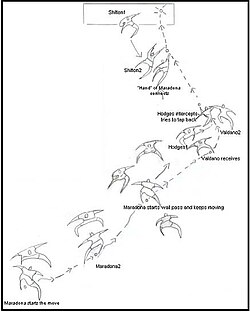
The goal gave Argentina a 1–0 lead. Just four minutes later, Maradona scored a second, legendary goal known as the Goal of the Century, leading Argentina to a 2–1 victory.
Admission and Symbolic Meaning
When first questioned about the legality of the goal, Maradona famously claimed it was scored "a little with the head of Maradona and a little with the hand of God." It was not until 2005, on the television program La Noche del 10, that he fully admitted to the handball. In his autobiography, he clarified: "What hand of God? It was the hand of Diego!"
Beyond the sport, the goal carried heavy political weight. In a 2019 documentary, Maradona described the goal as symbolic revenge for the United Kingdom's victory over Argentina in the 1982 Falklands War. This sentiment is echoed in the concept of viveza criolla (native cunning), a South American philosophy that justifies using unfair means to achieve success.
The Legacy of the Handball
The "Hand of God" has since become a global phrase used to describe similar incidents in sports. Several high-profile football handballs have since been compared to Maradona's act, including goals by Lionel Messi (2007) and Thierry Henry (2010), as well as a deliberate handball by Luis Suárez in 2010, which was dubbed "Hand of God 2.0." The phrase has even crossed into other sports, such as the NBA, and inspired the 2021 drama film The Hand of God by Paolo Sorrentino.
The physical artifacts of the match have also reached historic valuations. Maradona's match shirt, swapped with Steve Hodge in the tunnel, sold at Sotheby's in 2022 for £7.1 million. Additionally, the match ball used to score the goal was presented for auction in 2026 with an expected value of $10 million.
| Category | Details |
|---|---|
| Player | Diego Maradona |
| Opponent | England (Goalkeeper Peter Shilton) |
| Tournament | 1986 FIFA World Cup Quarter-final |
| Referee | Ali Ben Nasser (Tunisia) |
| Final Score | Argentina 2, England 1 |
| Shirt Sale Price | £7,100,000 (2022) |
Frequently Asked Questions
Why was the goal allowed if it was a handball?
The goal stood because neither the main referee, Ali Ben Nasser, nor the linesman saw Maradona use his hand to strike the ball.
What did Maradona mean by "symbolic revenge"?
Maradona linked the goal to the 1982 Falklands War, viewing the victory over England as a way to avenge the military defeat Argentina suffered against the UK.
Did Peter Shilton ever accept Maradona's apology?
No. When Maradona admitted to the handball on television in 2005, Peter Shilton rejected the apology, stating that it was too late.
What is viveza criolla?
It is a philosophy associated with South America, roughly translated as "native cunning," which suggests that the path to success is justified even if the methods used are unfair.
How much did Maradona's match shirt sell for?
The shirt sold for £7.1 million at a Sotheby's auction on May 4, 2022, setting a world record for sports memorabilia at the time.