The Great Train Robbery: The Production and Influence of a Cinematic Landmark
At the dawn of the 20th century, the film industry was a frontier of rapid experimentation. While early studios like the Edison Manufacturing Company and the Lumière company focused on actuality films—straightforward, single-shot recordings of real-life events—a new wave of filmmakers began pushing the boundaries of visual storytelling. From the surreal special effects of Georges Méliès to the narrative grammar developed by the "Brighton School" in England, the stage was set for a revolution in how stories were told on screen.
Enter Edwin S. Porter. Originally acclaimed for his technical expertise in cameras and projectors, Porter transitioned into the role of a cameraman for Edison's New York studio. In the early 1900s, the role of a cameraman encompassed both technical operation and creative control, effectively serving as what we now call film directing. Inspired by the complex works of foreign directors, Porter sought to move beyond simple sketches to create films that would draw audiences back to theaters through compelling narratives.
Key Facts
- Director: Edwin S. Porter, with creative collaboration from Max Aronson (G. M. Anderson).
- Studio: Produced by the Edison Manufacturing Company in 1903.
- Genre: An early Western that blended action, chase sequences, and narrative storytelling.
- Innovation: Used cross-cutting to suggest simultaneous action in different locations.
- Style: Exemplified the "cinema of attractions," prioritizing spectacle over deep character development.
Inspirations and Narrative Roots
Porter drew from a variety of cultural and cinematic sources to craft the scenario for The Great Train Robbery. The American West was already a popular theme in entertainment, with early films capturing cowboy life and staged anecdotes. Porter was likely influenced by Edison's 1901 film Stage Coach Hold-up, as well as real-life headlines involving the robberies of Butch Cassidy and Bill Miner.
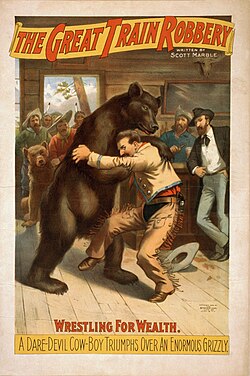
The film's title and core concept were borrowed from a popular 1896 stage melodrama by Scott Marble. The play followed a Texas gang attempting to steal a $50,000 gold shipment from a Wells Fargo office, culminating in a clash with the U.S. Marshals Service.
Cinematic Influences
Porter also looked to British "chase dramas," such as A Daring Daylight Burglary, which helped establish the narrative structure of the film. Additionally, he capitalized on the popularity of "phantom rides"—films that simulated the view from a moving train—to treat the railroad theme with more dramatic complexity than previous filmmakers.
The Filming Process
Filmed in November 1903, the production took place across New York and New Jersey. Key locations included the Delaware, Lackawanna and Western Railroad and the South Mountain Reservation in Essex County Park, where the stream-crossing scene was captured.

The cast featured Justus D. Barnes as the outlaw leader and Walter Cameron as the sheriff, while G. M. Anderson played three distinct minor roles. Interestingly, contemporary reports suggest that the Edison Company secured the use of railroad tracks and cars by agreeing to produce a separate advertising film for the railroad company. The production was so realistic that passersby reportedly mistook a dummy thrown from a locomotive for a real accident victim.
Technical Style and Legacy
While not the most sophisticated film of its era—some Brighton School films featured more advanced framing—The Great Train Robbery was a masterclass in synthesizing popular techniques. Porter utilized matte shots to combine studio and outdoor footage and employed rare camera movements to add a documentary-style immediacy to the action.
One of the most iconic moments is the final shot: a close-up of the outlaw leader firing his gun directly at the camera. This was not intended to advance the plot but to provide a visceral thrill for the audience. This approach is a hallmark of the cinema of attractions, where the primary goal was to astonish the viewer through spectacle.
| Category | Details |
|---|---|
| Release Year | 1903 |
| Key Personnel | Edwin S. Porter, G. M. Anderson |
| Primary Locations | New York, New Jersey (Essex County Park) |
| Key Innovations | Simultaneous action cutting, outdoor location filming, matte effects |
| Major Influence | Scott Marble's stage play, British chase films |
Frequently Asked Questions
Who was the primary director of The Great Train Robbery?
Edwin S. Porter was in charge of production and photography, though he collaborated creatively with Max Aronson (billed as G. M. Anderson), who may have assisted with the staging.
What is the "cinema of attractions"?
It is an early film style that prioritized visual spectacle and the thrill of the image over narrative coherency or character development, exemplified by the film's final close-up shot.
How did the film use railroad equipment?
The Edison Company reportedly traded the production of a promotional advertising film in exchange for the use of the railroad's tracks and cars.
What narrative techniques did Porter borrow from other filmmakers?
Porter adopted the use of multiple scenes and editing techniques from Georges Méliès and the Brighton School, as well as the chase structure found in British films like A Daring Daylight Burglary.
Where was the stream-crossing scene filmed?
This specific scene was filmed at Thistle Mill Ford within the South Mountain Reservation of Essex County Park.