The Great Seal of the Realm
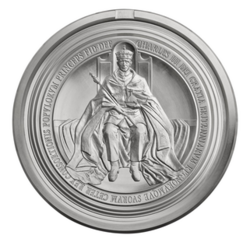
The Great Seal of the Realm is the ultimate symbol of the British sovereign's approval on state documents. In modern practice, the seal is applied based on the advice of the current government. Historically known as the Great Seal of England, it became the Great Seal of Great Britain following the Treaty of Union in 1707, and later the Great Seal of the United Kingdom after the Union of 1801.
The process of creating the seal involves softening granules of a thermoplastic—which replaced traditional wax—within a silver mould, known as a matrix. This material is then impressed into a plastic figure and attached to official documents via a cord or ribbon. The formal custody of this instrument rests with the Lord High Chancellor of Great Britain.
Key Facts
- Purpose: Symbolizes the monarch's official approval of state documents.
- Custodian: The Lord High Chancellor of Great Britain.
- Material: Modern seals use thermoplastic impressed by a silver matrix.
- Regional Seals: Separate seals exist for Scotland, Northern Ireland, and Wales.
- Recent Update: The Great Seal of King Charles III was unveiled in May 2025.
Regional Variations and the Union
While the Great Seal of the Realm serves the United Kingdom, other regional seals maintain distinct roles. Scotland has utilized its own great seal since the 14th century. Although the Acts of Union 1707 created a single seal for the Kingdom of Great Britain, the Great Seal of Scotland continued to exist and is still used by the monarch for Scottish Parliament bills.
Similarly, the Great Seal of Ireland was used from the 13th century until the secession of the Irish Free State, leading to the creation of the Great Seal of Northern Ireland. More recently, a Welsh Seal was introduced in 2011.
Historical Evolution
The tradition began before 1066 with Edward the Confessor, who used a wax casting of his own face to validate his will. Until 1603, most monarchs designed their own unique seals. During the Interregnum, the seal shifted from royal to commonwealth control. In 1654, Oliver Cromwell was escorted by the Commissioners of the Great Seal of the Commonwealth of England, whose seal featured a map of England, Ireland, Jersey, and Guernsey, alongside an image of the House of Commons.
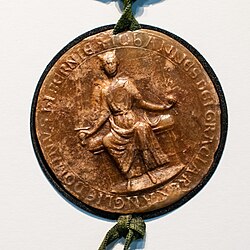
The 20th century brought significant nomenclature changes. Following the 1922 secession of the Irish Free State and the Royal and Parliamentary Titles Act 1927, the term "Great Seal of the Realm" was adopted. This broader designation ensured the seal's relevance to other Dominions of the British Commonwealth, rather than being limited to the "United Kingdom."
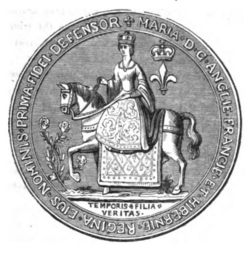
Because the silver matrices wear out over time due to the high melting point of the sealing material, long-reigning monarchs often require multiple seals. Queen Victoria, for example, used four different designs over her 63-year reign.
Design and Technical Specifications
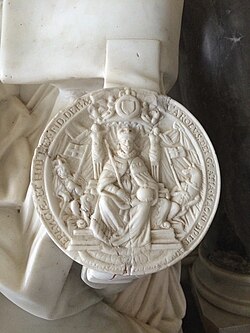
The design of the seal often reflects the monarch's image and titles. The final seal of Elizabeth II, authorized in 2001 and designed by James Butler, featured the Queen enthroned with a sceptre and orb. Its reverse side displayed the full royal arms—the first time the arms served as the primary design for one side of the British Great Seal. This matrix measured 6 inches (150 mm) in diameter and weighed over 275 troy ounces (approximately 8,600 g).
The most recent iteration, the Great Seal of Charles III, was approved by Order in Council on May 6, 2025, and unveiled shortly thereafter.
Administration and Legal Framework
The Lord Keeper of the Great Seal administers the instrument, a role that has been merged with that of the Lord Chancellor since 1761. The Constitutional Reform Act 2005 confirms the Lord Chancellor as the official custodian. Historically, the seal was returned to the Sovereign when used for documents granting gifts or emoluments to the Lord Chancellor himself.
The legal application of the seal is governed by Section 2 of the Great Seal Act 1884.
| Era/Entity | Primary Seal Name | Key Transition/Note |
|---|---|---|
| Pre-1707 | Great Seal of England | Used by monarchs since Edward the Confessor |
| 1707–1801 | Great Seal of Great Britain | Established by the Acts of Union 1707 |
| 1801–1927 | Great Seal of the United Kingdom | Following the Union of 1801 |
| 1927–Present | Great Seal of the Realm | Broadened to include Commonwealth Dominions |
| Regional | Seals of Scotland, N. Ireland, Wales | Used for specific regional legislative acts |
Frequently Asked Questions
Who is currently responsible for the Great Seal of the Realm?
The Lord Chancellor, currently David Lammy, serves as the custodian and administrator of the Great Seal.
What material is used to make the seal today?
While wax was used historically, modern seals use granules of a thermoplastic that are softened in a silver matrix.
Why do some monarchs have more than one Great Seal?
The silver plates of the matrix eventually wear out because of the high melting point of the sealing material, requiring new seals to be cast during long reigns.
Does Scotland still have its own seal?
Yes, the Great Seal of Scotland continues to be used by the monarch to sign letters patent for bills of the Scottish Parliament.
What is the significance of the 1927 name change?
The name was changed to the "Great Seal of the Realm" to avoid the narrowness of "United Kingdom," acknowledging the seal's use in relation to other British Commonwealth Dominions.