The Goon Show: The Surrealist Revolution of British Radio Comedy
Before the manic energy of Monty Python or the satirical wit of modern podcasts, there was The Goon Show. Broadcast by the BBC Home Service between 1951 and 1960, this groundbreaking program redefined British humor, replacing polished professionalism with a whirlwind of absurdity, manic surreality, and unpredictable anarchy.
What began as a modest experiment titled Crazy People quickly evolved into a cultural phenomenon. Within just 17 episodes of its debut, the show's audience skyrocketed from 370,000 to nearly two million listeners, signaling a seismic shift in the public's appetite for comedy.

Key Facts
- Original Run: May 28, 1951 – January 28, 1960.
- Core Cast: Spike Milligan, Peter Sellers, and Harry Secombe.
- Total Episodes: 238 episodes across 10 series, plus 12 specials.
- Primary Station: BBC Home Service (with repeats on the BBC Light Programme).
- Legacy: Heavily influenced the Beatles and Monty Python.
- Recording Site: The Camden Theatre, London.
The Evolution of the Show
The program's journey began in May 1951 under the title Crazy People. While no recordings of this first series are known to have survived, it laid the groundwork for what would become The Goon Show. By the second series, the BBC implemented several changes: the title was updated, musical interludes were shortened, and Max Geldray joined the musical lineup.
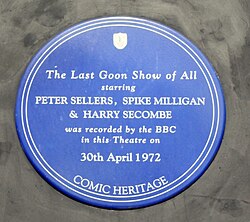
Over the next decade, the show expanded into a massive body of work. This included the Vintage Goons series—a collection of re-recordings of early episodes that had not been preserved by transcription services. The show's longevity culminated in a one-off reunion special in 1972 titled The Last Goon Show of All, which was broadcast simultaneously on BBC Radio 4 and BBC Two.
Characters and Surrealist Format
From the third series onward, the show established a recurring cast of eccentric characters. The humor relied heavily on surrealism—a style of art and comedy that seeks to release the unconscious mind by depicting illogical scenes with photographic precision.
The Principal Cast
- Harry Secombe: Best known for playing the optimistic yet hapless Neddie Seagoon.
- Spike Milligan: The creative force who voiced characters like Eccles, Minnie Bannister, and Count Jim Moriarty.
- Peter Sellers: A master of mimicry who portrayed Major Dennis Bloodnok, Bluebottle, Henry Crun, and Hercules Grytpype-Thynne.
- Michael Bentine: A key member in the early years (1951–1952) who played Prof. Osric Pureheart.
The show's impact was cemented by its catchphrases, which entered the common British vernacular. Phrases such as "He's fallen in the water!" and "You dirty, rotten swine, you! You have deaded me!" became national staples. The nonsensical phrase "Ying Tong Iddle I Po" even inspired a novelty hit song.
Production and Musical Elements
The sonic landscape of The Goon Show was as important as the scripts. The production utilized innovative sound effects and musical interludes provided by the Ray Ellington Quartet and The Stargazers. The show often opened with themes like "Lucky Strike" or "Goons' Gallop" and typically closed with "Crazy Rhythm" or "Stompin' at the Savoy."
| Category | Details |
|---|---|
| Total Series | 10 (plus Vintage Goons) |
| Primary Producers | Peter Eton, Dennis Main Wilson, Pat Dixon, Charles Chilton |
| Audio Format | Mono |
| Key Musical Acts | Ray Ellington Quartet, Max Geldray |
| Recording Studio | Camden Theatre, London |
Cultural Impact and Legacy
The influence of The Goon Show extended far beyond the radio. It is widely cited as a primary influence on Monty Python, with critics noting that Python's absurdity would not have existed without the Goons' precedent of uncontrolled anarchy.
The Beatles were also deeply affected. John Lennon recalled being 12 years old when the show first "hit" him, stating that their humor was the only proof he had that the world was insane. Lennon's own early writing for his school newspaper, The Daily Howl, mirrored the Goons' style. Furthermore, the Beatles' producer George Martin had previously worked with both Peter Sellers and Spike Milligan.
Beyond the Radio
The Goons' creativity spilled over into other media, including films like Down Among the Z Men (1952) and a puppet show called The Telegoons (1963–1964). Spike Milligan also published several books, including The Goon Show Scripts and The Goon Cartoons.
Frequently Asked Questions
What was the original name of The Goon Show?
The first series, which premiered in May 1951, was originally titled Crazy People before being renamed The Goon Show for the second series.
Who were the main stars of the program?
The core trio consisted of Spike Milligan, Peter Sellers, and Harry Secombe, with Michael Bentine appearing in the early years from 1951 to 1952.
How did the show influence the Beatles?
John Lennon credited the show's absurd humor as a major influence on his own worldview and early writing, noting that the Goons' style proved the world was "insane."
What happened to the recordings of the first series?
Unfortunately, no recordings of the first series (Crazy People) are known to have survived.
What was The Last Goon Show of All?
It was a one-off reunion episode recorded and broadcast in 1972, appearing on both BBC Radio 4 and BBC Two.