The Globe and Mail: A History of Canada's National Newspaper
For nearly two centuries, The Globe and Mail has served as a cornerstone of Canadian journalism. From its origins as a weekly political organ to its current status as a digital-first national news leader, the publication has mirrored the political and social evolution of Canada itself. Known for its influence in business and national policy, the paper has navigated mergers, ownership shifts, and the disruptive transition from print to digital media.
Predecessors and Establishment
The roots of the publication trace back to 1844, when Scottish immigrant and Father of Confederation George Brown founded The Globe. Initially established in Toronto as a weekly organ for Brown's Reform Party, the paper championed liberal politics and courted the support of the Clear Grits, a precursor to the modern Liberal Party of Canada. Brown's vision was to reach liberal-minded freeholders, and he adopted a motto from Junius regarding loyalty to the Chief Magistrate and opposition to arbitrary measures—a quote that still appears on the editorial page today.
By the 1850s, The Globe had evolved into a respected independent daily. Following Confederation, it expanded its reach via railway distribution across Ontario. At the turn of the 20th century, the paper modernized by introducing photography, a women's section, and the enduring slogan "Canada's National Newspaper."
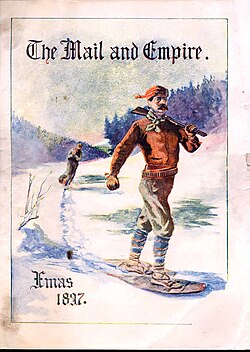
Parallel to The Globe was The Daily Mail and Empire, formed in 1895 through the merger of The Toronto Mail (est. 1872) and The Empire (est. 1887). The latter had been founded by Brown's political rival, Prime Minister John A. Macdonald. On November 23, 1936, these two rivals merged to create The Globe and Mail. The merger was orchestrated by George McCullagh on behalf of mining magnate William Henry Wright. At the time, the merger was described as "the minnow swallowing the whale," as The Globe's circulation of 78,000 was significantly smaller than The Mail and Empire's 118,000.
Evolution from the 1930s to the 1990s
From 1937 to 1974, the newspaper operated out of the William H. Wright Building at 140 King Street West. Following George McCullagh's suicide in 1952, the paper was sold to the Webster family of Montreal. To compete with The Toronto Star, the publication shifted its focus toward national circulation. In 1955, the staff became unionized under the American Newspaper Guild.
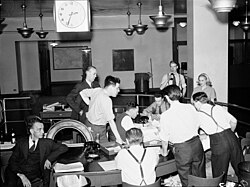
A pivotal shift occurred in 1965 when Winnipeg-based FP Publications acquired the paper. FP emphasized the Report on Business section, launched in 1962, which cemented the paper's reputation as the primary voice for Toronto's business community. In 1974, the newspaper moved to 444 Front Street West, a building previously owned by the Toronto Telegram.

In 1980, The Thomson Corporation, led by the family of Kenneth Thomson, purchased FP Publications and The Globe and Mail. Under Thomson, the paper shifted its editorial focus from regional Ontario news toward a broader national and international perspective. During the 1980s and 1990s, under editor William Thorsell, the paper endorsed free trade policies under Prime Minister Brian Mulroney and supported the Meech Lake and Charlottetown Accords. It also advocated for socially liberal causes, including gay rights and the decriminalization of certain drugs.
The Digital Era and 21st Century Transitions
The launch of the National Post in 1998 sparked a perceived "national newspaper war," leading The Globe and Mail to enter a joint venture with BCE Inc. in 2001 to form Bell Globemedia. The paper also began its digital transformation, launching globeandmail.com in 1995 and introducing original breaking news content online in 2000. By 2004, the site began implementing paid subscription models for premium features.
In 2010, the Thomson family, via the holding company Woodbridge, re-acquired an 85% stake in the paper. This era saw a massive redesign on October 1, 2010, which introduced full-color pages, glossy stock, and a heavier emphasis on lifestyle content. To better compete in Western Canada, the paper launched a distinct west-coast edition edited in Vancouver.
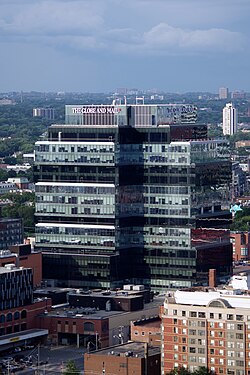
The 2010s were marked by further digital evolution and corporate restructuring. In 2012, the "Globe Unlimited" metered subscription model was launched. By 2015, Woodbridge acquired the remaining 15% stake from BCE, gaining full control. The newspaper also relocated its headquarters to the Globe and Mail Centre on King Street East in 2016.
Key Facts
- Founded: 1844 (as The Globe).
- Key Merger: Merged with The Mail and Empire on November 23, 1936.
- Ownership: Currently owned by the Woodbridge Company.
- Digital Shift: Launched website in 1995; introduced metered paywall (Globe Unlimited) in 2012.
- Headquarters: Moved to the Globe and Mail Centre in 2016.
- Distribution: Ended print distribution to Newfoundland (2013) and the Maritimes (2017).
| Period | Primary Owner/Controller | Headquarters Location |
|---|---|---|
| 1844–1936 | George Brown / Various | Toronto |
| 1936–1952 | George McCullagh / William H. Wright | 140 King Street West |
| 1952–1965 | Webster Family | 140 King Street West |
| 1965–1980 | FP Publications | 444 Front Street West (from 1974) |
| 1980–2001 | The Thomson Corporation | 444 Front Street West |
| 2001–2010 | Bell Globemedia (Joint Venture) | 444 Front Street West |
| 2010–Present | Woodbridge Company | Globe and Mail Centre (from 2016) |
Frequently Asked Questions
Who founded the original version of the newspaper?
The predecessor, The Globe, was founded in 1844 by George Brown, a Scottish immigrant and one of the Fathers of Confederation.
When did The Globe and Mail become a single entity?
The current entity was formed on November 23, 1936, through the merger of The Globe and The Mail and Empire.
What is the "Report on Business"?
Launched in 1962, the Report on Business is a specialized section that established the newspaper's reputation as the leading voice for the Toronto and Canadian business communities.
How has the newspaper's distribution changed recently?
The paper has reduced its print footprint, ending distribution to Newfoundland in 2013 and to New Brunswick, Nova Scotia, and Prince Edward Island in 2017.
Who currently owns The Globe and Mail?
The newspaper is owned by the Woodbridge Company, which acquired full control after buying the remaining 15% stake from BCE in 2015.