The Book of Murder and the Marcus Affair
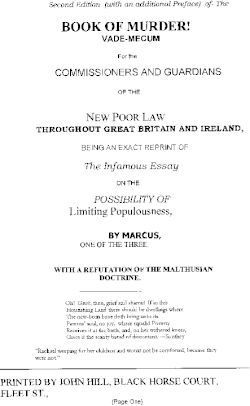
In the 1830s, a controversial piece of propaganda known as The Book of Murder—also referred to as the Marcus Affair—emerged as a powerful tool for those opposing the English Poor Laws. Published by Joshua Hobson, the work was presented as the writings of a pseudonymous author named "Marcus." Its primary goal was to incite public outrage against the Poor Law Amendment Act 1834, a piece of legislation that fundamentally changed how the state provided aid to the impoverished in England and Wales.
Before the 1834 Act, the system relied heavily on outdoor relief, which provided paupers with money or goods while allowing them to remain in their own homes. The new legislation shifted this approach toward indoor relief, leading to the construction of workhouses—institutions designed to provide basic sustenance and shelter in exchange for labor, effectively removing the poor from their communities.
The Origins of the Marcus Pamphlets
The Book of Murder was compiled from two earlier pamphlets attributed to Marcus: "An Essay of Populousness" and "On the Possibility of Limiting Populousness." These texts explored extreme methods for managing population explosions, including the use of gas and the possibility of infanticide.
Anti-Poor Law campaigners seized upon these writings, alleging that the pamphlets were actually authored by the Poor Law Commissioners. These officials were known to share population theories similar to those of Thomas Malthus, who argued that population growth would eventually outpace food production. Furthermore, the movement claimed that the government had actively suppressed original copies of the pamphlets to hide the Commissioners' true intentions.
Political Influence and the Chartist Movement
The Marcus Affair became a cornerstone for conspiracy theories within Radical and Chartist circles. The Reverend Joseph Rayner Stephens, a proponent of violent resistance against the government, was instrumental in popularizing the idea of a conspiracy against the poor. Between his arrest in December 1838 and his imprisonment in 1839, Stephens traveled the country, frequently referencing the alleged plot to incite the masses.
The reach of these claims was further amplified by Feargus O'Connor, a prominent Chartist leader, who published the books in the Northern Star, a widely read newspaper of the era.
Key Facts
- Purpose: To incite opposition to the Poor Law Amendment Act 1834.
- Core Conflict: The transition from outdoor relief (home-based aid) to indoor relief (workhouses).
- Pseudonym: The works were attributed to a mysterious figure named "Marcus."
- Controversial Content: The original pamphlets discussed population control via gas and infanticide.
- Key Figures: Published by Joshua Hobson and promoted by Feargus O'Connor and Joseph Rayner Stephens.
| Feature | Pre-1834 System | Post-1834 System |
|---|---|---|
| Relief Type | Outdoor Relief | Indoor Relief |
| Living Situation | Recipients lived in their own homes | Recipients lived in workhouses |
| Provision | Money or goods (in kind) | Shelter and basic sustenance |
Frequently Asked Questions
What was the primary goal of The Book of Murder?
The book was a piece of propaganda designed to incite opposition to the Poor Law Amendment Act 1834 by suggesting a conspiracy against the poor.
What is the difference between outdoor and indoor relief?
Outdoor relief allowed paupers to receive financial or material aid while living in their own homes, whereas indoor relief required them to enter workhouses for sustenance and shelter.
Who was "Marcus"?
Marcus was a pseudonym used for the author of two pamphlets regarding population control; anti-Poor Law activists claimed this persona was a cover for the Poor Law Commissioners.
How did the Chartist movement use this text?
Chartist leaders like Feargus O'Connor and figures like Joseph Rayner Stephens used the pamphlets to popularize the idea of a government conspiracy to harm the impoverished.
What scientific or theoretical views influenced the controversy?
The controversy was linked to population theories similar to those of Thomas Malthus, specifically regarding the dangers of population explosions and methods of limitation.