The Argus: A History of Melbourne's Pioneering Daily Newspaper
For over a century, The Argus stood as a cornerstone of the Melbourne media landscape. From its beginnings as a provocative local sheet to becoming a global pioneer in printing technology, the newspaper mirrored the growth and volatility of Victoria's colonial and metropolitan society.
The Early Years and Founding
The newspaper was established by William Kerr, a former journalist for the Sydney Gazette who moved to Melbourne in 1839 to work on the Port Phillip Patriot. Kerr, who also served as Melbourne's town clerk between 1851 and 1856, published the first edition of The Argus on June 2, 1846.
In its infancy, the publication gained a reputation for sarcasm and scurrilous abuse. This editorial style eventually led to a series of libel lawsuits—legal actions brought against a party for publishing false statements that damage a reputation. By 1853, the financial burden of these lawsuits forced Kerr to sell the paper to Edward Wilson to avoid total ruin. Despite these early controversies, the paper grew rapidly, reaching a daily circulation of 13,000 by 1855.
Growth and Influence
A pivotal figure in the paper's success was Lauchlan Mackinnon, an enterprising pastoralist and politician who served as a proprietor from 1852 until his death in 1888. Under stable leadership, the publication expanded its reach and prestige. By 1883, editor and owner Richard Twopeny praised The Argus as the finest daily newspaper published outside of England.
The company also sought to diversify its offerings. It became a stablemate to the weekly The Australasian (renamed the Australasian Post in 1946). However, not all ventures were successful; the Evening Mail, launched in October 1881 and edited by Henry Short, ceased publication in August 1882 after failing to gain traction.
Economic Challenges and Diversification
The 20th century brought significant economic hurdles. During the Great Depression in 1933, The Argus launched the Melbourne Evening Star to compete with The Herald (of the Herald & Weekly Times). Due to poor circulation, this venture was shuttered in 1936.
From 1939 through the 1950s, the company faced severe financial losses. This decline was driven by a combination of economic turmoil, the rising cost of newsprint (the low-cost unleavened paper used for newspapers), and aggressive competition for readers within the Melbourne market.
Innovation and the Final Edition
In June 1949, the London-based Daily Mirror newspaper group acquired The Argus. This international partnership led to a historic milestone: on July 28, 1952, The Argus became the first daily newspaper in the world to publish colour photographs.
The company also expanded into broadcasting. It held interests in radio and, starting in 1956, entered the television market as part of the General Telecasters Victoria (GTV) consortium, which operated GTV-9 (now part of the Nine Network).
Despite these innovations, the print publication could not survive. On January 19, 1957, after 110 years, seven months, and 17 days of operation, the final edition of The Argus was published.
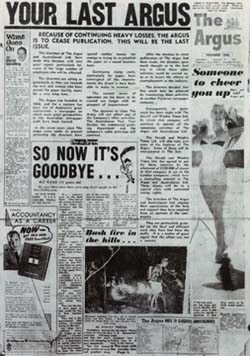
The paper was sold to the Herald and Weekly Times (HWT) group. As part of the agreement, HWT undertook to re-employ Argus staff, continue specific features, and allocate shares to the UK owners. While the newspaper ceased, the company's other broadcasting and print operations remained unaffected.
Key Facts
- Founded: June 2, 1846, by William Kerr.
- World First: First daily newspaper to publish colour photographs (July 28, 1952).
- Circulation: Reached 13,000 daily readers by 1855.
- Broadcasting: Co-founder of GTV-9 via the General Telecasters Victoria consortium.
- Closure: Final edition published on January 19, 1957.
| Year | Event | Significance |
|---|---|---|
| 1846 | First edition published | Establishment of the newspaper |
| 1853 | Sale to Edward Wilson | Ownership change following libel lawsuits |
| 1933 | Launch of Melbourne Evening Star | Attempted competition with The Herald |
| 1949 | Acquisition by Daily Mirror | Shift to London-based ownership |
| 1952 | Introduction of colour photos | Global printing milestone |
| 1957 | Final edition published | End of 110-year publication history |
Frequently Asked Questions
Why did William Kerr sell The Argus in 1853?
William Kerr was forced to sell the paper to Edward Wilson to avoid financial ruin after losing a series of libel lawsuits resulting from the paper's sarcastic and abusive editorial style.
What was the global significance of The Argus in 1952?
On July 28, 1952, The Argus became the first daily newspaper in the world to publish colour photographs.
Did The Argus have interests outside of print media?
Yes, the company had interests in radio and television, notably as part of the General Telecasters Victoria (GTV) consortium which launched GTV-9 in 1956.
What happened to the staff after the paper closed in 1957?
When the paper was sold to the Herald and Weekly Times (HWT) group, HWT undertook to re-employ the staff of The Argus.
Which other publications were associated with The Argus?
The Argus was a stablemate to the weekly The Australasian (later the Australasian Post) and briefly launched the Evening Mail (1881–1882) and the Melbourne Evening Star (1933–1936).