Tetratonic Scales in Global Music and Art
In the diverse landscape of music theory, the tetratonic scale—a musical scale consisting of four distinct pitches—serves as a fundamental building block for various cultures and compositions. While often overshadowed by the more common pentatonic (five-note) or heptatonic (seven-note) systems, tetratonic structures provide a unique melodic framework that appears across nearly every continent.
Many of these scales are anhemitonic, meaning they do not contain semitones (the smallest interval in traditional Western music), resulting in a more open, consonant sound. From the indigenous songs of the Americas to the minimalist experiments of the 20th century, the four-note scale demonstrates a universal tendency toward melodic simplicity and structural clarity.
Key Facts
- Tetratonic scales consist of exactly four distinct pitches.
- They are frequently found in Native American, Inuit, and Maori musical traditions.
- In the European Arctic, tetratonic and pentatonic scales make up 54% of the traditional Sami joik repertoire.
- Some African instruments, such as the Lobi xylophone and Gwere tongoli harp, utilize tetratonic tuning.
- In art music, Steve Reich's Reed Phase is a primary example of a work based entirely on a tetratonic scale.
Indigenous Music of the Americas
Among Native American populations, tetratonic scales were common, particularly among the Plains Indians. Tribes such as the Arapaho, Blackfoot, Crow, Omaha, Kiowa, Pawnee, and Sioux, along with Plateau tribes like the Flathead, utilized anhemitonic tetratonic and pentatonic scales. These scales are also present in the music of the Creek Indians and Great Basin groups, including the Washo, Ute, Paiute, and Shoshone.
In the Southwest, the Navajo people employed tetratonic and pentatonic scales, occasionally incorporating tritonic (three-note) scales. Further north, tetratonic music was also practiced by the Inuit, including those in Greenland.
Musical Traditions of Oceania and Asia
In Oceania, tetratonic music is prevalent throughout Polynesia and Melanesia. On Guadalcanal, anhemitonic pentatonic and tetratonic scales predominate. While the minor second occasionally appears as a melodic interval, the most frequent intervals used are the major second, minor third, perfect fourth, perfect fifth, and octave.
Among the Maori tribes, a 1969 study by ethnomusicologist Mervyn McLean found that tetratonic scales were the second-most common type, accounting for 31% of the scales surveyed. These trailed only tritonic scales (47%), while ditonic (two-note) scales made up 17%.
In India, tribal peoples such as the Juang and Bhuyan of Orissa state commonly utilized both tetratonic and tritonic scales.
African and Eurasian Distributions
Across Africa, tetratonic scales appear in various instrumental contexts. In Ghana's Lobi area, some xylophones are tuned to four notes. In eastern Uganda, the Gwere use a tetratonic scale for the tongoli (a six-string harp) featuring nearly equal intervals that resemble a chain of minor thirds to Western listeners. In South Africa, the San people use a tetratonic scale that approaches 5-equal temperament but lacks the second step.
In Russia, the Mari people (Volga-Finnic Cheremis) primarily used pentatonic scales, though tetratonic scales appeared in 20% of their music. In Western Europe, it is believed that the earliest scales of English, Scottish, German, and Scandinavian folk music were tetratonic, later evolving into pentatonic scales.
The Sami people of the European Arctic incorporate tetratonic and pentatonic scales into 54% of their traditional joik (a unique form of song), with a singing range that can extend to a tenth or eleventh. Meanwhile, in the Peloponnese region of Greece, music influenced by Christian, Albanian, and Vlach traditions employs tetratonic, pentachordal, and pentatonic scales, often enhanced by stolidia or psevtikes (microtonal ornamentation).
Tetratonicism in Art Music
While more common in folk and indigenous traditions, tetratonic structures appear in formal art music. Ludwig van Beethoven utilized a limited pitch set in the trio of the scherzo from his Hammerklavier Sonata, using only notes from the D♭ major and B♭ minor triads.
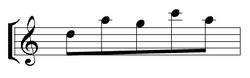
A more rigorous application is found in the early minimalist work Reed Phase (1966) by Steve Reich. The piece is based on a single five-note cell repeated throughout. However, because the note A is repeated within that cell, the work is based on only four distinct pitches, making it a purely tetratonic composition.
Summary of Scale Distribution
| Region/Culture | Scale Type/Context | Key Detail |
|---|---|---|
| Plains Indians | Anhemitonic Tetratonic | Common among Sioux, Pawnee, and others |
| Maori | Tetratonic | Used in 31% of surveyed scales |
| Sami (Arctic) | Tetratonic/Pentatonic | 54% of traditional joik repertoire |
| Gwere (Uganda) | Tetratonic | Used for the tongoli harp |
| Mari (Russia) | Tetratonic | Used in 20% of their music |
| Steve Reich | Tetratonic | Basis for the work Reed Phase |
Frequently Asked Questions
What is an anhemitonic scale?
An anhemitonic scale is a musical scale that does not contain any semitones (half-steps), which typically results in a more open sound without the tension associated with smaller intervals.
How common were tetratonic scales among the Maori?
According to a 1969 study by Mervyn McLean, tetratonic scales were the second-most common type used by Maori tribes, appearing in 31% of the scales surveyed.
Which instrument in Uganda uses a tetratonic scale?
The Gwere people of eastern Uganda use a tetratonic scale for the tongoli, which is a six-string harp.
How does Steve Reich's Reed Phase use a tetratonic scale?
Although Reed Phase is based on a five-note basic unit, the note A occurs twice within that pattern, meaning the entire composition utilizes only four distinct pitches.
Where are tetratonic scales found in European folk music?
They are found in the traditional joik of the Sami people in the European Arctic and are believed to be the precursors to the pentatonic scales found in early English, Scottish, German, and Scandinavian folk music.