Ternary Plot Derivation from Cartesian Coordinates
A ternary plot is a specialized graphical representation used to display the relative proportions of three components that sum to a constant value. While these plots appear as two-dimensional triangles, they are mathematically derived from a three-dimensional Cartesian space. By understanding the geometric transition from 3D coordinates to a 2D plane, we can see how complex compositional data is simplified into a readable format.
The Geometric Foundation
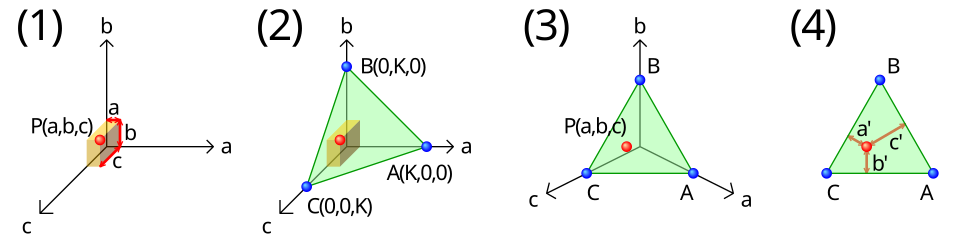
The process begins in a 3D Cartesian space with three axes: a, b, and c. Consider a point P defined by the coordinates (a, b, c). To create a ternary system, we introduce a constraint where the sum of these coordinates equals a positive constant, K (a + b + c = K).
When this constraint is applied, point P is no longer free to move anywhere in 3D space; instead, it is restricted to a flat plane. This plane intersects the axes at three specific points: A(K, 0, 0), B(0, K, 0), and C(0, 0, K). Furthermore, if we stipulate that the values of a, b, and c cannot be negative, point P is confined within the triangle formed by vertices A, B, and C.
To visualize this as a standard ternary plot, the axes are rotated to provide an isometric view—a method of representing 3D objects in 2D where the three coordinate axes appear equally foreshortened. In this view, the triangle appears equilateral.
Mathematical Derivation of Distances
To map the point P onto the 2D triangle, we calculate its perpendicular distance from the triangle's edges. Let a', b', and c' represent the distances from point P to the lines BC, AC, and AB, respectively.
The Perpendicular Distance Formula
In vector form, the perpendicular distance from a point p to a line defined by l = s + tn̂ (where n̂ is a unit vector) is calculated as:
‖ ( s − p ) − ( ( s − p ) ⋅ n ^ ) n ^ ‖
Calculating Distance a'
For the line BC, the starting point s is (0, K, 0) and the unit vector n̂ is derived from the difference between points B and C. By applying the distance formula to point P(a, b, c), the calculation proceeds as follows:
- The initial vector subtraction and dot product are performed.
- The resulting expression simplifies to the square root of a squared term and a combined term involving K, b, and c.
- By substituting the constant K = a + b + c, the formula simplifies significantly.
The final result for the distance is a' = a√(3/2). Following the same mathematical logic for the other two sides, we find that b' = b√(3/2) and c' = c√(3/2).
Key Facts
- Constraint: Ternary plots require the sum of the three variables to be a constant (a + b + c = K).
- Dimensionality: The plot is a 2D projection of a 3D Cartesian plane.
- Geometry: The resulting plot is an equilateral triangle when viewed isometrically.
- Linearity: The distance of a point from the triangle's edges is linearly proportional to the original coordinate values.
Summary of Coordinate Transformation
| Component | Cartesian Coordinate | Ternary Distance (2D) | Relationship |
|---|---|---|---|
| Variable A | a | a' = a√(3/2) | Linear Proportionality |
| Variable B | b | b' = b√(3/2) | Linear Proportionality |
| Variable C | c | c' = c√(3/2) | Linear Proportionality |
Frequently Asked Questions
What is the primary constraint for a ternary plot?
The primary constraint is that the sum of the three variables (a, b, and c) must equal a positive constant, K.
How does a 3D point become a 2D triangle?
By restricting the point to a plane where a + b + c = K and ensuring no value is negative, the point is confined to a triangle. An isometric rotation then allows this triangle to be viewed face-on as an equilateral shape.
What does the distance a' represent?
The distance a' is the perpendicular distance from point P to the line BC, which represents the boundary where the value of variable 'a' is zero.
Is the relationship between Cartesian coordinates and ternary distances linear?
Yes, the distances (a', b', c') are linearly proportional to the original values (a, b, c), specifically by a factor of √(3/2).