Teaching Profession: Global Standards, Certification, and Compensation
Education is a universal pillar of society, yet the path to becoming a teacher varies significantly across borders. While the core mission of imparting knowledge remains constant, the requirements for certification—the official process of granting a license to teach—and the professional status of educators are shaped by national laws, cultural traditions, and economic priorities.
In most nations, teachers are educated at the university or college level. Many governments mandate certification by a recognized body before an individual can enter a classroom. In some regions, elementary education certificates are earned shortly after high school via specialized tracks and student-teaching experience. To ensure student safety, many institutions, particularly in the United States, now require background checks and psychiatric evaluations, a trend that is increasingly becoming a global norm due to rising security concerns.
Key Facts
- Gender Trends: Women are overrepresented in primary and secondary teaching roles globally.
- International Schools: These typically utilize Western, English-speaking curricula tailored for expatriate communities.
- Certification: Most countries require a university degree, though specific requirements (like the 18 units of professional education in the Philippines) vary.
- Employment Status: In countries like France and Germany, teachers are primarily recruited as civil servants.
- Salary Drivers: Pay is generally determined by seniority, experience, educational qualifications, and geographic location.
Teaching Standards by Country
Australia
Education is managed by individual states and territories. Australia employs a three-tier model: primary education, secondary education, and tertiary education, which includes universities or TAFE (Technical and Further Education) colleges.
Canada
A Bachelor's degree is the minimum requirement, though most provinces require a second degree, such as a Bachelor of Education. Salaries typically range from $40,000 to $90,000 per year. Educators can choose between public schools funded by provincial governments or private schools funded by businesses and sponsors.
Europe: France, Germany, and Ireland
In France and Germany, teachers are largely civil servants. German educators are recruited through Lehramtstudien (Teaching Education Studies) and are categorized by the school level they teach, such as Grundschule (elementary) or Gymnasium (higher secondary). Salaries in Germany follow the Bundesbesoldungsordnung (civil servants' salary index scale).
In Ireland, teachers must register with the Teaching Council to receive payment from Oireachtas funds. Salaries are based on seniority and qualifications, starting at €27,814 and rising to €53,423 after 25 years. Principals of large schools can earn over €90,000. Since 2006, Garda vetting (background checks) has been mandatory for all school staff.
India
India has a rich history of the gurukula system, a teacher-disciple tradition where the guru and shishya lived together, supported by public donations without fees. While the British invasion disrupted this, the system was revived in 1886 and 1948. Today, the CENTA Standards define modern teacher competencies. Government school teachers are appointed via eligibility tests, while private schools appoint directly.
Philippines
A bachelor's degree in education is required, though other degrees are accepted if the candidate completes 18 units of professional education (10 for arts and sciences). Candidates must pass a board exam to receive a teaching license from the Professional Regulatory Commission.
United Kingdom
Education is a devolved matter, meaning England, Scotland, and Wales each maintain separate systems.
- England: State school teachers need a bachelor's degree and a license. In 2007, salaries for nursery, primary, and secondary teachers ranged from £20,133 to £41,004.
- Scotland: Teaching is an all-graduate profession. Candidates must complete Initial Teacher Education (ITE) and register with the General Teaching Council for Scotland (GTCS). Salaries for unpromoted teachers range from £20,427 (probationers) to £39,942 for those with Chartered Teacher Status.
- Wales: A distinct feature is the prevalence of Welsh-medium education; in 2008/09, 22% of primary classes used Welsh as the main medium of instruction.
United States
Licensing is determined by individual states, with certifications typically lasting between three and ten years. Most public school teachers must hold a bachelor's degree and state certification, though some charter schools follow the "highly qualified" standards of No Child Left Behind instead of full certification.
The U.S. employs roughly 1.4 million elementary, 1 million secondary, and 674,000 middle school teachers. Salaries are graduated based on experience and education. In 2004, the median salary for primary and secondary teachers was $46,000. By 2007, high school teacher medians ranged from $35,000 in South Dakota to $71,000 in New York. Some teachers supplement their income by selling lesson plans online via platforms like TeachersPayTeachers.com.
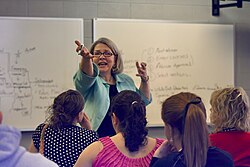
Despite these structures, a 2024 study indicates that teacher status in the U.S.—measured by prestige, satisfaction, and student interest—is at its lowest level since the 1950s.
Global Teaching Comparison Summary
| Country/Region | Primary Qualification | Employment Type | Key Feature |
|---|---|---|---|
| Canada | Bachelor's + B.Ed | Public or Private | Provincial funding for public schools |
| France/Germany | University Degree | Civil Servant | Competitive exams/Specialized studies |
| India | CENTA Standards/Tests | Private or Government | Historical Gurukula tradition |
| Ireland | Teaching Council Reg. | Registered Professional | Pay bonuses for Irish language teaching |
| Philippines | B.Ed + Board Exam | Licensed Professional | PRC issued licenses |
| United States | Bachelor's + State License | Public/Charter/Private | State-by-state certification rules |
Frequently Asked Questions
What is the gurukula system in India?
The gurukula was an ancient Indian education system based on the guru-shishya (teacher-disciple) tradition, where students lived with their teacher and education was supported by public donations rather than fees.
How does teacher certification work in the United States?
Certification is handled at the state level. Most public school teachers need a bachelor's degree and a state license, which typically lasts between three and ten years.
What are the requirements for teaching in Scotland?
Teaching in Scotland is an all-graduate profession. Candidates must complete an Initial Teacher Education (ITE) program at a Scottish university and register with the General Teaching Council for Scotland (GTCS).
How are teachers recruited in Germany and France?
In both countries, teachers are primarily recruited as civil servants. In Germany, this involves specialized university classes known as Lehramtstudien.
Do all teachers worldwide need a university degree?
While most countries require university or college education, some regions allow elementary teachers to begin their careers after high school if they follow a specific education track and complete student-teaching requirements.