Târgu Mureș Landmarks: A Journey Through Architecture and Faith
Târgu Mureș is a city where history is etched into every stone, from the imposing walls of its medieval fortifications to the intricate mosaics of its Art Nouveau palaces. The city serves as a living museum of Transylvanian heritage, reflecting a complex tapestry of religious diversity and architectural evolution over several centuries.
Key Facts
- Oldest Church: The Reformed Fortress Church dates back to the 14th century.
- Military Heritage: The City Fortress was established in 1492 by voivode Stephen Báthory.
- Literary Treasure: The Teleki-Bolyai Library houses over 200,000 volumes.
- Artistic Peak: The Palace of Culture is a prime example of the Hungarian Art Nouveau school.
- Religious Diversity: The city features significant Roman Catholic, Reformed, Unitarian, Orthodox, and Jewish places of worship.
Sacred Spaces and Places of Worship
The Reformed Fortress Church
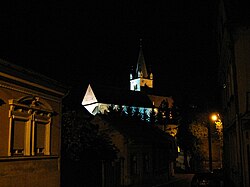
The Reformed Fortress Church stands as the oldest religious site in town. Its construction spanned a century, from the mid-14th to the mid-15th century, eventually comprising a church, steeple, monastery, and chapel. While traces of original frescos remain, most were removed after 1557 when the church transitioned to Protestant believers, whose religious reforms prohibited statues and mural paintings.
The Franciscan Legacy and the Grey Friars
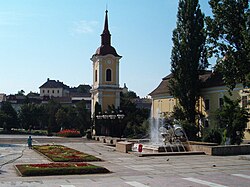
The Franciscan order's presence in the city was volatile. After being forced out in 1557 due to the rise of the Reformed Church, they returned under the Habsburgs and completed a new monastery and church by 1777. However, in 1971, the communist regime demolished the monastery to make room for the National Theater, leaving only the tower designed by architect János Topler in 1802.
Roman Catholic and Jewish Heritage
St John the Baptist Church is one of Transylvania's most representative Baroque churches. Built in the early 18th century, it features a monumental main altar created in 1755 by Anton Schuchbauer and Johannes Nachtigal, along with stained glass windows installed in 1898 by the Türke Company of Grottau.
The Great Synagogue, built between 1899 and 1900 by the "Status Quo" Jewish community, is dominated by a central cupola and floral rosettes. Designed by Gartner Jacob of Vienna, the interior is richly decorated and provides seating for 552 people across two floors.
Unitarianism and Other Faiths
The city's Unitarian history is tied to Ferenc Dávid, the founder of Unitarianism. Following the Diet of Torda (1557–1568), which granted freedom of faith in Transylvania, Unitarianism became a recognized religion. The current Unitarian Church was constructed between 1929 and 1930.
| Site Name | Denomination | Key Period/Date | Notable Feature |
|---|---|---|---|
| Fortress Church | Reformed | 14th-15th Century | Oldest church in town |
| St John the Baptist | Roman Catholic | Early 18th Century | Baroque style; monumental altar |
| Great Synagogue | Jewish (Status Quo) | 1899-1900 | Central cupola and floral rosettes |
| Unitarian Church | Unitarian | 1929-1930 | Linked to Ferenc Dávid |
| Ascension Cathedral | Orthodox | 1934 | Major Orthodox landmark |
Civic Landmarks and Cultural Treasures
The City Fortress
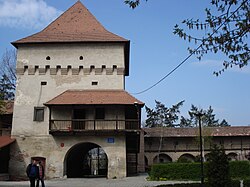
Erected in 1492 by voivode Stephen Báthory and completed between 1602 and 1652, the Citadel features a pentagon plan. It consists of seven forts, five of which were named after the guilds that maintained them: the butchers, coopers, ironmongers, tailors, and leather dressers. Today, the gate fort houses a museum detailing the history of the town.
The Teleki-Bolyai Library
Founded in 1802 by Count Sámuel Teleki, this historic public library is one of Transylvania's richest cultural collections. It houses over 200,000 volumes, including the original 40,000-volume Teleki collection and the 80,000-volume Bolyai Library, serving as a comprehensive scientific database for the region.
The Old City Hall
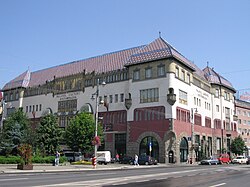
Built between 1906 and 1907 by Márcell Komor and Dezső Jakab, the Old City Hall is noted for its ribbed stellar vaults inspired by Gothic architecture. The exterior is adorned with polychromatic ceramics featuring Hungarian-Székely folk motifs.
The Palace of Culture
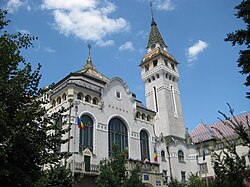
Initiated by mayor György Bernády in 1911, the Palace of Culture is a masterpiece of the Hungarian Art Nouveau school. The building is characterized by its irregular rectangular plan and rich exterior decorations, including colored mosaic panels and busts of prominent Hungarians. Much of the stained glass and mosaic work was authored by Róth Miksa, with allegorical scenes based on designs by Nagy Sándor.
Frequently Asked Questions
What is the oldest church in Târgu Mureș?
The Reformed Fortress Church is the oldest, with construction taking place between the middle of the 14th century and the middle of the 15th century.
Who founded the City Fortress?
The first fortress was erected in 1492 upon the order of voivode Stephen Báthory.
What makes the Palace of Culture architecturally significant?
It is a key example of the Hungarian Art Nouveau school in Transylvania, featuring bi-dimensional facades, colored mosaic panels, and works by artist Róth Miksa.
What is the significance of the Teleki-Bolyai Library?
Founded in 1802, it is one of the richest collections of cultural artefacts in Transylvania, housing over 200,000 volumes including rare scientific texts.
Why were the frescos in the Fortress Church removed?
The paintings disappeared because the church became the property of Protestant believers in 1557, and the religious reform of the time required churches to be free of paintings and statues.