Tapajós River: A Vital Amazonian Tributary Under Threat
The Tapajós River is one of the most significant waterways in Brazil, carving a path through the heart of the Amazon rainforest. As a major tributary of the Amazon River, it plays a critical role in the region's hydrology, accounting for approximately 6% of the total water volume in the Amazon basin. Historically celebrated for its crystal-clear waters, the river is now at the center of intense environmental and social conflicts.
Key Facts
- Total Length: Approximately 2,080 km (1,290 mi) when combined with the Juruena River.
- Basin Size: 494,253.9 km².
- Water Type: Traditionally a clearwater river, now becoming an anthropogenic whitewater river due to erosion.
- Biodiversity: Home to at least 325 known fish species, including 65 endemics.
- Major Mouth: Empties into the Amazon River at Santarém, Pará State.
Geography and Course
The Tapajós River originates at the junction of the Juruena and Teles Pires rivers. Its course primarily traverses Pará State, though its southern reaches define the border between Pará and Amazonas State. The river's journey is marked by a stark contrast in navigability: the stretch from the lower Arinos River to the Maranhão Grande falls is characterized by formidable rapids and cataracts. However, from Maranhão Grande to its mouth, the river becomes navigable for large vessels for about 303 km (188 mi).
In its final 160 km (100 mi), the river widens to between 6.4 and 14.5 km and reaches significant depths. The valley is flanked by towering bluffs, ranging from 91 to 122 meters in height, which provide a dramatic landscape leading toward the Amazon floodplain near Santarém.
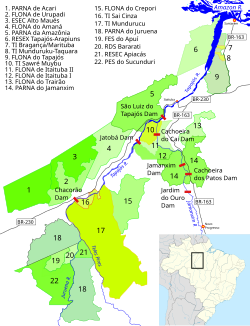
Regional Significance
The river serves as a natural boundary for several protected areas, including the eastern border of the Amazônia National Park. It also lies near the South American pole of inaccessibility, located close to Utiariti. The river takes its name from the Tapajós people, an extinct indigenous group from Santarém whose cultural legacy survives through their distinct ceramics.
Ecology and Biodiversity
The Tapajós is categorized as a clearwater river—one of only three such major rivers in the Amazon Basin. Unlike blackwater rivers, clearwater rivers have low conductivity and low dissolved solids but maintain a near-neutral pH (typically around 6.5) and a characteristic greenish transparency.
This unique chemistry supports a rich array of aquatic life. While 325 fish species have been identified, scientists believe the actual number may exceed 500. Many of these species are endemic, meaning they are found nowhere else on Earth.
![Geophagus pyrocephalus known only from the lower Tapajós basin[16]](/images/32/39/32394f0ad38566214038d72e5cd05a0dd54182149ba99461d2ac26638cfc0c07.jpg)
Environmental Crisis: Illegal Gold Mining
In recent years, the Tapajós has suffered severe degradation due to garimpeiros (illegal gold miners). Driven by rising global gold prices and a decrease in environmental enforcement, these miners use dredging barges and excavators to strip the riparian buffer and suck up stream-bed mud. This process dumps an estimated 7 million tonnes of sediment into the river annually, transforming the once "blue river" into a light brown color.
More dangerously, the process of amalgamation—using mercury to separate gold from sediment—has poisoned the ecosystem. Mercury and its more toxic derivative, methylmercury, enter the food chain through fish. This leads to mercury poisoning in local human populations, causing infertility, psychiatric disorders, and visual disturbances. The Munduruku people, whose ancestral land of Mundurukânia encompasses the Tapajós valley, have been particularly hard-hit by this contamination.
Proposed Hydroelectric Dams
The river's future is further threatened by plans for a hydroelectric complex. These projects aim to convert the Tapajós into a waterway for soybean barges traveling from Mato Grosso to Amazon ports. Proposed dams include:
- São Luiz do Tapajós Dam: Currently suspended by IBAMA due to its impact on indigenous territories, specifically the Sawré Muybu.
- Jatobá Hydroelectric Power Plant: A planned 2,338 MW facility.
- Chacorão Dam: A controversial project that would flood large portions of Munduruku Indigenous Territory.
Environmental organizations and indigenous communities view these dams as a critical threat to the river's endemic biodiversity and the survival of traditional riverine cultures.
Tapajós River Summary
| Feature | Detail |
|---|---|
| Length | 840 km (Main stem); ~2,080 km (with Juruena) |
| Basin Area | 494,253.9 km² |
| Average Discharge (Santarém) | 12,800 to 13,540 m³/s (depending on period) |
| Primary Sources | Teles Pires and Juruena Rivers |
| Water Classification | Clearwater (historically) / Anthropogenic Whitewater (currently) |
Frequently Asked Questions
What is a clearwater river?
A clearwater river is a type of Amazonian waterway characterized by low conductivity, low levels of dissolved solids, and a greenish, transparent appearance. They typically have a pH around 6.5, making them less acidic than blackwater rivers.
How does illegal gold mining affect the river's color?
Illegal miners use excavators and dredging barges to remove mud from stream beds and riparian buffers. This releases millions of tonnes of sediment into the water, changing the river's color from its natural blue/green to a light brown.
What are the health risks of mercury in the Tapajós?
Mercury used in gold amalgamation converts to methylmercury via microbes. This toxin bioaccumulates in fish, which are then consumed by humans, leading to mercury poisoning that can cause infertility, psychiatric issues, and visual impairment.
Why are the proposed dams controversial?
The dams would flood indigenous territories (such as the Munduruku and Sawré Muybu lands) and destroy the rapids and waterfalls that are essential for endemic fish species and local biodiversity.
Who were the Tapajós people?
The Tapajós were an indigenous group from the Santarém region. Although now extinct, they are remembered for their sophisticated ceramics, which were studied extensively by anthropologist Helen Palmatary in the 1930s.