Tan Guansan: A Legacy of Military Leadership and Political Diplomacy
Tan Guansan was a pivotal figure in the early history of the People's Republic of China, evolving from a grassroots peasant movement leader in Hunan province to a high-ranking military and political official. His career spanned the most turbulent decades of the 20th century, characterized by guerrilla warfare, strategic retreats, and the complex administration of frontier regions.
Early Revolutionary Career and the Long March
Tan's political journey began in 1926 when he joined both the Young Communist League and the Chinese Communist Party. He quickly rose through the ranks in southern Hunan, serving as the secretary of the Party League for the Second District of Leiyang County and representing the District Red Guard. In 1928, he participated in the southern Hunan uprising and moved to the Jinggangshan Mountains, a critical early revolutionary base, where he served as a clerk in the Red Army's quartermaster's office.
By 1929, Tan was involved in campaigns across southern Jiangxi and western Fujian. His administrative and political capabilities led to his appointment as the director of the Political Department for the 1st Red Army Corps and the director of the Inspection Corps.
In October 1934, Tan joined the Central Red Army for the Long March—the legendary strategic retreat to avoid encirclement. During this period, he held various leadership roles, including secretary of the Military Magistracy of the 1st Red Army Corps and director of the Political Office of the Fourth Brigade of the Shaanxi-Gansu Detachment. Upon arriving in northern Shaanxi, he served as the political commissar of the 242nd Regiment, participating in key engagements such as the battles of Zhiluozhen and the East March. To further his strategic knowledge, he enrolled in the Anti-Japanese Red Army University in 1936.
The War of Resistance and Civil Conflict
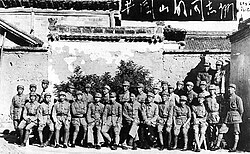
Following the outbreak of the Second Sino-Japanese War, Tan transitioned into educational and guerrilla leadership. He served as the director of the Political Department of the Anti-Japanese Military University. By 1938, he was stationed in Jizhong, where he managed the Political Department of the 3rd Column of the Eighth Route Army and served as Political Commissar of the 1st Military Sub-District.
In 1940, Tan led the Southward-Advancing Detachment in guerrilla warfare within the Ji-Lu-Yu border areas. After further training at the CPC Central Committee Party School in 1943, he returned to military leadership in the Jizhong Column and the Runan Work Committee. Between 1946 and 1949, he played a role in the battle of Handan, the battle of Lunan, and the Huaihai campaign.
By 1949, as Political Commissar of the 18th Army of the Second Field Army, Tan led his troops through the Yangtze River Crossing campaign, the Battle of Hengbao, and the Battle of Southwest China.
The Tibet Mission and Regional Governance
In January 1950, Mao Zedong sought a commander to lead the march into Tibet. Based on recommendations from Deng Xiaoping and Liu Bocheng, Tan Guansan and Zhang Guohua were selected. Together, they led the 18th Army in the Battle of Chamdo in October 1950.
This military success paved the way for the 1951 signing of the Seventeen-Point Agreement between the Tibetan authorities and the Central People's Government. By October 1951, troops were stationed in Lhasa, completing the annexation of Tibet.
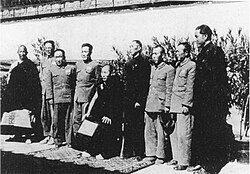
Tan's influence in the region grew as he became the political commissar of the Tibet Military Region in 1958 and established the Bayi Farm for land reclamation. During the 1959 Tibetan uprising, Tan served as the acting representative of the Central Committee. He negotiated with the Dalai Lama and ensured the safety of key figures like Ngapoi Ngawang Jigme, which was instrumental in quelling the rebellion.
In December 1959, he became the first chairman of the Tibet Autonomous Regional Committee of the Chinese People's Political Consultative Conference. When the Tibet Autonomous Region (TAR) was formally established on September 9, 1965, Tan served as the Second Secretary.
Final Years and Legal Career
In 1966, Tan transitioned from military and regional governance to the judiciary, becoming the First Vice-president of the Supreme People's Court of the People's Republic of China in Beijing. His later years were spent as an advisor to the Chengdu Military Region and as a member of the Standing Committee of the Fourth and Fifth Chinese People's Political Consultative Conference (CPPCC). He passed away on December 6, 1985, in Chengdu.
Key Facts
- Early Start: Joined the CPC and Young Communist League in 1926.
- Military Experience: Participated in the Long March and the Second Sino-Japanese War.
- Tibet Leadership: Co-led the Battle of Chamdo (1950) and served as Second Secretary of the TAR.
- Diplomatic Role: Negotiated with the Dalai Lama during the 1959 uprising.
- Judicial Service: Served as First Vice-president of the Supreme People's Court.
| Period | Primary Role/Event | Key Location |
|---|---|---|
| 1926–1928 | Peasant Movement Leader / Party Secretary | Hunan Province |
| 1934–1936 | Long March Leadership | Shaanxi-Gansu |
| 1938–1945 | Anti-Japanese Guerrilla Warfare | Jizhong / Ji-Lu-Yu |
| 1949–1951 | Political Commissar, 18th Army | Southwest China / Tibet |
| 1959–1965 | TAR Governance / Central Committee Rep | Tibet |
| 1966–1978 | First Vice-president, Supreme People's Court | Beijing |
Frequently Asked Questions
What role did Tan Guansan play in the annexation of Tibet?
Tan Guansan, as Political Commissar of the 18th Army, co-led the Battle of Chamdo in 1950 alongside Zhang Guohua. This military action led to the signing of the Seventeen-Point Agreement in 1951 and the subsequent stationing of troops in Lhasa.
How did Tan Guansan contribute to the 1959 Tibetan uprising?
Serving as the acting representative of the Central Committee, Tan negotiated with the Dalai Lama and worked to ensure the safety of Ngapoi Ngawang Jigme and others, which helped quell the rebellion.
Which major military campaigns did Tan Guansan participate in?
His extensive military career included the Long March, the Second Sino-Japanese War (specifically in the Ji-Lu-Yu border areas), the battle of Handan, the battle of Lunan, the Huaihai campaign, the Yangtze River Crossing campaign, and the Battle of Hengbao.
What was Tan Guansan's role after his military service in Tibet?
In 1966, he moved to Beijing to serve as the First Vice-president of the Supreme People's Court of the People's Republic of China, later becoming an advisor to the Chengdu Military Region.