Taiwan's Campaign for United Nations Membership
Since 1993, the Republic of China (ROC) has engaged in a persistent diplomatic effort to regain its standing within the United Nations (UN). This complex journey has evolved from seeking full membership to advocating for meaningful participation in specialized agencies, reflecting the intricate geopolitical tensions between Taiwan and the People's Republic of China (PRC).
The Early Strategy: 1993 to 2006
Beginning in 1993, the ROC explored several avenues to rejoin the UN, including applying for observer status, seeking membership in specialized agencies, or requesting the revocation of General Assembly Resolution 2758—the 1971 resolution that recognized the PRC as the only legitimate representative of China to the UN.
Between 1993 and 2006, member states submitted annual memorandums to the UN Secretary-General. This method was chosen specifically to bypass the UN Security Council, where the PRC holds a veto power that would likely block any formal membership application. Early proposals suggested a "parallel representation" model, similar to the historical UN status of East and West Germany or North and South Korea.
Over this period, the nomenclature used in these proposals shifted to reflect changing political stances, moving from "Republic of China in Taiwan" (1993–94) to simply "Taiwan" (2004–06). Despite fourteen attempts, the General Assembly's General Committee declined to put the issue on the agenda due to strong opposition from the PRC.
The 2007 Formal Application and Legal Conflict
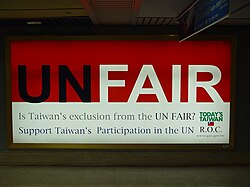
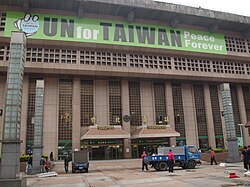
In 2007, the ROC shifted its strategy by submitting a formal application for full membership under the name "Taiwan." This move sparked significant public support, including rallies of over 300,000 people in Taiwan and 3,000 supporters in New York City, as well as backing from various Members of the European Parliament.
The application was rejected by the UN Office of Legal Affairs without being forwarded to the Security Council. Secretary-General Ban Ki-moon stated that the UN position, based on Resolution 2758, is that the PRC represents the whole of China and that Taiwan is part of China.
The ROC government countered this rejection by arguing that Resolution 2758 only transferred the UN seat and did not explicitly address the sovereignty of Taiwan or prevent its participation as an independent nation. They further criticized the UN for failing to follow standard procedural rules by returning the application without a formal vote.
Shift Toward Meaningful Participation
Following the failure of two 2008 referendums due to low voter turnout, Taiwan pivoted toward seeking "meaningful participation" in UN specialized agencies. This approach focused on functional cooperation rather than full state membership.
This strategy saw a breakthrough in May 2009, when Taiwan's Department of Health was invited to attend the 62nd World Health Assembly as an observer under the name "Chinese Taipei." This marked the first time Taiwan participated in a UN-affiliated event since 1971.
In subsequent years, the campaign continued under different administrations. In 2016, President Tsai Ing-wen requested support for inclusion in the World Health Organization (WHO), the International Civil Aviation Organization (ICAO), and the United Nations Framework Convention on Climate Change (UNFCCC). By 2018, allies such as Belize and Eswatini submitted joint letters to Secretary-General António Guterres in support of these efforts.
Key Facts
- Resolution 2758: The 1971 UN General Assembly resolution that recognized the PRC as the sole legitimate representative of China.
- Strategic Pivot: Taiwan shifted from seeking full membership to "meaningful participation" in specialized agencies after 2008.
- First Breakthrough: In 2009, Taiwan joined the World Health Assembly as an observer under the name "Chinese Taipei."
- Global Support: Countries including Palau, Guatemala, Paraguay, and Tuvalu have voiced support for Taiwan's UN inclusion.
- PRC Position: China consistently maintains that Taiwan is part of China and is therefore ineligible for UN membership.
Summary of Membership Efforts
| Period/Year | Approach | Outcome |
|---|---|---|
| 1993–2006 | Annual memorandums for participation | Declined by General Committee |
| 2007 | Formal application for full membership as "Taiwan" | Rejected by UN Office of Legal Affairs |
| 2008 | Public referendums on joining the UN | Failed due to low voter participation |
| 2009 | Request for participation in specialized agencies | Joined WHO as observer ("Chinese Taipei") |
| 2016–Present | Targeted bids for WHO, ICAO, and UNFCCC | Ongoing diplomatic advocacy |
International Perspectives
Support for Taiwan has come from various international actors. In 2011, Tuvalu's Prime Minister Willy Telavi urged the UN to recognize Taiwan's contributions to global peace and development. Similarly, Saint Lucia highlighted Taiwan as a viable economic model for small states in 2014. In 2021, U.S. Secretary of State Antony Blinken stated that Taiwan's exclusion undermines the work of the UN.
Conversely, the PRC remains steadfast in its opposition. Chinese officials have asserted that Taiwan has no right to join the UN, citing the "one-China principle." The United States has also historically shown mixed positions; while supporting "meaningful participation," it previously viewed the 2008 referendum as an alteration of the status quo.
Frequently Asked Questions
What is General Assembly Resolution 2758?
Passed in 1971, this resolution recognized the People's Republic of China as the only legitimate representative of China to the United Nations, effectively removing the Republic of China (Taiwan) from its seat.
Why did Taiwan stop applying for full membership?
After repeated rejections and the realization that the PRC could veto any application in the Security Council, Taiwan shifted its focus to "meaningful participation" in specialized agencies where the barriers to entry were lower.
What does "Chinese Taipei" mean in the UN context?
It is a compromise designation that allows Taiwan to participate in certain UN-affiliated organizations, such as the World Health Organization, without explicitly claiming statehood or sovereignty, which would be opposed by the PRC.
Which UN agencies has Taiwan sought to join?
Taiwan has specifically targeted the World Health Organization (WHO), the International Civil Aviation Organization (ICAO), and the United Nations Framework Convention on Climate Change (UNFCCC).
Does the United States support Taiwan's UN membership?
The U.S. position has been nuanced. While it has expressed support for Taiwan's "meaningful participation" in the UN system, it has at times opposed formal bids for state membership to avoid altering the diplomatic status quo.