Taejo Wang Kŏn: The Founder and Unifier of the Goryeo Dynasty
Taejo, born as Wang Kŏn (877–943), was the visionary leader and founder of the Goryeo Dynasty. Ruling from 918 to 943, he navigated the turbulent political landscape of the Later Three Kingdoms to achieve a comprehensive unification of the Korean Peninsula in 936. His reign marked the transition from a fragmented era of warring states to a centralized dynasty that would endure for nearly five centuries.
Key Facts
- Reign: July 25, 918 – July 4, 943.
- Major Achievement: Unified the Later Three Kingdoms in 936.
- Dynasty: Founded the Goryeo Dynasty, moving the capital to Gaegyeong.
- Lineage: Born into a powerful maritime merchant family of Goguryeo descent in Songak.
- Diplomacy: Welcomed refugees from Balhae while maintaining a hostile stance toward the Khitans.
Early Life and Background
Wang Kŏn was born on January 31, 877, in Songak (modern-day Kaesong) to Wang Ryung and Lady Han. He descended from a wealthy family of hojoks (local lords) who specialized in maritime trade with China. While later hagiographical accounts attempted to link his ancestry to the Tang dynasty emperors, modern historians identify his family as influential Goguryeo nobility who accumulated significant wealth and regional control over the Ryesong River area.
During the decline of the Silla kingdom, the northern regions became strongholds for Goguryeo refugees. This environment provided the foundation for Wang Kŏn's eventual rise to power.
Rise to Power under Kung Ye
Wang Kŏn began his military career serving under Kung Ye, a powerful rebel leader in the northwestern region. Recognizing Wang Kŏn's strategic brilliance and leadership, Kung Ye promoted him to general. Wang Kŏn gained widespread fame through successful campaigns, including a notable naval operation against Later Baekje at Keumsung (Naju) in 903.
Beyond his military success, Wang Kŏn became beloved by the public for his generosity and his efforts to assist those living in poverty under Silla rule, establishing a reputation for benevolence that would later support his claim to the throne.
The Founding of Goryeo
By 918, the rule of Kung Ye had become unstable. On the night of July 24, four high-ranking generals—Hong Yu, Pae Hyŏn-gyŏng, Sin Sung-gyŏm, and Pok Chigyŏm—conspired to overthrow Kung Ye and install Wang Kŏn as the new monarch. Following a successful coup, Wang Kŏn was crowned on July 25, 918, at Pojeong Hall in Cheorwon.
He renamed the kingdom Goryeo and, in 919, moved the capital to his hometown of Gaegyeong.
![Life-sized bronze statue of Taejo, constructed in 951, discovered in 1992 at Kaesong[28][29]](/images/96/00/96001e7b17221f6dfdd397bee191eea4f830ec02b09d370bf9c648e5fb96585a.png)
The War of the Later Three Kingdoms
The path to unification was fraught with conflict, primarily against Later Baekje. In 927, during the Battle of Gongsan, Taejo suffered a devastating defeat against the forces of Kyon Hwon. According to legend, General Sin Sung-gyŏm sacrificed himself by exchanging armor with the king, allowing Taejo to escape and hide in a cave on Apsan Mountain.
Despite this setback, Goryeo recovered. In 935, King Gyeongsun, the final monarch of Silla, recognized the inevitability of Goryeo's rise and surrendered his kingdom peacefully. Taejo accepted the surrender with grace, granting Gyeongsun the title of prince and integrating the Silla royal line into his own through marriage.
Final Victory and Unification
In 936, Taejo led his final campaign against Sin-gom of Later Baekje. Facing internal strife and military disadvantage, Sin-gom surrendered, effectively unifying the nation for the second time in history. Unlike the earlier unification by Silla in 668, Taejo's unification was more complete, as it integrated a wider array of peoples and territories.
Diplomacy and the Balhae Connection
Taejo viewed the fallen kingdom of Balhae as a "Relative Country" due to their shared Goguryeo roots. After the Khitans destroyed Balhae in 926, Taejo warmly welcomed the Balhae crown prince and the ruling class, granting them land and incorporating them into the Goryeo royal household.
This kinship fueled a deep animosity toward the Khitans. In 942, Taejo famously exiled Khitan envoys and allowed their gift camels to starve under a bridge as retribution for the destruction of Balhae. He explicitly warned his descendants in his "Ten Injunctions" to remain vigilant against the Khitans.
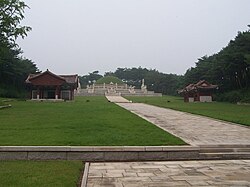
Legacy and Family
Taejo's unification created a single, unified state that persisted until 1948. His strategy of stability involved marrying the daughters of local leaders to secure loyalty across the peninsula. He had six queens and numerous consorts, fathering 25 sons and at least 10 daughters.
| Category | Details |
|---|---|
| Personal Name | Wang Kŏn (Wang Geon) |
| Reign Period | 918 – 943 CE |
| Capital | Gaegyeong (Kaesong) |
| Key Adversaries | Later Baekje, Khitans |
| Successor | Hyejong of Goryeo |
| Burial Site | Hyeolleung Royal Tomb |
Frequently Asked Questions
How did Wang Kŏn come to power?
Wang Kŏn was a successful general under the leader Kung Ye. In 918, a group of generals overthrew Kung Ye in a coup and installed Wang Kŏn as the king, who then founded the Goryeo Dynasty.
What was the significance of the Battle of Gongsan?
The Battle of Gongsan was a major defeat for Taejo against Later Baekje. It is most remembered for the sacrifice of General Sin Sung-gyŏm, who wore the king's armor to distract the enemy, allowing Taejo to escape.
How did Taejo treat the refugees from Balhae?
Taejo welcomed them warmly, viewing them as kin due to their shared Goguryeo descent. He provided them with land and included the Balhae crown prince in the Goryeo royal register.
Why did Taejo hate the Khitans?
Taejo held a strong grudge against the Khitans because they had destroyed the kingdom of Balhae. He expressed this animosity by mistreating Khitan envoys and warning his descendants to guard against them.
How did the unification of 936 differ from the unification of 668?
The unification of 668 by Silla only covered about half of the people and territory, with Balhae remaining in the north. Taejo's unification in 936 was more comprehensive, bringing the majority of the peninsula's people under a single state.