Table Tennis Racket Grips: Styles, Techniques, and Strategic Advantages
In competitive table tennis, the way a player holds their racket—the grip—fundamentally shapes their playing style, shot selection, and movement on the court. While the International Table Tennis Federation (ITTF) does not mandate a specific gripping method, most professionals gravitate toward two primary systems: the shakehand and the penhold. From these foundations, a variety of specialized variations have emerged to optimize power, spin, and agility.
Key Facts
- Shakehand is the most common grip globally, used by nearly all European players and about two-thirds of Asian players.
- Penhold grips offer superior wrist mobility (around 270°) and eliminate the "crossover point" weakness found in shakehand.
- Reverse Penhold Backhand (RPB) allows penholders to attack from the back side of the racket, overcoming traditional backhand limitations.
- Seemiller and V-Grip are specialized alternatives that offer unique blocking and spin advantages.
- Footwork requirements are generally higher for traditional penholders who rely heavily on their forehand to cover the table.
The Shakehand Grip
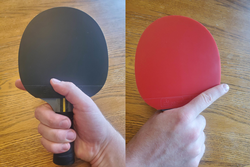
The shakehand grip is one of the oldest styles in the sport. As the name suggests, the player holds the racket as if shaking hands with it: the thumb rests on one side, the index finger on the other, and the remaining three fingers wrap around the handle. This grip provides a balanced distribution of power between forehand and backhand shots.
The primary advantage of the shakehand grip is the ability to generate extreme spin, particularly pure topspin and backspin, and to execute fast attacks from both sides. However, it introduces a "crossover point" in the middle of the body—an area of weakness where the player must quickly decide whether to use a forehand or backhand stroke.
Shakehand Variations
- Shallow Shakehand: The thumb is placed on the handle, which is preferred for loops and topspin attacks.
- Deep Shakehand: The thumb is placed directly on the rubber, allowing for greater precision and better backspin control.
Penhold Grips
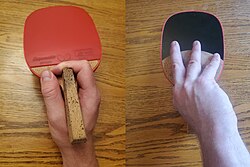
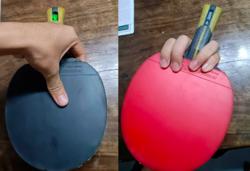
Penhold grips are inspired by traditional Asian calligraphy, where the racket is held similarly to a pen. The thumb and index finger wrap around the front of the handle, while the other three fingers rest on the back of the blade. Unlike shakehand, penhold players have no crossover point, as they can cover the center of the table with a pendulum-like forehand motion.
This grip allows for exceptional wrist mobility, making it easier to disguise spin and create hybrid shots (sidespin-topspin or sidespin-backspin). However, creating pure topspin or backspin is more difficult because the racket typically strikes the ball at a side angle.
Traditional (One-Sided) Penhold
Also known as Japanese, Korean, or Traditional Chinese Penhold, this style uses only the forehand side of the racket. Japanese and Korean rackets are often square, made of thick single-ply cypress wood with a protruding cork handle for the index finger to hook around. The backhand is performed with an underhand "windshield wiper" motion, which is excellent for blocking but lacks the mechanics for fast attacks.
Modern Chinese Penhold (Two-Sided)
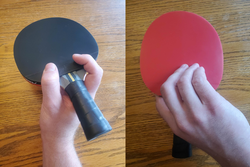
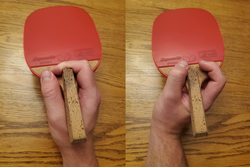
To address the backhand weakness, the Reverse Penhold Backhand (RPB) was developed. By relaxing the index finger and pressing with the thumb, players can rotate the racket to hit the ball with the underside. While this allows for aggressive looping and attacking, it puts the wrist out of alignment, slightly weakening the forehand compared to the traditional grip.
Hybrid Penhold
The hybrid style merges traditional blocking with modern RPB looping, offering the most versatility among penhold variations. Notable players like Ma Lin have utilized this approach.
Specialized and Unusual Grips
The Seemiller Grip
Developed by American champion Dan Seemiller, this grip involves hitting backhands with the same side of the racket as the forehand by turning the wrist. This eliminates the crossover point and provides excellent feel for blocking. Players often use a "combo bat" with different rubbers on each side (e.g., anti-spin on the back) to disrupt the opponent's rhythm.
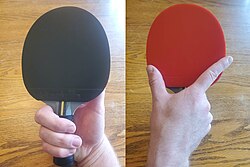
The V-Grip
An experimental Chinese style where the blade is gripped between the forefinger and middle finger in a "V" shape. This creates a longer lever for increased spin, though it has seen limited success at the highest levels. Variations include the Natural V-Grip (using a pistol-shaped handle) and Alessandro's V, which uses a modified short handle to improve both offense and defense.
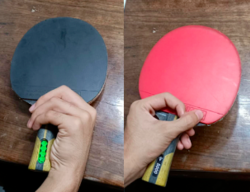
Rare Outlier Grips
- W-Grip: A penhold variant where the thumb and little finger are on the forehand side, creating a "W" shape on the back.
- The Claw: A penhold variant using the thumb on the forehand and four fingers on the back for explosive forehand attacks.
- Spider Grip: Designed for blockers, with four fingers on the forehand side and the thumb on the backhand.
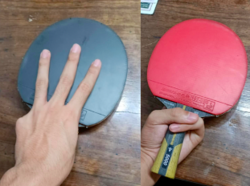
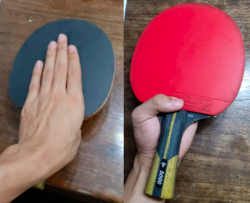
Playing Styles Based on Grip
| Style | Primary Grip | Key Characteristic | Strategic Focus |
|---|---|---|---|
| Forehand Looper | Penhold | Heavy topspin loops | Aggressive forehand coverage |
| Two-Sided Looper | Modern Chinese Penhold | RPB hybrid loops | Unpredictable backhand attacks |
| Counter Driver | Penhold | Fast blocks and drives | Pace change and positioning |
| Short Pips Hitter | Penhold | Flat, linear hits | Negating spin for maximum speed |
The Role of Equipment in Style
Players often match their rubber choice to their grip. Short pips out rubber is common among penhold hitters who prefer to hit the ball flatly. Because these shots lack the downward arc of a topspin Magnus effect (the physical phenomenon that causes a spinning ball to curve), they are faster and harder to block but more sensitive to air pressure, creating a "knuckle ball" effect.
Frequently Asked Questions
What is the main difference between shakehand and penhold?
The shakehand grip is like shaking hands with the racket, offering balanced power on both sides but having a "crossover point" weakness. The penhold grip is held like a pen, offering superior wrist mobility and no crossover point, though it traditionally has a weaker backhand.
What is the Reverse Penhold Backhand (RPB)?
RPB is a modern technique where penhold players use the underside of the racket to hit backhand shots. This allows them to loop and attack from the backhand side, solving the mechanical limitations of the traditional one-sided penhold grip.
Why is the Seemiller grip unique?
The Seemiller grip is unique because the player uses the same side of the racket for both forehand and backhand shots. This removes the crossover point and allows for highly effective blocking, often paired with a "combo bat" featuring different rubber types.
Which grip is better for beginners?
Shakehand is generally more accessible for beginners because it provides a more natural backhand attack. Traditional penhold requires significantly more athletic footwork and coordination to cover the table effectively.
How does a short pips hitter differ from a looper?
A looper uses a brushing motion to create heavy topspin, causing the ball to arc downward. A short pips hitter strikes the ball flatly to maximize linear velocity, resulting in faster shots that are less affected by the opponent's spin but harder to keep on the table.