Syrinx: The Specialized Vocal Organ of Birds
While mammals rely on the larynx to produce sound, birds possess a unique and highly specialized vocal organ known as the syrinx. Named after the Greek word for "pan pipes," the syrinx is located at the base of the trachea, where it forks into the lungs. This strategic positioning allows birds to produce a vast array of complex sounds, from simple calls to the intricate songs of songbirds and the human-like mimicry seen in parrots, crows, and mynas.
Unlike the mammalian vocal system, the syrinx produces sound through the vibration of the membrana tympaniformis (the walls of the syrinx) and the pessulus. As air flows through the organ, it creates a self-oscillating system that modulates airflow into sound. Specialized muscles then adjust the tension of these membranes and the bronchial openings to shape the resulting notes.
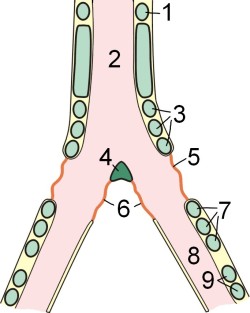
Key Facts
- Location: Situated at the tracheobronchial juncture (where the trachea splits into the lungs).
- Mechanism: Sound is generated by vibrating membranes and the pessulus, not vocal folds.
- Lateralization: Because it sits at a fork, some birds can modulate the left and right sides independently to produce two sounds simultaneously.
- Exceptions: Some species, such as New World vultures, lack a syrinx and communicate via hisses.
- Larynx Role: Birds have a larynx, but unlike mammals, it is not used for vocalization.
The Evolution of the Syrinx
The transition from a larynx-based sound source to a tracheobronchial syrinx occurred within the Dinosauria lineage, either at or before the origin of Aves. Fossil evidence, including a specimen of Vegavis iaai from the late Cretaceous, suggests that the syrinx may have been a late-arising feature in avian evolution.
Scientists debate whether the larynx lost its vocal function before the syrinx appeared—creating a "silent period"—or if the syrinx evolved to supplement the larynx before the latter's vocal capabilities vanished. One notable trend in the fossil record is the increase in mineralization at the tracheobronchial juncture, a feature likely appearing after other key adaptations like increased metabolic rates and feather ornamentation.
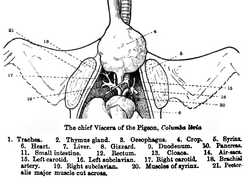
Evolutionary Causation and Structural Support
The shift to a syrinx may not have been driven by sound alone. Some researchers suggest that wall shear stress—the friction between airflow and vessel walls—created selective pressure for structural support at the tracheobronchial juncture. In continuous breathers like birds, the highest stress occurs during exhalation at this fork, potentially favoring the development of cartilage to maintain airway patency (openness).
Furthermore, the muscles of the syrinx were likely selected to ensure the airway did not collapse during non-vocal respiration. This suggests that the organ's structural and respiratory functions may have been exapted (co-opted) for vocalization later.
Vocal Efficiency and Neck Length
The position of the syrinx deeper in the respiratory tract provides a significant acoustic advantage. A longer, narrower tube increases inertance (the "sluggishness" of air), making it easier to produce sound. This efficiency is closely tied to the evolution of longer necks in birds.
Because of the unidirectional flow of the avian respiratory system, birds can have longer tracheas without sacrificing diameter. This creates an "acoustically long trachea," where the lowest resonant frequency of the syrinx is four times the length of the tube. This combination of body size and tracheal length likely made the syrinx more efficient than the ancestral larynx.
Sexual Selection and Dimorphism
Once the syrinx provided a boost in vocal efficiency, sexual selection likely drove its further diversification. Acoustic communication is vital for courtship and territorial defense. For example, wood warblers with superior trill performance often exhibit higher fitness, and polygynous birds use a wider frequency range during displays to attract mates.
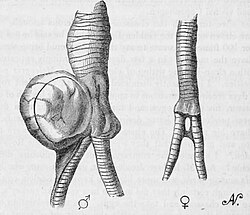
This evolutionary pressure has also led to sexual dimorphism, where the syrinx differs between males and females. In the mallard (Anas platyrhynchos), these differences are distinct and can be detected as early as 10 days in Pekin ducks, providing a biological method for sexing birds at a young age.
Syrinx Summary Table
| Feature | Avian Syrinx | Mammalian Larynx |
|---|---|---|
| Location | Base of trachea (tracheobronchial juncture) | Top of trachea |
| Sound Source | Membrana tympaniformis & pessulus | Vocal folds |
| Capabilities | Potential for dual-sound production (lateralization) | Single sound source |
| Primary Driver | Vocal efficiency, neck length, sexual selection | Upper airway protection and vocalization |
Frequently Asked Questions
Can all birds produce sound with a syrinx?
No. While most birds use a syrinx, some species, such as New World vultures, lack this organ entirely and communicate using throaty hisses.
How do some birds mimic human speech?
Species like parrots and mynas use their syrinx and associated muscles to modulate airflow and membrane tension with extreme precision, allowing them to replicate complex human speech patterns.
Why can some songbirds sing two notes at once?
Because the syrinx is located where the trachea splits into two bronchi, birds can control the muscles on the left and right sides independently, allowing for lateralized sound production.
What is the relationship between neck length and bird song?
Longer necks provide a longer tracheal tube, which increases the inertance of the air. This makes the vocal system more efficient and allows for a better overlap between the fundamental frequency and tracheal resonance.
Does the syrinx differ between male and female birds?
It depends on the species. In some birds, there is no difference, but in others, such as the mallard, the syrinx is sexually dimorphic and can be used to determine the bird's sex.