Sword Hilt Anatomy: Components, Evolution, and Design
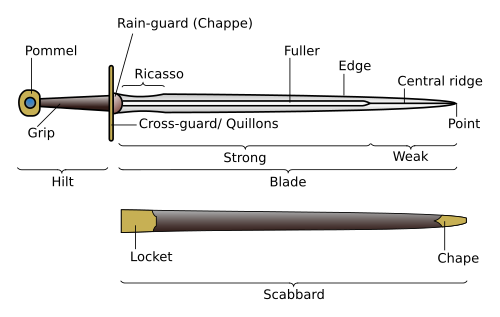
The hilt—occasionally referred to as a haft or shaft—is the handle assembly of a bladed weapon, such as a sword, dagger, knife, or bayonet. Far from being a simple handle, the hilt is a sophisticated piece of engineering comprising three primary elements: the guard, the grip, and the pommel. Together, these components ensure the weapon is balanced, secure in the hand, and capable of protecting the wielder.
While the blade does the cutting, the hilt dictates how the weapon is handled and balanced. Over centuries, these designs evolved from simple stops to elaborate protective cages, reflecting changes in armor, combat styles, and social status.
Key Facts
- The Pommel acts as a counterweight to the blade, shifting the point of balance closer to the hand for better agility.
- The Grip is typically made of wood or metal, often wrapped in durable materials like shagreen or rubber.
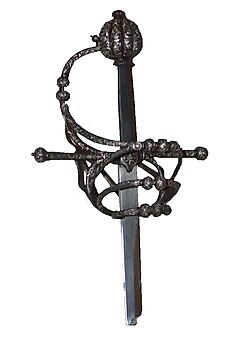
- The Guard evolved from a simple crossbar (quillon) to complex basket and cup hilts to protect the hand as shields disappeared.
- The Ricasso is the unsharpened section of the blade just above the guard, sometimes used for alternative grip positions.
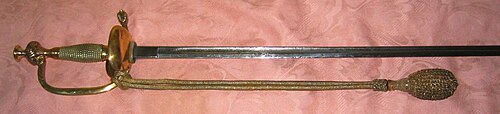
- Sword Knots serve the dual purpose of preventing the weapon from being lost and providing ornamental military distinction.
The Pommel: Balance and Utility
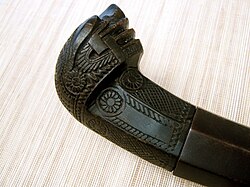
Derived from the Anglo-Norman word pomel (meaning "little apple"), the pommel is the enlarged fitting at the top of the hilt. Originally designed to prevent the sword from slipping out of the hand, pommels became heavy enough by the 11th century in Europe to serve as a critical counterweight. This balance allowed for a more fluid fighting style.
Beyond balance, the pommel could be used offensively, such as in the Mordhau technique, where the sword is held by the blade and the pommel is used to strike the opponent. Pommels vary wildly in shape—from disks and wheels to animal heads—and are often decorated with engravings, gilding, or jewels.
The Oakeshott Classification System
In 1964, Ewart Oakeshott established a typology for medieval pommels, assigning letters A through Z to identify main types and numerals for subtypes. Notable examples include:
- Type A: The "Brazil-nut" form, derived from Viking swords.
- Type G: Plain disks, with G1 and G2 featuring Italian flower or shell ornaments.
- Type H: A disk with chamfered edges, one of the most common forms from the 10th to 15th centuries.
- Type J: The wheel-pommel, with J1 being an elaborated version.
- Type T: The "scent-stopper" or "pear" shape, common after 1360 and extending into the 16th century.
- Type Z: Square shapes, with variants like Z3 ("cat's head") typical of Venetian swords.
The Grip: Ergonomics and Materials
The grip is the central handle of the sword. To ensure a secure hold, it is usually constructed from wood or metal and covered with a high-friction material. Shagreen (untanned tough leather or shark skin) was historically preferred for its durability in temperate climates, though it deteriorates in heat. In the latter half of the 19th century, rubber became a popular alternative for hot environments.
In Japanese katana construction, ray skin is used and referred to as same. Regardless of the material, the covering is typically glued to the core and secured with a helical wire wrap.
The Guard: Hand Protection
The guard is positioned between the grip and the blade. Early swords lacked true guards, using only a "stop" to prevent the hand from sliding onto the blade during a thrust, as these weapons were used alongside shields.
By the 11th century, European guards evolved into the quillon, a straight crossbar perpendicular to the blade. This protected the user from an opponent's blade sliding down the length of the sword to injure the hand.
As shields and armored gauntlets were abandoned, guards became more complex:
- Knuckle-bow: A curved bar protecting the fingers.
- Basket Hilt: Metal plates, often ornamentally pierced, that fully enclose the hand.
- Cup-hilt: A solid shield surrounding the blade (up to two inches in diameter), developed in the 17th century for rapiers and smallswords to defend against thrusts. This design is the ancestor of modern foil and épée guards.
The Ricasso and Sword Knot
The ricasso is the blunt, unsharpened section of the blade immediately above the guard. In some designs, it is protected by the guard's extension. On two-handed swords, the ricasso allows for a third hand position, providing greater leverage at the cost of guard protection.
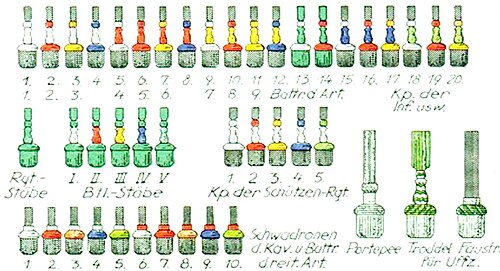
The sword knot (or tassel) is a lanyard made of leather, metallic lace, or gold/silver bullion. Looped around the wrist, it prevents the sword from being lost if dropped. While practical, these are often highly decorative. The art of making these ornamental braids is known as passementerie (French) or Posamenten (German).
Different cultures utilized tassels uniquely: Indian swords often featured an eyelet at the pommel for the knot, while Chinese jian and dao swords use tassels for both decoration and as part of choreographed performances.
Hilt Component Summary
| Component | Primary Function | Common Materials/Forms |
|---|---|---|
| Pommel | Balance and grip security | Spheroids, disks, wheels, animal heads |
| Grip | Handling and control | Wood, metal, shagreen, rubber, ray skin |
| Guard | Hand protection | Quillons, knuckle-bows, basket hilts, cup-hilts |
| Ricasso | Leverage and grip positioning | Blunt steel section |
| Sword Knot | Retention and decoration | Leather, gold/silver bullion, silk |
Frequently Asked Questions
What is the purpose of a pommel?
The pommel prevents the sword from slipping out of the hand and acts as a counterweight to the blade, moving the balance point closer to the hilt for better maneuverability. It can also be used as a striking tool in specific combat techniques.
What is the difference between a basket hilt and a cup hilt?
A basket hilt uses a cage of bars or pierced plates to protect the hand, whereas a cup hilt features a solid, circular shield that surrounds the base of the blade to protect against thrusting attacks.
What is shagreen and why was it used on grips?
Shagreen is untanned tough leather or shark skin. It was used on sword grips because it provides a highly durable, non-slip surface, although it is less effective in hot climates than rubber.
What is a ricasso used for?
The ricasso is the blunt part of the blade above the guard. On two-handed swords, it allows the wielder to place a hand above the guard for increased leverage during a swing.
What is passementerie?
Passementerie is the French term for the art of making ornamental braids, laces, cords, and trimmings, which includes the creation of decorative sword knots and tassels.