Swift Current: A History of the Saskatchewan Prairies
The story of Swift Current is deeply intertwined with the geography of the land. At its heart is the Swift Current Creek, a waterway originating at Cypress Hills that traverses 160 kilometres of prairie before emptying into the South Saskatchewan River at Lake Diefenbaker. For centuries, this creek served as a vital camp for First Nations people.
The name itself is rooted in the Cree language; the South Saskatchewan River was known as Kisiskâciwan, meaning "it flows swiftly." This characteristic was noted by early European explorers in the 1800s. Fur traders referred to it as "rivière au Courant" (river of the current), while Henri Julien, an artist with the 1874 North-West Mounted Police expedition, called it "Du Courant." Commissioner George French also recorded it as "Strong Current Creek" in his diary. Though official records took longer to catch up, the area has always been known as Swift Current.
Key Facts
- Founded: Settlement began in 1883 following CPR railway surveys.
- Incorporation: Became a village in 1904, a town in 1907, and a city on January 15, 1914.
- Early Economy: Driven by railway services, ranching, and bison bone gathering.
- Military Significance: Served as a troop mustering area during the 1885 Riel Rebellion.
- Aviation: Hosted the No. 39 Service Training Flying School during WWII.
- Energy: Oil discovery at Fosterton in 1952 led to massive production from the Shaunavon Formation.
The Birth of a Settlement
The formal establishment of Swift Current began in 1883 after the Canadian Pacific Railway (CPR) surveyed a line to the creek. Grading and track preparation started in 1882, and the first settlers arrived the following spring. Initially, the local economy relied almost entirely on supporting the new railway employees and infrastructure.
Beyond the rails, the region supported diverse industries. Métis residents operated a successful "freighting" business using Red River ox carts along the Swift Current–Battleford Trail until the late 1880s. Other early ventures included sugar refining, bone china production, and the collection of bison bones for fertilizer manufacturing.
The "76" Ranches and Early Agriculture
Ranching played a pivotal role in the early landscape, most notably through the "76" ranches. This operation consisted of 10 ranches raising cattle and sheep, stretching from Swift Current all the way to Calgary. The Swift Current location focused on sheep, with over 20,000 grazing on what is now known as the Kinetic Grounds. John Oman, a head shepherd from Scotland, later donated land in 1913 for the construction of the Oman School.
Military and Strategic Importance
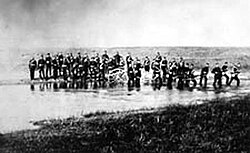
Due to its proximity to Battleford, Swift Current served as a major military base and troop mustering area during the Riel Rebellion of 1885, though this role was temporary.
Decades later, during World War II, the city became central to the British Commonwealth Air Training Plan. Because the United Kingdom was deemed unsuitable for pilot training, the Canadian Prairies were chosen for their clear weather and distance from enemy territory. In 1941, the Number 39 Service Training Flying School was built east of the city, housing over one thousand servicemen until March 1944. This facility now operates as the Swift Current Airport, which the city took over from Transport Canada in 1996.
Industrial Growth and Energy
The mid-20th century brought a new economic driver: oil. In 1952, oil was discovered at Fosterton, located thirty miles northwest of the city. The initial well remained productive for over 40 years. This discovery opened the door to the Shaunavon Formation, which has since seen nearly 4,000 completed wells and a total production of 500 million barrels of oil.
| Status | Date | Key Detail |
|---|---|---|
| Settlement | 1883 | First settlers arrive following CPR survey |
| Village | February 4, 1904 | Official hamlet status upgraded |
| Town | March 15, 1907 | Population recorded at 550 |
| City | January 15, 1914 | Incorporated under Mayor Frank E. West |
Today, the city is the primary service center for Southwestern Saskatchewan. Residents and businesses often use the affectionate nickname "Speedy Creek," or simply "Swift" or "Swifty," reflecting the community's enduring connection to its fast-flowing namesake creek.
Frequently Asked Questions
Where does the name Swift Current come from?
The name originates from the Cree word for the South Saskatchewan River, Kisiskâciwan, which means "it flows swiftly." This was later adapted by fur traders and explorers as "rivière au Courant" or "Strong Current Creek."
What was the role of the "76" ranches?
The "76" ranches were a significant ranching operation consisting of 10 ranches between Swift Current and Calgary. The Swift Current site specifically raised sheep, with populations reaching 20,000 animals.
How did World War II impact the city?
Swift Current became a training hub for pilots under the British Commonwealth Air Training Plan. The Number 39 Service Training Flying School was established in 1941, which eventually became the current Swift Current Airport.
What is the Shaunavon Formation?
The Shaunavon Formation is an oil-bearing geological layer. Following the 1952 discovery at Fosterton, it has yielded 500 million barrels of oil through nearly 4,000 wells in the region.
Who was the mayor when Swift Current became a city?
Frank E. West was the mayor when Swift Current was officially incorporated as a city on January 15, 1914.